


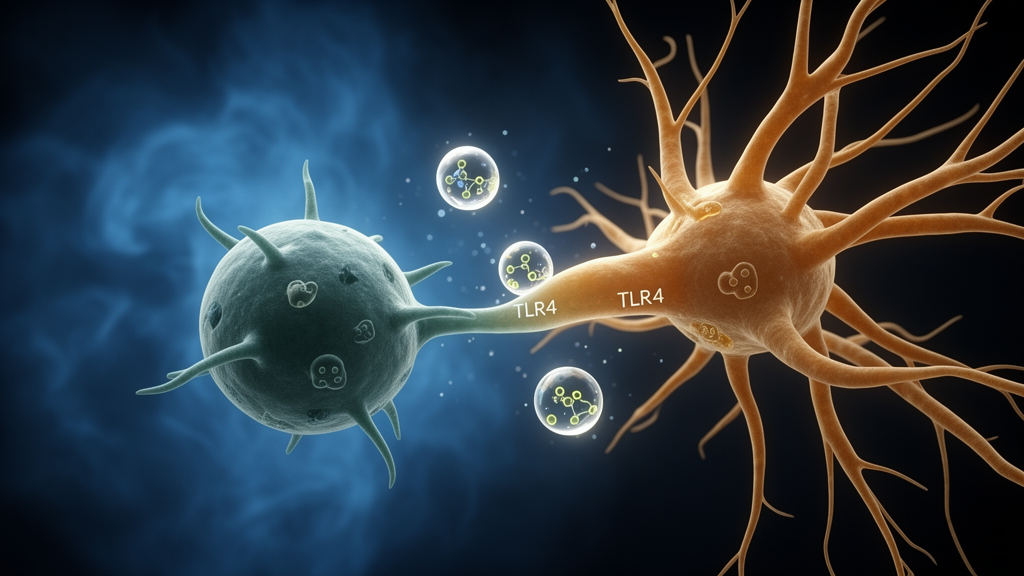
When the brain is starved of oxygen, its white matter pays a devastating price. Now researchers in China have traced a surprising chain of events linking oxygen-deprived immune cells to the destruction of the very cells that build myelin, the fatty insulation that keeps nerve signals fast and reliable. The study, published in the journal 3 Biotech, reveals that microglia, the resident immune guardians of the central nervous system, respond to hypoxia by flooding their surroundings with lactate, a metabolic byproduct that then travels inside tiny membrane-wrapped packages called small extracellular vesicles. Once these vesicles reach oligodendrocyte-lineage cells, they trigger a Toll-like receptor 4 inflammatory program that drives the recipient cells toward apoptosis and strips away their myelin basic protein.
The experimental framework was built around primary rat microglia exposed to 1 percent oxygen, a level that mimics the severe hypoxia seen in ischemic white-matter injury. Under these conditions, the microglia underwent a striking activation. The intensity of ionized calcium-binding adaptor molecule 1, a hallmark protein of activated microglia, rose 2.82-fold compared with normoxic controls. At the same time, extracellular lactate concentrations climbed from 27.4 plus or minus 2.3 to 48.5 plus or minus 5.2 micromoles per milliliter, nearly doubling the metabolic signal available to neighboring cells. These numbers establish that hypoxia does not merely activate microglia morphologically; it fundamentally rewires their metabolism toward glycolytic lactate production.
To test what this metabolic shift does to oligodendrocyte-lineage cells, the team used conditioned-medium and Transwell models in which recipient cells were exposed to factors released by hypoxic microglia. The consequences were dramatic. Recipient-cell apoptosis increased from 9.1 plus or minus 0.8 percent to 39.0 plus or minus 1.3 percent, a more than fourfold rise in programmed cell death. Meanwhile, myelin basic protein fluorescence, a proxy for the myelinating capacity of these cells, collapsed from 1.00 plus or minus 0.08 to 0.35 plus or minus 0.05. In other words, the cells were not just dying; the survivors were losing the molecular machinery needed to wrap axons in myelin.
The investigators then turned to small extracellular vesicles, nanoscale lipid bilayer particles that cells release to shuttle proteins, lipids, and genetic material between one another. When oligodendrocyte-lineage cells were exposed to hypoxia-conditioned sEVs, a similar injury phenotype emerged, suggesting that these vesicles carry much of the damaging signal from hypoxic microglia. The critical question was whether lactate itself was the cargo responsible. To answer it, the researchers treated donor microglia with oxamate, an inhibitor of lactate dehydrogenase that blocks the conversion of pyruvate to lactate. This intervention partially restored myelin basic protein fluorescence in recipient cells from 0.34 plus or minus 0.05 to 0.82 plus or minus 0.07, demonstrating that lactate-associated metabolism in the donor cells is a major contributor to the injury cascade.
Perhaps the most mechanistically revealing finding concerns what happens inside the recipient cells when they encounter lactate-laden vesicles. Hypoxia-conditioned microglia caused recipient-cell Toll-like receptor 4 mRNA to rise 5.6-fold, indicating a powerful transcriptional upregulation of this innate immune receptor. Even more striking, the team measured histone H3 lysine 18 lactylation enrichment at the TLR4 promoter, a epigenetic modification in which lactate-derived lactyl groups attach to histone tails and alter gene expression. Enrichment climbed from 0.9 plus or minus 0.1 to 7.1 plus or minus 0.9, an almost eightfold increase. Both the mRNA upregulation and the promoter lactylation were attenuated by oxamate, tying the epigenetic activation of TLR4 directly to lactate availability.
This lactylation mechanism represents a relatively new frontier in neuroimmunology. Histone lactylation was first described as a way that metabolic state can be written directly into chromatin, allowing glycolysis-derived lactate to act as an epigenetic signal rather than merely a waste product. In this study, the lactylation of histone H3 lysine 18 at the TLR4 promoter suggests that lactate carried by hypoxic microglial vesicles does not simply activate TLR4 from the outside; it reprograms the recipient cell’s genome to produce more of the receptor, creating a self-amplifying inflammatory loop. The authors note that this framework is testable and does not establish a single linear causal pathway, but the concordance between the metabolic, epigenetic, and inflammatory measurements is compelling.
To confirm that TLR4 signaling is functionally required for the injury phenotype, the team used TAK-242, a selective TLR4 inhibitor that blocks the receptor’s downstream signaling without affecting ligand binding. When recipient cells were treated with TAK-242, apoptosis fell from 13.9 plus or minus 0.9 percent to 7.3 plus or minus 0.7 percent, nearly halving cell death. Myelin basic protein fluorescence rose to 1.82 plus or minus 0.14, exceeding even the normoxic baseline and suggesting that blocking TLR4 not only prevents injury but may actively promote myelination. These pharmacological results provide strong evidence that TLR4 is a critical node in the cascade from hypoxic microglial metabolism to oligodendrocyte-lineage cell damage.
The researchers also examined human transcriptomic datasets to see whether the rat-cell findings align with what happens in human disease. The analysis showed directionally concordant metabolic, inflammatory, and myelination changes, meaning that the same patterns of altered lactate metabolism, TLR4-related inflammation, and reduced myelination gene expression appear in human white-matter injury contexts. This cross-species concordance strengthens the argument that the mechanism identified in vitro is relevant to clinical ischemic white-matter injury, although the authors are careful to frame their conclusions as supporting a testable framework rather than proving a definitive causal chain.
The clinical implications of this work are substantial. Ischemic white-matter injury underlies much of the disability from stroke, vascular cognitive impairment, and perinatal brain injury, and oligodendrocyte loss is a central driver of the long-term damage. If lactate-associated extracellular vesicles from hypoxic microglia are indeed a major route of injury, then interventions that block lactate production in microglia, inhibit vesicle release or uptake, or antagonize TLR4 signaling could protect myelin-forming cells and preserve white matter integrity. TAK-242 and related TLR4 inhibitors are already being explored in other neurological contexts, and oxamate-like strategies that modulate lactate dehydrogenase activity represent a complementary metabolic approach.
The study also adds to a growing body of evidence that extracellular vesicles are not passive cellular debris but active messengers that can carry pathological signals between glial cells. Previous work has shown that microglial vesicles can either promote or inhibit myelin repair depending on their cargo and the activation state of the parent cell. This research identifies lactate-associated metabolism as a specific determinant of whether hypoxic microglial vesicles become injurious, opening the possibility that manipulating the metabolic state of microglia before vesicle release could convert damaging vesicles into protective ones. As the field moves forward, the challenge will be to translate these in vitro findings into animal models and eventually into therapies that can be deployed in the narrow therapeutic window following ischemic events.
Subject of Research: Lactate-associated extracellular vesicles from hypoxic microglia induce oligodendrocyte injury via TLR4 signaling
Article Title: Hypoxic microglia induce oligodendrocyte injury through lactate associated extracellular vesicles and toll like receptor four signaling
Article References: Wen, Y., Li, D., Lin, J., Li, T., & Jin, X. (2026). Hypoxic microglia induce oligodendrocyte injury through lactate associated extracellular vesicles and toll like receptor four signaling. 3 Biotech, 16(11), Article 469. https://doi.org/10.1007/s13205-026-05095-1
Image Credits: AI Generated
DOI: 10.1007/s13205-026-05095-1
Keywords: microglia, oligodendrocyte, lactate, extracellular vesicles, TLR4, hypoxia, white matter injury, myelin, Hypoxic, induce, injury, associated
Cite Scienmag News
Cassandra Pierce. (October 17, 2026). Hypoxic Microglia Attack Myelin-Forming Cells Through Lactate-Laden Vesicles and TLR4 Signaling. Scienmag. https://scienmag.com/hypoxic-microglia-attack-myelin-forming-cells-through-lactate-laden-vesicles-and-tlr4-signaling/
Cassandra Pierce. "Hypoxic Microglia Attack Myelin-Forming Cells Through Lactate-Laden Vesicles and TLR4 Signaling." Scienmag, 17 October 2026, https://scienmag.com/hypoxic-microglia-attack-myelin-forming-cells-through-lactate-laden-vesicles-and-tlr4-signaling/. Accessed 17 October 2026.
Cassandra Pierce. "Hypoxic Microglia Attack Myelin-Forming Cells Through Lactate-Laden Vesicles and TLR4 Signaling." Scienmag. October 17, 2026. https://scienmag.com/hypoxic-microglia-attack-myelin-forming-cells-through-lactate-laden-vesicles-and-tlr4-signaling/


