


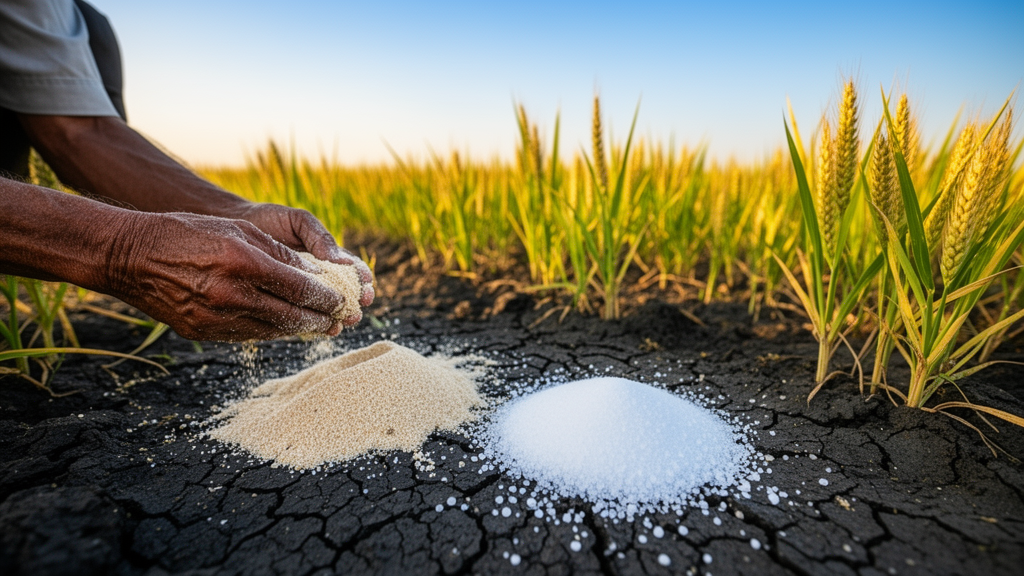
Salt-stressed farmland across northern China’s Datong Basin may have a surprisingly simple remedy hiding in local riverbeds. A new study from Shanxi Agricultural University, published in Frontiers in Agronomy, shows that mixing modest amounts of river sand into the topsoil—combined with carefully calibrated fertilizer applications—can dramatically improve water movement, nutrient distribution, and crop performance in moderately saline-alkali soil. The research, led by Wei Wang and colleagues, offers a practical, low-cost pathway for reclaiming degraded land in a region where roughly two-thirds of Shanxi Province’s saline-alkali territory is concentrated.
The research team focused on foxtail millet, a hardy cereal crop well suited to semi-arid conditions, grown in soil collected from farmland near Huairen City. The soil in this basin is classified as soda-type saline-alkali soil, characterized by high concentrations of carbonate and bicarbonate ions that severely restrict food production. Rather than relying on expensive hydraulic engineering, chemical amendments like gypsum, or early-stage halophyte planting, the researchers turned to a physical intervention: blending sand into the surface 20 centimeters of soil at five different volume ratios, ranging from zero to twenty percent.
To understand how sand mixing alters water and nutrient movement, the team conducted one-dimensional vertical ponded-infiltration experiments in laboratory soil columns. Each column, eighty centimeters tall with a ten-centimeter inner diameter, was packed with forty-five centimeters of untreated soil beneath a twenty-centimeter layer of soil-sand mixture. A Mariotte bottle system maintained a constant two-centimeter water head at the surface, while sampling ports at five-centimeter intervals allowed researchers to track moisture, salt, and nutrient distributions at ten depths. Three infiltration-water treatments were tested: deionized water, a low-concentration NPK solution containing five grams per liter of ammonium nitrate and 2.5 grams per liter of potassium dihydrogen phosphate, and a high-concentration version with double those amounts.
The results revealed a striking acceleration of water movement. When the wetting front reached fifty centimeters—the benchmark depth—untreated soil took approximately 650 minutes under deionized water. With twenty percent sand mixed in, that time dropped by twenty-six percent. Fertilizer solutions accelerated infiltration even further: the high-concentration NPK treatment shortened infiltration time by roughly forty percent compared to deionized water alone, and combining that with twenty percent sand mixing reduced the total time by forty-four percent. The mechanism, the researchers explain, involves ionic strength. As strong electrolytes, the fertilizer solutions compress the electrical double layer around soil particles, diminishing electrostatic repulsion and promoting flocculation of fine particles. This improves soil porosity and stabilizes structure, allowing water to move more freely through the profile.
Sand mixing also reshaped the vertical moisture distribution in unexpected ways. Within the top twenty centimeters—the mixed layer itself—soil water content decreased as the sand ratio increased, reflecting the coarse particles’ limited water-holding capacity. But below twenty centimeters, the opposite occurred: sand-mixed treatments consistently retained more moisture than the untreated control, with ten to fifteen percent ratios proving most effective. The underlying soil, with its higher clay content and greater specific surface area, adsorbs and holds water more strongly once it percolates down from the faster-draining surface layer. Meanwhile, higher nutrient concentrations in the infiltration water increased soil water content across all layers, likely because ammonium and potassium ions promote clay flocculation and aggregate formation more effectively than sodium ions native to the soil.
Salt dynamics told an equally compelling story. Under deionized water infiltration, all sand-mixing treatments achieved higher desalination rates than the control in the zero-to-forty-centimeter layer, with improvements ranging from ten percent at five percent sand to forty-three percent at twenty percent sand. However, the researchers observed a critical caveat: salts migrated downward and accumulated sharply in the forty-to-fifty-centimeter layer, forming what they describe as a subsurface salt reservoir. In regions with shallow, highly mineralized groundwater—like the Datong Basin—this stored salt could be remobilized through capillary rise and return to the root zone, causing secondary salinization. The team recommends long-term monitoring of the forty-to-sixty-centimeter layer combined with drip irrigation and plastic mulching to prevent this risk.
Nutrient transport patterns varied considerably depending on the interplay between sand ratio and fertilizer concentration. Ammonium nitrogen declined with increasing sand-mixing ratio in the surface layer, while higher fertilizer concentrations enhanced its vertical mobility, pushing it deeper into the profile. Nitrate nitrogen, a non-adsorbable anion, moved in close synchrony with the wetting front and accumulated at greater depths under higher sand ratios. Available phosphorus and available potassium showed inverse relationships with sand mixing in the top layers but responded positively to fertilizer concentration. Correlation analysis revealed that the relationship between available phosphorus and available potassium strengthened as nutrient concentration increased, suggesting that at high inputs, both ions persist in soil solution as free or weakly bound species co-transported with infiltrating water.
To quantify these complex interactions, the researchers deployed four machine-learning algorithms: multiple linear regression, random forest, XGBoost, and LightGBM. Using sand-mixing ratio, infiltration-water treatment, and soil depth as input features, the models predicted six target variables—water content, salt content, ammonium nitrogen, nitrate nitrogen, available phosphorus, and available potassium. XGBoost emerged as the clear winner, achieving coefficients of determination above 0.93 for water content, salt content, and all nutrient indicators, with the lowest or near-lowest root mean square and mean absolute errors. Linear regression performed worst, confirming that the relationships governing water-salt-nutrient transport are fundamentally nonlinear. The team notes that XGBoost’s regularization terms and efficient split-finding algorithm give it an edge in capturing high-dimensional interactions.
The field experiment, conducted from May to October 2024 in Huairen City, translated these laboratory findings into agronomic reality. Forty-five plots, each two by five meters, combined the same five sand ratios with three compound fertilizer rates: 1,050, 1,500, and 1,950 kilograms per hectare. At maturity, both sand ratio and fertilization rate significantly affected plant height and stem diameter, with highly significant effects on panicle weight—the core indicator of yield potential. Plant height generally increased with fertilization, while moderate sand mixing of ten percent produced the tallest plants and thickest stems under high fertilization. Excessive sand mixing at twenty percent consistently reduced plant height, even under high fertilizer inputs, suggesting a threshold beyond which the benefits of improved permeability are offset by diminished water retention.
Panicle weight told the most nuanced story. Under low and medium fertilization, panicle weight rose and then fell with increasing sand ratio, peaking at ten percent mixing—significantly higher than all other treatments. Under high fertilization, differences among sand ratios diminished, indicating that abundant nutrients can partially compensate for soil texture variations. The optimal combination emerged clearly: ten percent sand mixing paired with 1,500 kilograms per hectare of compound fertilizer produced the greatest panicle weight overall. The researchers conclude that a sand-mixing ratio of ten to fifteen percent, combined with appropriate water and fertilizer management, offers the best balance of surface desalination, deep-layer water storage, and crop productivity for moderately saline-alkali soils in northern Shanxi—turning locally abundant river sand from an underused resource into a practical tool for food security.
Subject of Research: Effects of sand mixing and nutrient management on water, salt, and nutrient transport and foxtail millet growth in moderately saline-alkali soil
Article Title: Impact of sand-mixing and nutrient treatments on the growth of foxtail millet in moderately saline-alkali soil
Article References: Wang, W., Qiu, S., Yang, S., Duan, X., Liu, Z., & Cui, Q. (2026). Impact of sand-mixing and nutrient treatments on the growth of foxtail millet in moderately saline-alkali soil. Frontiers in Agronomy, 8, Article 1850435. https://doi.org/10.3389/fagro.2026.1850435
Image Credits: AI Generated
DOI: 10.3389/fagro.2026.1850435
Keywords: saline-alkali soil, foxtail millet, sand mixing, soil infiltration, nutrient transport, XGBoost, soil salinity, fertilization, Datong Basin, soil water content, machine learning, crop yield
Cite Scienmag News
Alan Morgan. (October 16, 2026). Sand-Mixing and Fertilizer Strategy Boosts Foxtail Millet on Saline-Alkali Soil. Scienmag. https://scienmag.com/sand-mixing-and-fertilizer-strategy-boosts-foxtail-millet-on-saline-alkali-soil/
Alan Morgan. "Sand-Mixing and Fertilizer Strategy Boosts Foxtail Millet on Saline-Alkali Soil." Scienmag, 16 October 2026, https://scienmag.com/sand-mixing-and-fertilizer-strategy-boosts-foxtail-millet-on-saline-alkali-soil/. Accessed 16 October 2026.
Alan Morgan. "Sand-Mixing and Fertilizer Strategy Boosts Foxtail Millet on Saline-Alkali Soil." Scienmag. October 16, 2026. https://scienmag.com/sand-mixing-and-fertilizer-strategy-boosts-foxtail-millet-on-saline-alkali-soil/


