


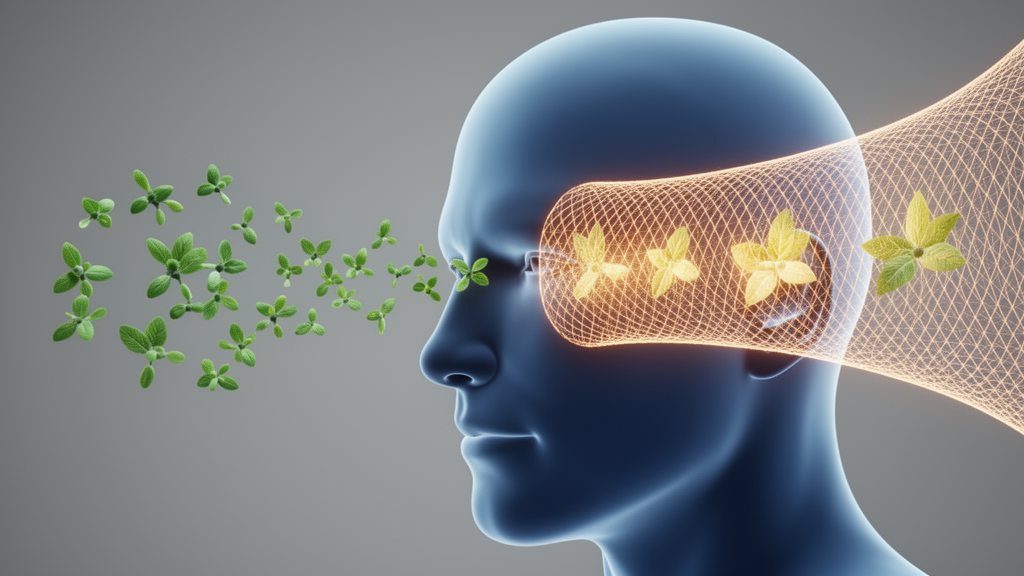
For years, researchers have celebrated the neuroprotective promise of phytochemicals—the xanthines in coffee, the (poly)phenols in berries and olive oil—yet a stubbornly basic question has gone largely unanswered: how many of these dietary molecules can actually cross the blood-brain barrier and reach the brain itself? A new computational study published in Frontiers in Drug Discovery offers the most systematic answer to date, screening more than 800 natural molecules in silico and identifying a surprisingly small set that may reach the brain by passive diffusion, alongside a machine learning model that flags 171 additional candidates traveling by other, still-unidentified routes.
The research team, led by Diogo Carregosa and Cláudia Nunes dos Santos at NOVA Medical School in Lisbon, assembled a database of 855 molecules spanning xanthines, phenolic terpenes, (poly)phenols and their circulating metabolites, including phase II conjugates such as sulfates, glucuronides and glutathione adducts. Endogenous molecules like melatonin and twelve commercial drugs—six known to cross the blood-brain barrier and six known not to—served as positive and negative controls, anchoring the predictions in experimentally validated ground truth.
Using QikProp, the team computed 42 physicochemical descriptors for every molecule, covering molecular weight, lipophilicity, predicted human oral absorption, serum albumin binding, metabolic load and brain-blood partitioning. The drug-likeness verdict was striking: 555 of the 855 molecules fell within the range occupied by 95 percent of known drugs across all 24 key descriptors, while the remaining 300—mostly bulky or highly hydrophilic conjugates—carried at least one flag.
Passive diffusion proved to be the great filter. Only 78 molecules cleared the predicted threshold of 85 percent human oral absorption combined with strong Caco-2 permeability, and just 52 of those also exceeded 500 nanometers per second in the MDCK cell model, a widely used mimic of blood-brain barrier permeation. The control drugs behaved exactly as expected: promazine, chlorpromazine, imipramine, nordazepam and alprazolam clustered inside the permeable set, while mannitol, theophylline, atenolol and salbutamol fell well below. Notably, ibuprofen—known to cross the barrier through saturable transporter-dependent uptake—landed just under the passive-diffusion cutoff, a detail the authors cite as evidence the model captures real biology rather than mere chemistry.
The 52 passive-diffusion candidates form a chemically eclectic list. It includes simple methoxylated phenols such as guaiacol and veratrole, benzaldehyde and its sulfate conjugates, several phenyl-γ-valerolactones produced by gut microbes from dietary flavan-3-ols, dimethoxylated resveratrol analogs, lignans like sesamin and matairesinol, the xanthines caffeine and isocaffeine, the flavonoids formononetin, flavone and psoralen, coumarin, and the sleep hormone melatonin. Most share a lean, modestly lipophilic architecture—often a single hydroxyl group decorated with methyl or methoxy substituents—consistent with the physicochemical demands of slipping through a lipid membrane unaided.
Safety profiling added a second layer of discrimination. Using SwissADME, the team predicted interactions with P-glycoprotein, the efflux pump that expels xenobiotics from the barrier, and with five cytochrome P450 enzymes central to drug metabolism. Some 139 molecules emerged as likely P-gp substrates, dominated by flavonoids and stilbenes, while the strongest predicted CYP inhibitors were again stilbenes, urolithins and flavonoids—information that matters for any future attempt to co-administer these compounds with existing medications.
But passive diffusion tells only part of the story. Prior metabolomic studies have repeatedly found polyphenol metabolites in human cerebrospinal fluid that should, in theory, be incapable of crossing the barrier unaided, implicating transporters such as organic anion transporters OAT1 and OAT3. To capture this hidden traffic, the team trained a machine learning model—SLIM GSGP, a geometric semantic genetic programming algorithm—on the 118 molecules from their dataset that had been experimentally detected in human cerebrospinal fluid, using QikProp descriptors as input features. The model achieved a median root mean square error of 0.31 across 15 Monte Carlo cross-validation runs and went on to predict 171 previously unreported phytochemicals with the potential to reach the brain environment.
Only ten molecules appeared on both lists—among them caffeine, guaiacol, coumarin and psoralen—suggesting that the remaining 161 machine learning hits likely reach the brain through carrier-mediated, receptor-mediated or active transport rather than passive diffusion. The predicted set is dominated by flavonoids, stilbenes, and phenylvaleric acid derivatives, many of them structural isomers or phase I and phase II modifications of compounds already confirmed in human cerebrospinal fluid, a convergence the authors argue reinforces the biological plausibility of the predictions.
Combined, the two approaches yield 213 novel phytochemical candidates for brain access—a prioritized roadmap for targeted metabolomics studies that could confirm their presence in cerebrospinal fluid and, ultimately, brain tissue. The authors are candid about limitations: cerebrospinal fluid serves only as a proxy for brain parenchyma, no in vitro or in vivo validation of transport mechanisms has yet been performed, and real brain exposure will always depend on dietary dose, metabolism, protein binding and clearance. Still, the work marks a shift from anecdote to systematic prediction in a field where the transport mechanisms of most dietary molecules remain speculative.
The implications extend beyond nutrition science. Brain drug development remains one of pharmacology’s hardest problems, with the vast majority of central nervous system candidates failing in clinical trials due to poor barrier permeability or rapid clearance. By identifying natural molecules with drug-like pharmacokinetic profiles and confirmed or predicted brain access, the study offers medicinal chemists a library of backbone structures already optimized by evolution for oral absorption and, in some cases, barrier crossing. Whether these dietary compounds can be developed into preventive or therapeutic agents for neurodegenerative disease remains an open question—but for the first time, the shortlist of molecules with a plausible ticket into the brain has been drawn up in full.
Subject of Research: In silico prediction of blood-brain barrier permeability of dietary phytochemicals using QikProp descriptors and machine learning
Article Title: In silico prediction of the permeability of phytochemicals across the blood-brain barrier
Article References: In silico prediction of the permeability of phytochemicals across the blood-brain barrier. (n.d.). https://doi.org/10.3389/fddsv.2026.1939611
Image Credits: AI Generated
DOI: 10.3389/fddsv.2026.1939611
Keywords: blood-brain barrier, phytochemicals, polyphenols, in silico, machine learning, drug discovery, neurodegenerative disease, QikProp, silico, prediction, permeability, across
Cite Scienmag News
Cassandra Pierce. (October 16, 2026). Computational Screen Reveals Which Plant Compounds Can Reach the Human Brain. Scienmag. https://scienmag.com/computational-screen-reveals-which-plant-compounds-can-reach-the-human-brain/
Cassandra Pierce. "Computational Screen Reveals Which Plant Compounds Can Reach the Human Brain." Scienmag, 16 October 2026, https://scienmag.com/computational-screen-reveals-which-plant-compounds-can-reach-the-human-brain/. Accessed 16 October 2026.
Cassandra Pierce. "Computational Screen Reveals Which Plant Compounds Can Reach the Human Brain." Scienmag. October 16, 2026. https://scienmag.com/computational-screen-reveals-which-plant-compounds-can-reach-the-human-brain/


