


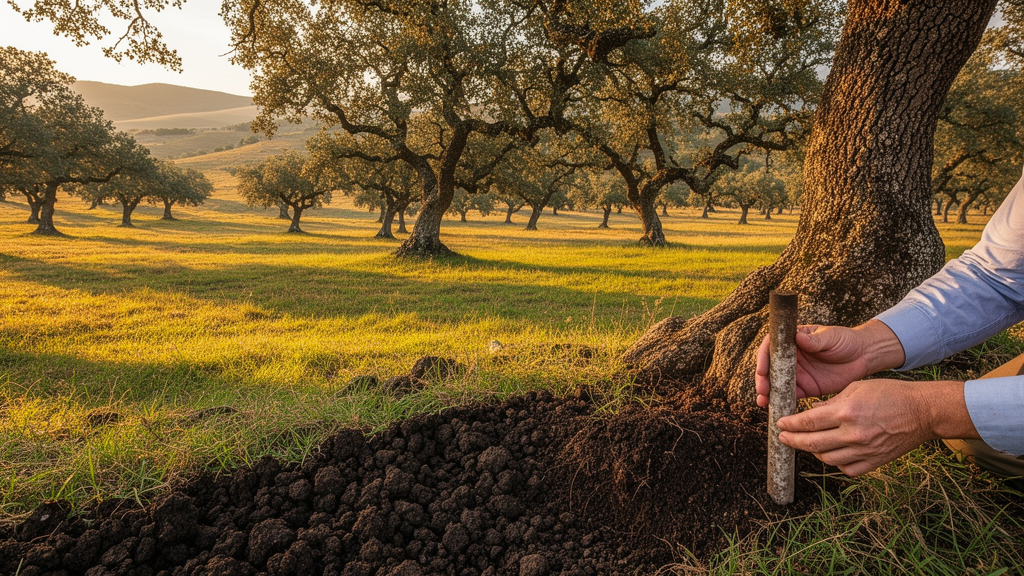
Deep in the mountains of northeastern Portugal, where native oak woodlands have been grazed by livestock for centuries, a new study has delivered a surprising verdict on one of the most debated questions in climate-smart agriculture: whether grazing livestock helps or harms the carbon stored in soil. The answer, according to researchers writing in the journal Pastoralism, is that under the extensive management conditions typical of these Mediterranean silvopastoral systems, grazing barely matters at all. What matters, overwhelmingly, is which oak species forms the stand.
The research team, led by Julio Henrique Germano De Souza of the University of Santiago de Compostela and the Instituto Politécnico de Bragança, together with colleagues in Spain, Portugal and Brazil, examined soil carbon and nitrogen dynamics in two oak-based silvopastoral systems within Montesinho Natural Park. One system was dominated by Quercus pyrenaica, the Galician-Portuguese deciduous oak, and the other by Quercus rotundifolia, the evergreen oak characteristic of Mediterranean woodlands. Both habitats are listed as of Community interest under the EU Habitats Directive and have developed naturally, without silvicultural intervention, while occasionally hosting extensive grazing by goats and sheep.
Soil organic carbon is one of the largest carbon reservoirs in the Earth system, and understanding how it responds to management is essential for evaluating the climate mitigation potential of grazing lands. Yet the impact of grazing on carbon distribution in Mediterranean oak silvopastoral soils has remained poorly understood, with most previous studies focusing on permanent pastures, intensive agricultural systems, or forests evaluated in isolation. Integrated systems, where trees, shrubs, herbaceous plants and pastoral management interact simultaneously, have been relatively understudied, hindering understanding of the mechanisms that regulate soil carbon dynamics and stability in these environments.
To fill this gap, the researchers collected soil samples at depths of 0 to 10 centimeters and 10 to 30 centimeters, both before grazing cycles in June 2023 and after grazing in June 2025. The grazed plots hosted distinctly different livestock regimes. At the Q. rotundifolia site, a flock of 25 late-gestation Preta de Montesinho goats grazed one plot for 15 consecutive days in July 2024, a low-intensity, short-duration treatment. At the Q. pyrenaica site, 220 pregnant Churra Galega Bragançana ewes grazed for a total of 55 non-consecutive days between May and October 2024, representing higher grazing intensity. The animals were gathered at night due to the presence of wolves in the area, a detail that underscores the wild character of this mountain landscape.
The technical approach was rigorous. After air drying and sieving, the whole soil was physically fractionated by wet sieving into three particle-size fractions: sand (250 to 2000 micrometers), silt (53 to 250 micrometers) and clay (less than 53 micrometers). This slaking-based procedure breaks apart water-unstable aggregates, leaving water-stable aggregates for analysis, and thereby distinguishes carbon that is physically protected within macroaggregates from carbon associated with finer, more organomineral-stabilized pools. Carbon concentrations were measured with a LECO elemental analyzer, and bulk density measurements allowed the team to convert concentrations into carbon stocks per hectare. Multivariate ordination by principal component analysis and generalized linear mixed models were then used to evaluate the effects of stand-forming tree species, presence of grazing, and soil depth.
The results were striking. Soil carbon and nitrogen were significantly influenced by stand type and soil depth, whereas grazing had no significant effect on any fraction analyzed. Under Q. pyrenaica, soil organic carbon in the surface layer reached 35.00 grams per kilogram, compared with 24.6 grams per kilogram under Q. rotundifolia. Carbon stocks ranged from 30.42 megagrams per hectare under Q. pyrenaica to 13.25 megagrams per hectare under Q. rotundifolia across the soil profile. Nitrogen followed the same pattern, with total values reaching 2.28 grams per kilogram under Q. pyrenaica against roughly 0.52 grams per kilogram under Q. rotundifolia. In every case, the sand fraction concentrated most of the carbon and nitrogen, consistent with the global literature showing that macroaggregates account for the majority of variation in total soil carbon stocks.
The ordination analysis reinforced this picture. The first two principal components explained 86.8 percent of the total variance in ungrazed plots, with the first axis representing a clear gradient of soil organic matter accumulation driven by carbon stocks, carbon content and nitrogen content, while bulk density was negatively associated with it. After grazing, the ordination structure remained essentially unchanged, with samples separating along the same vegetation-driven gradient. No substantial temporal shifts were detected in the ungrazed control sites either. The stability of the pattern between sampling periods indicates that grazing, under the conditions evaluated, did not substantially alter the multivariate structure of soil properties.
Why would tree species matter so much? The researchers point to intrinsic attributes of the habitat, including greater litterfall and litter quality, root architecture, and the intensity of biogeochemical cycling. Q. pyrenaica is a deciduous oak that sheds its leaves annually, delivering a substantial pulse of organic matter to the soil surface, while its soils, classified as Umbric Leptosols, feature a dark, humic surface horizon. Q. rotundifolia, by contrast, is evergreen, and its plots had higher bulk density and lower nutrient levels. The strong vertical stratification, with carbon declining markedly in the 10 to 30 centimeter layer, particularly under Q. rotundifolia, highlights the importance of surface organic inputs and the biological activity concentrated in the upper horizons.
The absence of a grazing effect on the silt and clay fractions, which offer the greatest physical and chemical protection of organic matter, suggests that the management strategy did not encourage sufficient aggregate restructuring to affect carbon stabilization in the fine pools. This finding is consistent with a growing body of evidence that moderate or rotational grazing does not necessarily result in losses of carbon associated with stable aggregates, and that silvopastoral systems are structurally resilient to moderate disturbances, maintaining the integrity of soil aggregates and biogeochemical functionality. The balance between organic matter inputs from plant residues and animal excreta and potential losses from trampling or biomass removal may simply result in neutral net effects under extensive management.
The authors are careful to note caveats. The study lacked habitat replication, so differences between the two oak systems should be interpreted cautiously, as site-specific factors may also have contributed. The assessment period was relatively short, and the observed stability of soil carbon stocks should not be read as direct evidence of long-term carbon sequestration. Nevertheless, the implications are significant for the region, where grazing plays an important socio-economic role for small and medium-sized family farms, contributing to income generation, rural population retention and the preservation of traditional knowledge. The findings suggest that well-managed extensive grazing can be compatible with surface carbon conservation, and that tree species composition, particularly the dominance of Q. pyrenaica, is the key lever controlling soil carbon and nitrogen dynamics in Mediterranean silvopastoral systems. Long-term monitoring will be needed to determine whether these systems can consistently sustain their carbon sequestration potential and their contribution to climate change mitigation.
Subject of Research: Distribution of soil carbon and nitrogen in Mediterranean oak silvopastoral systems under grazing
Article Title: Distribution of soil carbon and nitrogen in Mediterranean oak silvopastoral systems under grazing
Article References: Distribution of soil carbon and nitrogen in Mediterranean oak silvopastoral systems under grazing. (n.d.). https://doi.org/10.3389/past.2026.16765
Image Credits: AI Generated
Keywords: soil organic carbon, silvopastoral systems, grazing, Mediterranean oak woodlands, carbon sequestration, soil nitrogen, agroforestry, Distribution, soil, carbon, nitrogen, Mediterranean
Cite Scienmag News
Alan Morgan. (October 16, 2026). Tree species, not grazing, drive soil carbon in Mediterranean oak silvopastures. Scienmag. https://scienmag.com/tree-species-not-grazing-drive-soil-carbon-in-mediterranean-oak-silvopastures/
Alan Morgan. "Tree species, not grazing, drive soil carbon in Mediterranean oak silvopastures." Scienmag, 16 October 2026, https://scienmag.com/tree-species-not-grazing-drive-soil-carbon-in-mediterranean-oak-silvopastures/. Accessed 16 October 2026.
Alan Morgan. "Tree species, not grazing, drive soil carbon in Mediterranean oak silvopastures." Scienmag. October 16, 2026. https://scienmag.com/tree-species-not-grazing-drive-soil-carbon-in-mediterranean-oak-silvopastures/


