


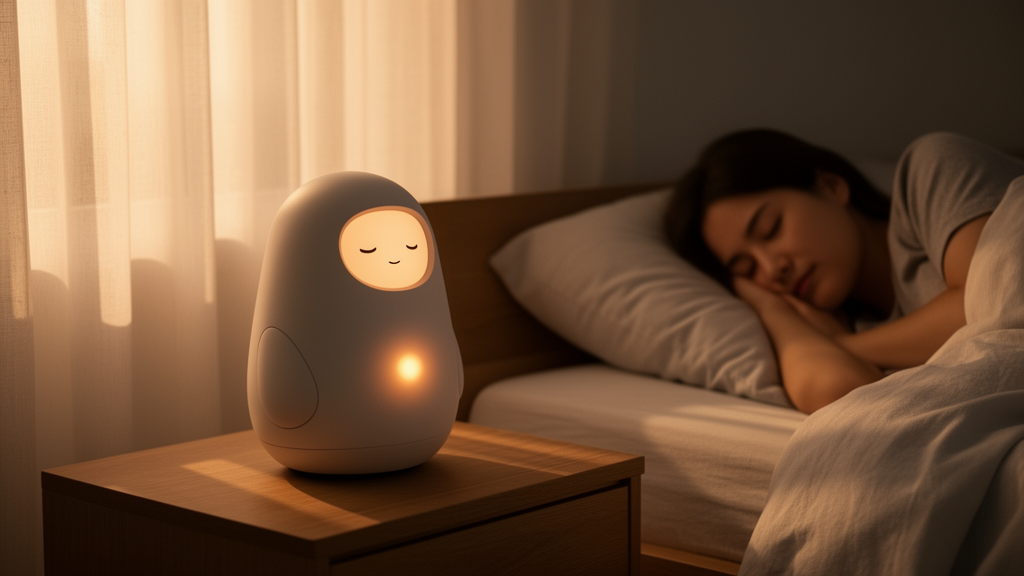
What should a robot that helps you breathe and relax actually look like? A cute cartoon character, a soft plush animal, a sleek clinical gadget, or a serene meditative figure? A new study from researchers at the Berlin University of Applied Sciences, the Technion Israel Institute of Technology, and the Technical University of Berlin suggests that the answer matters far more than most robot designers might assume. Their work, published in Frontiers in Cognition, compared four visual design styles of a breathing companion robot called Neffy and found that calm, contemplative aesthetics outperformed cute, playful ones on nearly every measure that matters for a wellbeing device, from perceived competence to trustworthiness to the simple question of which robot people would rather practice breathing with.
Neffy is a small tabletop robot built to guide slow-paced breathing exercises for stress reduction. It guides users through rhythmic breathing by combining gentle vertical motion, soft light signals, and a calm voice, raising and lowering its upper torso so that people can synchronize their own inhalations and exhalations with its movement. The researchers reasoned that because the robot simulates a human physiological process, breathing, without necessarily resembling a human or an animal, it represents an ideal testbed for a question that has long divided the field of human-robot interaction: is a robot’s success driven mainly by how human-like it looks, or by how well its appearance matches its purpose?
To answer this, the team created four visual variants of Neffy using a controlled, multi-stage image generation process. The cartoonish humanoid version looked like a cute toy robot in blue and white, with big eyes, blushing cheeks, and baby-schema features designed to trigger feelings of safety and warmth. The zoomorphic version resembled a plush dog with floppy ears, paws, and fur texture. The mechanomorphic version was an industrial gray device with a blue LED bar instead of a face, evoking consumer electronics. The meditative humanoid looked like a Buddha-inspired figure, with a simplified face, closed eyes, a gentle smile, and a golden dome on its head. Crucially, all four variants shared identical functional features, including a warm yellow light on the torso signaling where users should place their hands, so that any differences in evaluation could be attributed to aesthetics alone.
A total of 126 participants were recruited through the online platform Prolific, with 106 completing the study after exclusions. Each participant watched a short video demonstrating the real Neffy robot guiding a breathing exercise, then evaluated all four design variants in random order. They rated each version on warmth and competence using scales drawn from the Stereotype Content Model, a social psychology framework that organizes human judgments along two fundamental dimensions: friendliness and capability. They also assessed perceived enjoyment and intention to use, drawing on the Technology Acceptance Model, and then made forced-choice pairwise comparisons across human-likeness, social presence, trustworthiness, breathing companion preference, and overall liking.
The results delivered a striking dissociation between warmth and competence. The zoomorphic plush-dog design received the highest warmth ratings of all, averaging 4.12 on a five-point scale, while the machine-like device scored lowest across every measure, and the effect of design on warmth was enormous, explaining roughly 60 percent of the variance. Yet the two humanoid designs, cartoonish and meditative, were rated as equally warm and, crucially, as equally human-like. Despite this equivalence, the meditative humanoid significantly outperformed the cartoonish one on competence, trustworthiness, and breathing companion preference. Participants judged the serene figure more capable of guiding a breathing exercise, even though its playful twin looked, by their own comparison, exactly as human.
The researchers interpret this pattern through a concept they call aesthetic-functional congruence: the alignment between a robot’s visual design and its functional purpose. Their theoretical framework weaves together three perspectives. Affordance theory suggests that a robot’s form signals what kinds of interaction are possible and appropriate, so a meditative form signals calm, focused engagement while a cartoonish form signals playful, child-directed interaction. Schema congruity theory holds that people evaluate objects by their fit with pre-existing mental categories; a breathing robot must satisfy both a robot schema of a functional device and a wellbeing schema of a calm therapeutic companion, and the best design activates both in a resolvable balance. The Stereotype Content Model then explains why warmth, driven mainly by appearance, and competence, more sensitive to contextual fit, can diverge within the same morphological category.
Qualitative comments from participants reinforced the quantitative findings. One participant called the meditative design the best one in direct comparisons. The cartoonish humanoid was described as too childish, suggesting its baby-schema features activated a toy schema rather than a therapeutic one. The machine-like device drew some of the harshest reactions, described as cold and clinical, with one participant joking that it reminded them of a Dalek, the aggressive cyborg villains of British science fiction, a comparison the authors read as evidence that strongly technical aesthetics fundamentally conflict with expectations of emotional support. Several participants also connected the robot concept to personal health experiences, including asthma, long COVID, and anxiety, indicating they were spontaneously evaluating the designs in terms of fit with wellbeing goals.
The study also uncovered an important limit of human-likeness as an explanatory variable. Perceived human-likeness initially predicted all social evaluations, most strongly social presence and trustworthiness, consistent with the Computers Are Social Actors paradigm, in which humans automatically apply social rules to machines displaying social cues. But when the researchers accounted for individual differences, particularly participants’ pre-existing interest in robots, the predictive effect of human-likeness vanished on all four primary outcomes, while robot interest remained significant throughout. This suggests that a substantial share of what has been attributed to anthropomorphic design may actually reflect users’ general attitudes toward robots, a finding with major implications for how the field interprets appearance studies.
The design implications are clear. For wellbeing robots, the authors argue, maximizing human realism should not be the default strategy; instead, designers should prioritize aesthetics that communicate calmness, presence, trust, and psychological safety, which serene, simplified, and composed designs appear to do better than playful or child-directed ones, and which mechanical or industrial designs actively undermine. The team cautions that their study relied on image and video evaluations rather than hands-on interaction with a physical robot, that the Buddhist-inspired meditative design may carry different meanings in non-Western cultures, and that preferences could shift across clinical, workplace, educational, and domestic contexts. Still, the core message stands: when it comes to robots meant to help us breathe, relax, and cope with stress, the evidence suggests that calm beats cute, and that matching a robot’s look to its mission may matter as much as any humanoid feature.
Subject of Research: Aesthetic-functional congruence in the design of social breathing companion robots
Article Title: Calm beats cute: designing aesthetic-functional congruence in human-robot interaction for breathing companion robots
Article References: Calm beats cute: designing aesthetic-functional congruence in human-robot interaction for breathing companion robots. (n.d.). https://doi.org/10.3389/fcogn.2026.1886795
Image Credits: AI Generated
DOI: 10.3389/fcogn.2026.1886795
Keywords: human-robot interaction, social robots, robot design, aesthetics, breathing companion robot, wellbeing technology, anthropomorphism, technology acceptance, warmth and competence, human-likeness, schema congruity, stress relief
Cite Scienmag News
Denise Maddox. (October 16, 2026). Calm Beats Cute: Serene Robot Design Wins Trust for Breathing Companion. Scienmag. https://scienmag.com/calm-beats-cute-serene-robot-design-wins-trust-for-breathing-companion/
Denise Maddox. "Calm Beats Cute: Serene Robot Design Wins Trust for Breathing Companion." Scienmag, 16 October 2026, https://scienmag.com/calm-beats-cute-serene-robot-design-wins-trust-for-breathing-companion/. Accessed 16 October 2026.
Denise Maddox. "Calm Beats Cute: Serene Robot Design Wins Trust for Breathing Companion." Scienmag. October 16, 2026. https://scienmag.com/calm-beats-cute-serene-robot-design-wins-trust-for-breathing-companion/


