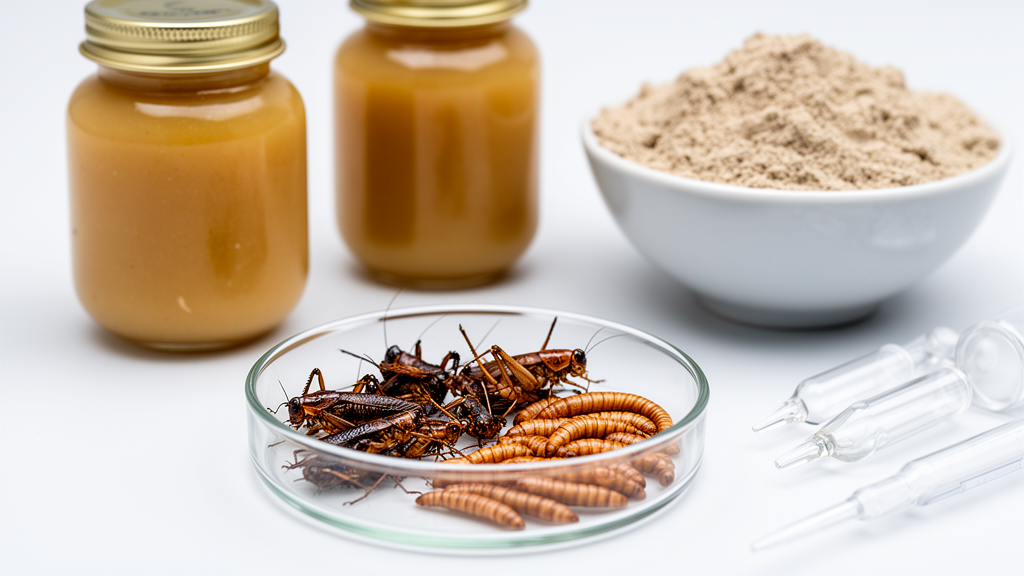
Edible insects have long been celebrated as a sustainable, nutrient-dense food of the future, but a new study from Kenya and Belgium reveals a hidden side to this protein revolution. Researchers at Ghent University, the International Centre of Insect Physiology and Ecology (icipe), the University of Nairobi, and Kenyatta University have uncovered widespread fungal contamination, mycotoxin traces, and elevated histamine levels in edible insects and insect-fortified complementary foods designed for infants and young children. The findings, published in Frontiers in Fungal Biology, offer the first detailed joint assessment of fungal, mycotoxin, histamine, and allergen-related risks across edible insects and the porridge flours made from them.
The scale of insect consumption worldwide is staggering. More than 3,000 ethnic groups eat insects, and 2,205 species have been documented as food across 128 countries. In Africa alone, 464 edible species have been reported from 48 countries, with termites, caterpillars, crickets, and grasshoppers among the most widely consumed. Yet while insects deliver high-quality protein, lipids, vitamins, and minerals, the safety landscape surrounding them has remained surprisingly underexplored—particularly when they are incorporated into foods for the most vulnerable consumers: infants and young children.
To fill this gap, the research team analyzed 30 material types: 11 edible-insect products, seven food ingredients, seven insect-enriched formulations, and five commercial complementary flours. The insects included winged termites (Macrotermes subhyalinus), lake-flies (Chaoborus sp.), crickets (Gryllus bimaculatus and Scapsipedus icipe), desert locusts (Schistocerca gregaria), grasshoppers (Ruspolia differens), silkworm pupae (Bombyx mori), wild silk moth caterpillars (Anaphe panda), mopane worms (Gynanisa maja and Gonimbrasia belina), Bunaea alcinoe, and Gonimbrasia zambesina. Fungal isolation comprised 1,080 inoculated culture observations across three independent batches per material type, from which 798 fungal isolates were recovered and identified by culture, microscopy, and internal transcribed spacer (ITS) sequencing.
The results paint a striking picture of fungal prevalence. Aspergillus accounted for 70.7 percent of isolates recovered from insect products, followed by Penicillium at 18.6 percent and Fusarium at 7.4 percent. Penicillium was detected in all 11 insect products, while Fusarium appeared in eight of them. Across all material categories, Aspergillus dominated at 55.3 percent of the 798 recovered isolates, followed by Penicillium at 26.1 percent and Fusarium at 14.5 percent. The distribution of fungal genera differed significantly between material types, with Aspergillus predominating in insects, ingredients, and enriched formulations, while Penicillium was more common in commercial complementary flours.
Beyond mere presence, the researchers probed the toxigenic potential of the recovered fungi using endpoint PCR. Among 44 Aspergillus flavus-like morphotypes, the aflatoxin-biosynthesis genes aflD and aflQ were detected in 32 and 23 isolates, respectively. Among 22 Fusarium-like isolates, the fumonisin-biosynthesis gene FUM1 was detected in 19, and the VERTF intergenic-spacer profile associated with potentially fumonisin-producing Fusarium verticillioides strains appeared in 10. The authors are careful to note that marker detection does not establish gene expression or actual mycotoxin production—but it does provide biological context for the chemical findings that followed.
Using liquid chromatography–tandem mass spectrometry (LC–MS/MS), the team screened 23 mycotoxins in five complementary-food formulations—four insect-fortified and one non-insect control—over three months of storage at approximately 22 degrees Celsius. Six mycotoxins were confirmed: 3-acetyldeoxynivalenol, aflatoxin G1, sterigmatocystin, and fumonisins B1, B2, and B3. Only aflatoxin G1 and fumonisin B1 were quantified above their limits of quantification, at 4.20 µg/kg and 20.31–86.88 µg/kg, respectively. Quantifiable fumonisin B1 occurred more frequently at later storage points and peaked after three months, although the temporal pattern was not uniformly monotonic across formulations. The aflatoxin G1 point estimate fell below the Kenyan total-aflatoxin maximum for processed cereal-based foods for older infants and young children, and the European Union maize-based infant-food fumonisin value was used only as a contextual benchmark, since the formulations were grain-amaranth-based and contained no maize. Neither comparison established compliance or safety.
Notably, fumonisin B1 was detected in all five formulations, including the non-insect control, while the aflatoxin G1 and fumonisin B3 detections occurred only in the control formulation. The findings therefore do not support attribution of the detected mycotoxins specifically to the insect ingredients. Grain amaranth, common to all formulations, may have contributed to the widespread fumonisin occurrence, but the source cannot be assigned because individual ingredient batches were not analyzed separately for mycotoxins. This nuance underscores a broader challenge in multi-ingredient foods: contamination can flow from any component, and pinpointing origins requires ingredient-level surveillance.
The histamine and allergen-related findings add another layer of complexity. Histamine, which forms through microbial decarboxylation of histidine during inadequate handling or storage, is heat-stable and has caused poisoning outbreaks following insect consumption in Thailand. In this study, quantifiable histamine concentrations in 17 insect preparations ranged from 3,108 to 30,232 µg/kg, with the highest values recorded in raw and pan-fried lake flies (Chaoborus spp.). One oven-dried mopane worm preparation (Gonimbrasia belina) exceeded the assay’s upper quantitative limit and was reported as greater than 40,000 µg/kg. Three preparations fell below the assay’s lower limit of quantification. These values are descriptive rather than evidence of regulatory compliance, since no histamine limits currently exist for edible insects or insect-based complementary foods.
On the allergen front, lysozyme-reactive ELISA signals were below 25 µg/kg in all 17 insect preparations, suggesting minimal reactivity with hen’s-egg lysozyme antibodies. However, crustacean-reactive signals exceeded the assay’s upper quantification limit of 400 µg/kg in 16 of 17 preparations, with the remaining oven-dried Gonimbrasia belina result at 382 µg/kg. These signals represent analytical boundaries rather than health-based safety thresholds, and the reacting proteins were not identified. Tropomyosin and arginine kinase are among the arthropod proteins most frequently implicated in cross-reactivity between crustaceans and insects, and previous studies have demonstrated IgE recognition of cricket and grasshopper proteins by shrimp-allergic patients. The authors stress that the ELISA component was exploratory and that confirmation using multiple independently collected batches within each species and processing category is required before clinical conclusions can be drawn.
The study’s conclusions are clear: edible insects remain a promising, sustainable, and nutrient-rich food source, but their safety depends on species, rearing, processing, and storage. The findings support improved hygienic processing, ingredient control, routine fungal and mycotoxin surveillance, prompt post-harvest temperature control, and continued assessment of allergen-related cross-reactivity—particularly when insects are intended for incorporation into complementary foods for infants and young children. As insect-based nutrition scales up across Africa and beyond, this research provides a critical technical foundation for building safe, trustworthy value chains that can deliver on the promise of insects as food without compromising the health of the most vulnerable consumers.
Subject of Research: Fungal contamination, mycotoxins, histamine, and allergen-related immunoreactivity in edible insects and insect-fortified complementary foods
Article Title: Fungal contamination, mycotoxins, histamine, and allergen-related immunoreactivity in edible insects and insect-fortified complementary foods
Article References: Fungal contamination, mycotoxins, histamine, and allergen-related immunoreactivity in edible insects and insect-fortified complementary foods. (n.d.). https://doi.org/10.3389/ffunb.2026.1798430
Image Credits: AI Generated
DOI: 10.3389/ffunb.2026.1798430
Keywords: edible insects, fungal contamination, mycotoxins, histamine, allergen cross-reactivity, complementary foods, food safety, Aspergillus, Fusarium, infant nutrition, Fungal, contamination
Cite Scienmag News
Gavin Prescott. (October 16, 2026). Fungi, Mycotoxins, and Histamine Lurk in Edible Insects and Baby Foods. Scienmag. https://scienmag.com/fungi-mycotoxins-and-histamine-lurk-in-edible-insects-and-baby-foods/
Gavin Prescott. "Fungi, Mycotoxins, and Histamine Lurk in Edible Insects and Baby Foods." Scienmag, 16 October 2026, https://scienmag.com/fungi-mycotoxins-and-histamine-lurk-in-edible-insects-and-baby-foods/. Accessed 16 October 2026.
Gavin Prescott. "Fungi, Mycotoxins, and Histamine Lurk in Edible Insects and Baby Foods." Scienmag. October 16, 2026. https://scienmag.com/fungi-mycotoxins-and-histamine-lurk-in-edible-insects-and-baby-foods/