


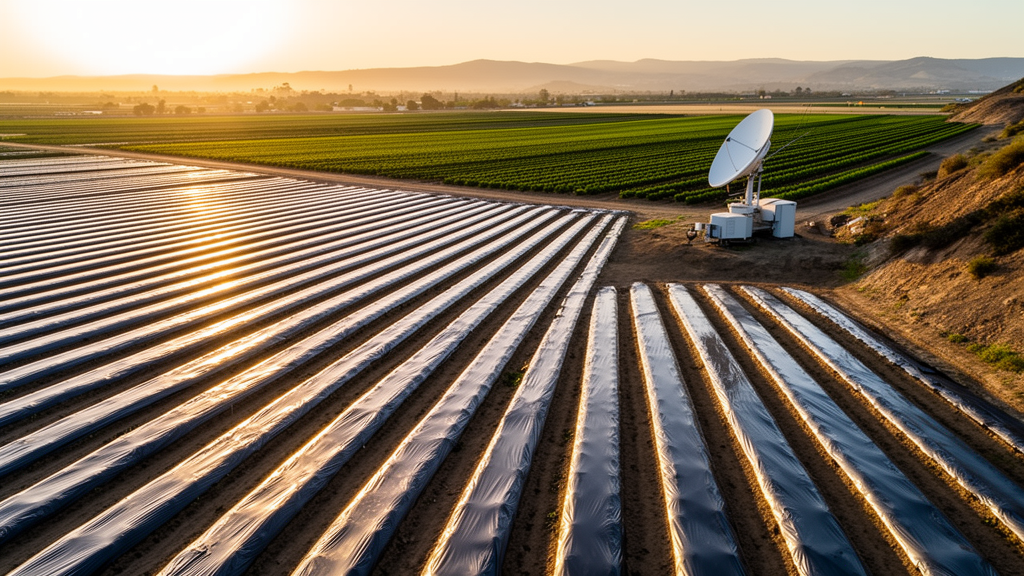
Every winter, farmers along California’s central coast unroll vast sheets of black plastic over their strawberry fields, and every summer they swap them for white film that keeps soil temperatures down. These plastic mulches are indispensable to modern intensive agriculture, yet they are also one of the planet’s least-tracked sources of plastic waste. Now a research team led by scientists at California Polytechnic State University and San Diego State University has shown that ordinary free satellite imagery can map this hidden plastic infrastructure with remarkable precision, achieving an overall classification accuracy of 0.982 across a full year and a half of observations over Santa Maria, California.
The study, published in Frontiers in Remote Sensing, tackles a problem that has long frustrated environmental scientists: nobody really knows how much agricultural plastic the world uses. Global estimates hover around a minimum of 2.5 million tons of plastic mulch annually, but those figures rest largely on voluntary grower surveys and industry reports. The same field may host multiple crops and multiple farmers within a single year, so survey-based accounting systematically misses both the spread of plasticulture across landscapes and the number of times plastic is applied per year in any given place. Without reliable maps, policymakers cannot identify contamination hotspots or design interventions, even as weathered mulch fragments shed microplastics into soils and waterways.
Satellite spectroscopy has long promised a solution, but plastic mulch is a notoriously difficult target. Semi-permanent greenhouses are relatively easy to spot from orbit, and numerous studies have mapped them successfully. Temporary mulch films are another matter entirely. As crops grow, their canopies progressively swallow the plastic beneath, so the same field can flip from being clearly plastic-covered to apparently vegetated within weeks. Meanwhile, mulch films come in a bewildering array of colors, and the dark varieties, black and green polyethylene, mimic soil and vegetation spectrally, which is why most remote sensing work has focused on bright white and clear plastics alone.
To overcome these obstacles, the researchers began on the ground. They collected samples of white, black, and green low-density polyethylene mulch from five agricultural sites in central and southern California and measured their reflectance in the laboratory using a Spectra Vista Corporation HR-1024i spectroradiometer covering wavelengths from 350 to 2500 nanometers. They also measured soil from five mulched fields under controlled illumination. The resulting spectral library revealed distinctive signatures: white plastic was the brightest material, peaking at 30 to 50 percent reflectance in the visible range and declining steadily into the infrared; black plastic was nearly flat at 1 to 3 percent reflectance across the entire range, dangerously similar to shadow and wet mud; and green plastic showed a sharp reflectance rise near 700 nanometers that eerily mimicked the red edge of photosynthetic vegetation.
Crucially, the team found that the dominant broadband features of these materials survived when the laboratory spectra were mathematically convolved to match the coarser spectral resolution of the Sentinel-2 satellites, the European Space Agency’s free, openly available imaging constellation. The narrowband infrared absorption features that hyperspectral sensors typically exploit to identify plastics were absent or weak in these mulch samples, but that turned out not to matter: the broad spectral shapes carried enough information for Sentinel-2’s multispectral bands to work with.
From the spectral library, the researchers distilled three physically interpretable metrics into a simple decision tree. First, dark plastics, a combined class of black and green mulch, were isolated by their low total reflectance in the shortwave infrared, where they sit roughly 30 to 40 percent below soil. Second, bare soil was identified by its uniquely positive spectral slope between 800 and 1600 nanometers among the remaining pixels. Third, everything left over was split between crops and bright plastics using the Apparent Visible Wavelength, or AVW, a weighted harmonic mean of reflectance across the spectrum that condenses an entire spectral curve into a single number describing color. Originally developed for ocean color work, AVW had never before been applied to terrestrial surface reflectance imagery, and here it cleanly separated white plastic and greenhouse covers, with AVW below 815 nanometers, from vegetated pixels above that threshold.
Before trusting the classifier, the team stress-tested it with linear mixture analysis, blending plastic spectra with soil and vegetation in increments from 0 to 100 percent to simulate the subpixel mixing that plagues 10-meter satellite pixels. Black plastic became detectable above roughly 60 percent subpixel coverage, dark green mulch required more than 90 percent coverage when mixed with soil, and white plastic separated from crops above about 40 percent. Monte Carlo simulations with Rayleigh scattering atmospheres of varying opacity confirmed that these separabilities largely survived realistic atmospheric noise, though dark green mulch emerged as the most fragile target, detectable only in well-illuminated conditions shortly after application.
Validation came from a reference dataset of 416 spectra assembled from high-resolution NearMap aerial imagery, field observations, Google Street View records, and Sentinel-2 imagery itself, split 60/40 into training and testing sets. Against the held-out data, the decision tree achieved an overall accuracy of 0.982, a Cohen’s kappa of 0.973, and a macro-averaged F1 score of 0.967. Conventional machine learning classifiers, a random forest and a radial-basis-function support vector machine trained on identical data, edged it out by less than one percentage point in accuracy, but at a steep computational price: the decision tree classified one million pixels in about 0.024 seconds, roughly 87 to 110 times faster than its rivals, while remaining fully interpretable at every decision branch.
Applied across Santa Maria from April 2023 to January 2025, the classifier revealed a striking seasonal rhythm that matched regional farming practice without any prior knowledge of it. Total plastic coverage peaked at 1682.56 hectares in November 2023 and 1841.21 hectares in December 2024 as dark mulch was laid for winter strawberries, then collapsed as canopies overgrew the film by summer. White plastic peaked near 1548 hectares in July 2023 and 1577 hectares in July 2024, riding atop a persistent baseline of about 630 hectares attributable to year-round greenhouses and hoop houses. Summed over the May 2023 to April 2024 period, the method estimated roughly 2593 hectares of agricultural plastic deployed in the study area alone.
The authors are candid about limitations: thresholds will need recalibration in regions with different soils, crop architectures, or plastic pigments, and the 10-meter pixel resolution cannot resolve plastic hidden inside greenhouses or mixed along field edges. Still, the framework’s spectral foundation means it can be retuned with minimal training data rather than rebuilt from scratch. As the European Union’s new Soil Monitoring Directive begins requiring countries to track soil plastic contamination, and as floods, which can amplify riverine plastic transport a hundredfold, grow more erratic under climate change, the ability to watch plastic mulch ebb and flow across entire agricultural landscapes from orbit may prove one of the most consequential tools yet for confronting agriculture’s plastic footprint.
Subject of Research: Remote sensing detection and mapping of agricultural plastic mulch distribution using Sentinel-2 satellite imagery in California
Article Title: Remote estimation of plastic distribution in California agriculture using Sentinel-2 imagery: a case study
Article References: Scrivner, E., Hamilton, D., Sousa, D., Mattson, M., Williams, N. E., & Sistla, S. (2026). Remote estimation of plastic distribution in California agriculture using Sentinel-2 imagery: a case study. Frontiers in Remote Sensing, 7, Article 1927646. https://doi.org/10.3389/frsen.2026.1927646
Image Credits: AI Generated
DOI: 10.3389/frsen.2026.1927646
Keywords: remote sensing, Sentinel-2, plastic mulch, plasticulture, California agriculture, spectroscopy, microplastics, decision tree classification, agricultural plastic pollution, Santa Maria, Apparent Visible Wavelength, satellite imagery
Cite Scienmag News
Alan Morgan. (October 16, 2026). Satellites Now Track Hidden Plastic Mulch Across California’s Farm Fields. Scienmag. https://scienmag.com/satellites-now-track-hidden-plastic-mulch-across-californias-farm-fields/
Alan Morgan. "Satellites Now Track Hidden Plastic Mulch Across California’s Farm Fields." Scienmag, 16 October 2026, https://scienmag.com/satellites-now-track-hidden-plastic-mulch-across-californias-farm-fields/. Accessed 16 October 2026.
Alan Morgan. "Satellites Now Track Hidden Plastic Mulch Across California’s Farm Fields." Scienmag. October 16, 2026. https://scienmag.com/satellites-now-track-hidden-plastic-mulch-across-californias-farm-fields/


