


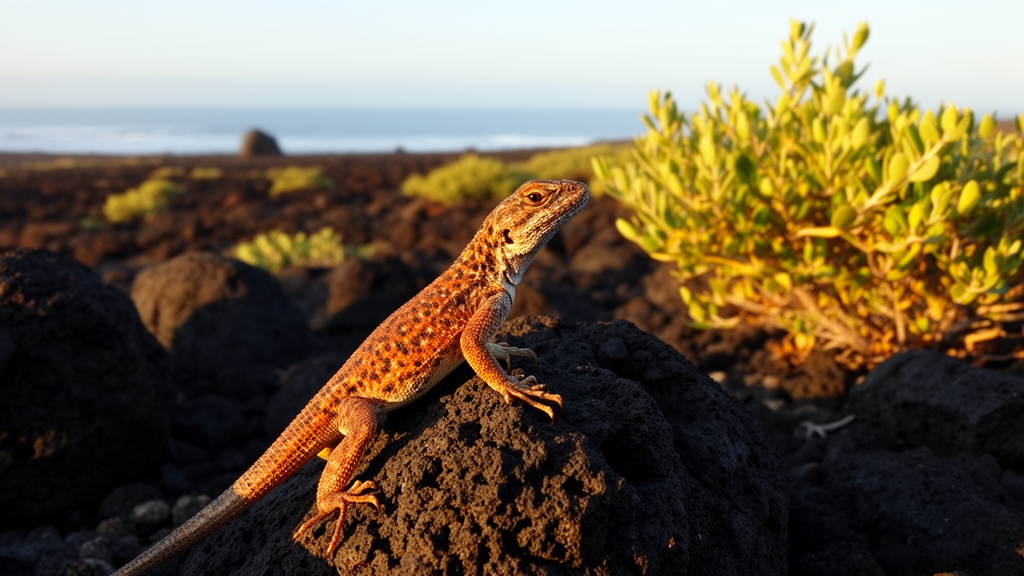
On the rocky slopes of San Cristóbal in the Galápagos, the islands’ most visible reptiles are quietly rewriting the rules of survival. A new radiotelemetry study of the San Cristóbal lava lizard (Microlophus bivittatus) reveals that these small, sun-loving animals dramatically compress their daily lives when the archipelago slides from its hot, wet season into the cool, dry one. Lizards tracked across both periods cut their activity areas by more than half, moved far shorter distances each day, and sometimes simply stopped moving altogether for days at a time. The findings offer one of the most detailed portraits yet of how a tropical ectotherm reorganizes its spatial world in response to seasonal swings in temperature, water, and food.
The research, published in Neotropical Biology and Conservation, followed radio-tagged lizards at a study site near Frigatebird Hill during March 2016, at the peak of the hot-wet season, and again in August 2016, during the cool-dry period. Researchers fitted each animal with a 0.5-gram radio transmitter glued to the dorsal pelvis, then relocated them three times a day, in the morning, at midday, and in the late afternoon. Over 165 total tracking days and 451 radiolocations, the team mapped each lizard’s movements on a 60-by-60-meter survey grid, then analyzed the resulting tracks with two complementary methods: minimum convex polygons, which enclose all recorded positions, and autocorrelated kernel density estimation, a statistical approach that captures clusters of repeated use within an animal’s range.
The seasonal contrast was stark. Lizards in March moved an average of 14.2 meters per day, while those in August managed only 5.8 meters, a large effect size that held regardless of sex. Activity areas told the same story. The mean core area, representing the 50 percent utilization distribution, shrank from roughly 151 square meters in March to just 43 square meters in August. Overall home ranges, measured as 95 percent utilization distributions, contracted from about 750 square meters to 238 square meters. These are not subtle shifts; they represent a fundamental restructuring of how much space an individual lizard needs to make a living depending on the time of year.
Equally striking was what the lizards did with the space they retained. Rather than wandering uniformly across their ranges, individuals concentrated their movements within a single core area, occasionally making repeated forays to specific peripheral spots. The researchers interpret these excursions as likely related to searching for prey, establishing ambush sites, or monitoring potential mates and rivals. When neighboring lizards’ ranges overlapped, the overlap occurred almost exclusively at the broader 95 percent level. Core areas, by contrast, rarely overlapped at all, suggesting that these tightly used zones function as de facto territories within larger, more permissive activity areas.
Habitat selection proved equally season-dependent. In March, the strongest predictors of where a lizard chose to position itself were distance to the nearest low tree and substrate temperature. Lizards selected microhabitats with cooler substrate temperatures than random sites would predict, and they positioned themselves roughly 2.4 times farther from low trees than expected in the morning, gradually moving closer as the day progressed. This pattern is consistent with a classic thermoregulatory strategy: bask on open rock faces in the cool morning, then retreat to shaded spots as the equatorial sun climbs. By afternoon, lizards had shifted to rocks under canopy, detritus, and the vicinity of larger trees.
In August, the picture changed entirely. The top statistical models pointed toward rock crevices and open rock faces, but no single predictor received strong, consistent support across the model set. Lizards spent their days in or near crevices, on detritus, or under low vegetation, and four individuals, two females and two males, were documented remaining inactive for entire days. One male was stationary for six consecutive days, moved 11.4 meters in a single burst, then settled back into near-total inactivity. This kind of multi-day dormancy was essentially absent during the hot-wet period.
The researchers attribute these behavioral shifts to a combination of thermal and resource constraints. During March 2016, operative temperatures on open rock faces in direct sunlight exceeded the lizards’ preferred body temperature range by roughly 8 degrees Celsius, making shaded rock faces under canopy the only viable midday option. In August, by contrast, temperatures in sun and shade converged and fell within the preferred range only briefly during late morning and early afternoon. Yet lizards still overwhelmingly chose shaded rock faces, possibly because conductive heat from rock surfaces remains available even under leafless canopy, or because staying hidden reduces exposure to predators such as Galápagos racers, hawks, and feral cats.
Resource scarcity likely compounds the thermal story. By August, the dominant palo santo and Jerusalem thorn trees had dropped most of their leaves, leaving primary production to sparse evergreen shrubs and grasses. Since lava lizards consume both plant material and arthropods, the cool-dry season represents a bottleneck in both food and water availability. Reduced movement and extended inactivity may be an energy-conservation strategy, similar to patterns documented in other tropical reptiles such as Guatemalan beaded lizards, which contract their home ranges by up to 90 percent during dry periods.
The study’s authors caution that their monitoring windows were relatively short, offering snapshots rather than a full annual picture. Still, the consistency of the seasonal effect across all measured metrics, from daily distance to home range size to microhabitat choice, suggests that San Cristóbal lava lizards are finely tuned to the temporal rhythm of their environment. As climate patterns shift and El Niño and La Niña events grow more variable, understanding how these lizards buffer themselves against seasonal extremes may become increasingly important for predicting their resilience across the Galápagos.
What emerges from this work is a portrait of an animal that is neither a passive hostage of its thermal environment nor a freewheeling explorer of its landscape. Instead, the San Cristóbal lava lizard operates as a strategic compromise artist, expanding its world when conditions permit and contracting it when they do not, always balancing the competing demands of staying warm enough, staying hydrated, staying fed, and staying alive.
Subject of Research: Seasonal variation in spatial ecology, habitat use, and habitat selection of the San Cristóbal lava lizard in the Galápagos
Article Title: Seasonal variations in spatial ecology, habitat use and habitat selection by San Cristóbal lava lizards Microlophus bivittatus in Galápagos
Article References: Rowe, J. W., Moore, J. A., Fonley, M. R., Clark, D. L., & Valle, C. A. (2026). Seasonal variations in spatial ecology, habitat use and habitat selection by San Cristóbal lava lizards Microlophus bivittatus in Galápagos. Neotropical Biology and Conservation, 21(2), 149-171. https://doi.org/10.3897/neotropical.21.e185618
Image Credits: AI Generated
DOI: 10.3897/neotropical.21.e185618
Keywords: Galápagos, lava lizard, Microlophus bivittatus, radiotelemetry, habitat selection, thermoregulation, seasonality, home range, ectotherm, spatial ecology, San Cristóbal, reptile behavior
Cite Scienmag News
Drew Townsend. (October 16, 2026). Galápagos Lava Lizards Shrink Their Territories When the Cool-Dry Season Sets In. Scienmag. https://scienmag.com/galapagos-lava-lizards-shrink-their-territories-when-the-cool-dry-season-sets-in/
Drew Townsend. "Galápagos Lava Lizards Shrink Their Territories When the Cool-Dry Season Sets In." Scienmag, 16 October 2026, https://scienmag.com/galapagos-lava-lizards-shrink-their-territories-when-the-cool-dry-season-sets-in/. Accessed 16 October 2026.
Drew Townsend. "Galápagos Lava Lizards Shrink Their Territories When the Cool-Dry Season Sets In." Scienmag. October 16, 2026. https://scienmag.com/galapagos-lava-lizards-shrink-their-territories-when-the-cool-dry-season-sets-in/


