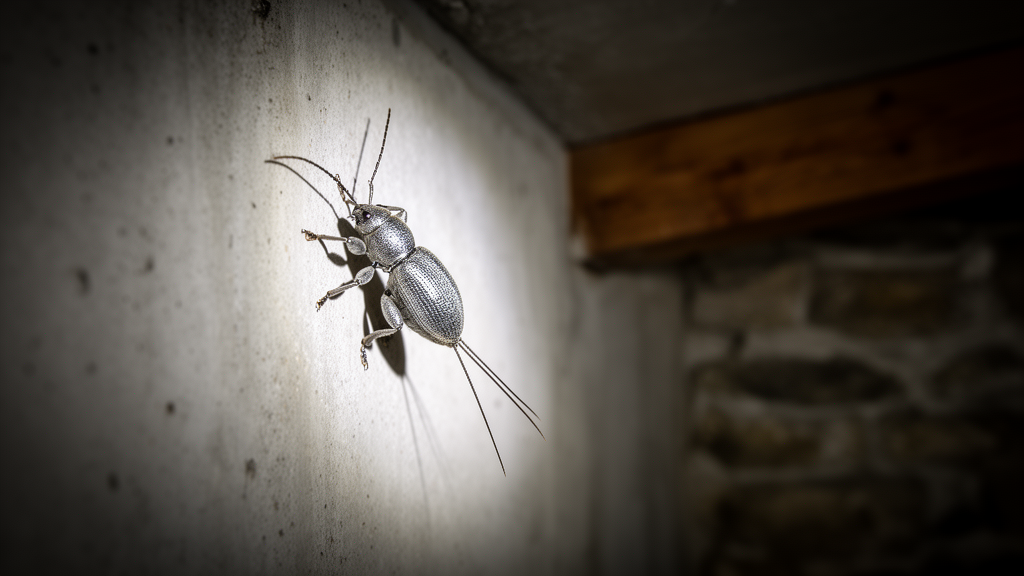
Silverfish and their relatives belong to one of the most ancient lineages of winged-insect relatives on Earth, yet in Switzerland they have remained so poorly studied that the national species list could not even be fixed with certainty. A new faunistic survey, published in Alpine Entomology, has now compiled historic literature, fresh fieldwork, museum specimens and thousands of validated citizen-science photographs to produce the most complete picture to date of the order Zygentoma in the country. The result is a snapshot of a quietly changing fauna: three native species confirmed, at least three non-native newcomers established, and clear signs that modern buildings and a warming climate are reshaping which silverfish live where.
Zygentoma are primitive, wingless insects with flattened, teardrop-shaped bodies covered in silvery scales and long tail-like appendages. Unlike their jumping relatives, the bristletails of the order Archaeognatha, they have small compound eyes with only a few ommatidia, and some subfamilies, such as the ant-dwelling Atelurinae and the soil-living Nicoletiinae, have lost their eyes entirely. Among insects they are unusually long-lived: individuals may survive for several years, and the long-tailed silverfish Ctenolepisma longicaudatum needs up to fourteen moults, sometimes over several years, before reaching sexual maturity. In Central Europe most species live in close association with humans, feeding on organic debris such as dust and mould, and occasionally on paper and textiles in archives and museums, although serious damage is generally confined to such collections.
The historical record shows that silverfish have shared Swiss homes for centuries. The common silverfish Lepisma saccharinum has been recorded in the country since at least the eighteenth century, and the four-lined silverfish Ctenolepisma lineatum was originally described from Switzerland, with its neotype also originating there. The ant-associated Atelura formicaria was added later, in records from the Basel region published in the early twentieth century. A summary from 2000 acknowledged three confirmed species and one suspected, and a recent assessment by the Swiss Academy of Sciences estimated that between zero and three additional species might occur without direct records. Since then, the greenhouse-dwelling Nicoletia phytophila has been documented, and evidence has accumulated for two further Ctenolepisma species.
To update this picture, the authors combined targeted prospections and specimen collection with a systematic review of occurrence data from the biodiversity aggregators GBIF and the citizen-science platform iNaturalist. Only iNaturalist observations classified as research grade, meaning identifications supported by at least two independent users with a two-thirds majority, were included in the GBIF exports used for the analysis. The team also contacted bakeries and the Swiss Pest Control Association in an effort to trace the heat-loving firebrat Thermobia domestica, and reached out to ant specialists to locate the elusive Atelura formicaria. Identification keys were updated to reflect a major taxonomic revision: European populations formerly assigned to Ctenolepisma calvum were reclassified in 2025 as a newly described species, Ctenolepisma phantasma, the ghost silverfish.
The survey confirmed three native species in Switzerland. Atelura formicaria, the ant silverfish, is the rarest and most specialised. It lives obligatorily in ant nests, where its eyeless, teardrop-shaped body and shortened appendages are adaptations to a myrmecophile lifestyle, and it can even follow ant pheromone trails. The species had not been reported in Switzerland for more than eighty years, but the team confirmed a population in the Basel port area near the Dreiländereck, finding groups of more than thirty individuals under stone slabs together with ants of the Tetramorium caespitum complex, and uncovered an additional population in the canton of Valais, at Liesberg, Fully and Sierre, associated with Formica and Lasius flavus colonies. The Valais records lie outside the previously known Central European distribution, although the species is known from other inner-alpine valleys. In Basel the species may have declined: where the early twentieth-century entomologist Wygodzinsky found it regularly at eight locations over two years, only a single site is known today.
The other two natives appear to be faring better. Lepisma saccharinum, the common silverfish, is now globally distributed through human activity and was documented from thirty-two records across Switzerland, widespread north of the Alps but so far absent from Ticino. Notably, the survey confirmed that the species also lives outdoors in Switzerland, with records from a tree trunk at a mine entrance, a log at a cave mouth, a hollow tree trunk at night and paving stones under a bridge, echoing historic reports of populations living on rock in warm, dry microhabitats. Ctenolepisma lineatum, the four-lined silverfish, identifiable by its two shades of brown dorsal scales forming longitudinal stripes and its long cerci usually held perpendicular to the body, produced seventy-two records and is currently the most frequently reported Zygentoma species in the country, concentrated in warmer regions and capable of surviving outside even in winter.
Among the non-native species, the headline finding is the first vouchered Swiss record of Ctenolepisma longicaudatum, the long-tailed or giant silverfish. Originally described from South Africa in 1905, the species was spread by human trade early in the twentieth century and reached most of Europe only in the second half of the twentieth century or later. Swiss pest-control data from Zurich suggest its presence from 2008 onward, and photographic records go back to 2017, but until now no verifiable specimen existed. A specimen collected in Köniz in the canton of Bern in August 2023 and deposited in the Natural History Museum Vienna now constitutes the first confirmed record. With forty records across the country, mostly from urban centres and exclusively indoors, the species is clearly established. It tolerates drier conditions than the common silverfish, prefers temperatures between twenty and twenty-six degrees Celsius, and thrives in the stable, warm microclimates created by modern building infrastructure, with continuous heating, cable ducts and pipework providing ideal corridors through large buildings.
The ghost silverfish Ctenolepisma phantasma tells a parallel story of cryptic invasion. First recorded in Switzerland in 2017 and detected regularly between 2019 and 2021 in at least three museums during pest monitoring, the species was long misidentified as C. calvum until its 2025 description. Ten records are now known from regions outside the Alps, and the authors expect additional finds as the species expands across Europe. Its biology remains poorly understood, but evidence of parthenogenetic reproduction, in which females can reproduce without males, likely facilitates rapid spread, although both sexes have been reported in Europe. Its whitish to very pale grey scaling gives the species its name, but because several Ctenolepisma species and juveniles look similar, microscopic confirmation of identifications remains essential. Meanwhile, the tropical greenhouse species Nicoletia phytophila, eyeless, scaleless and whitish, persists in the Zurich Botanical Garden, while its survival in Basel after the renovation of the tropical house is uncertain. The firebrat Thermobia domestica, whose presence has been indicated by Zurich pest-control records since 1999 but never confirmed by a specimen, may have declined as wood-fired kitchen stoves disappeared in favour of central heating, since its long-term survival depends on sustained high temperatures such as those found in bakeries.
The broader ecological picture is one of anthropogenic reshaping. Outdoor records of the native species are confined to lower elevations of roughly three hundred to eight hundred metres above sea level, yet indoor records exist of the common silverfish at 1400 metres in Sent and of the long-tailed silverfish at 1240 metres in Ramosch, both in the Grisons Alps. Buildings thus allow species to occupy elevations that would otherwise be climatically unsuitable, and climate change may further promote outdoor expansion and montane colonisation. The authors also warn of potential competition between newly introduced and native species: while several Zygentoma can coexist within a single household, competitive exclusion cannot be ruled out. Paradoxically, seamless crack-free renovations may reduce habitat for some species, but the overall effect of modern construction, with its warm, stable conditions and service ducts, appears to favour synanthropic invaders such as C. longicaudatum and C. phantasma.
Looking ahead, the study highlights how much remains to be discovered. Species such as Tricholepisma aureum could shift northward naturally as the climate warms, the cave-dwelling Coletinia maggii, recorded in Austria, might find suitable habitats in Switzerland, and global trade could introduce further taxa such as Ctenolepisma rothschildi or the Congo silverfish Namunukulina congolense, which can be easily confused with young common silverfish. Because Zygentoma are small, nocturnal and cryptic, photographic records remain sparse and identification from images is fraught with pitfalls, from variable scale colouration to broken appendages. The authors argue that ongoing surveys, regular specimen collection and the continued involvement of citizen scientists on platforms such as iNaturalist are essential for tracking future changes in the distribution and community composition of these ancient insects, whose quiet spread through Swiss homes, museums and alpine valleys offers a vivid example of how global trade, building technology and a changing climate together reshape even the most inconspicuous corners of urban biodiversity.
Subject of Research: Distribution and ecology of native and non-native silverfish (Zygentoma) in Switzerland
Article Title: Zygentoma of Switzerland: Faunistic contribution with first records of Ctenolepisma longicaudatum and new occurrences of Atelura formicaria
Article References: Moser, V., & Szucsich, N. (2026). Zygentoma of Switzerland: Faunistic contribution with first records of Ctenolepisma longicaudatum and new occurrences of Atelura formicaria. Alpine Entomology, 10, 79-87. https://doi.org/10.3897/alpento.10.164953
Image Credits: AI Generated
DOI: 10.3897/alpento.10.164953
Keywords: Zygentoma, silverfish, Switzerland, Ctenolepisma longicaudatum, Atelura formicaria, citizen science, invasive species, urban entomology, climate change, myrmecophily, Alpine Entomology, faunistics
Cite Scienmag News
Gavin Prescott. (October 16, 2026). Silverfish survey reveals hidden invaders spreading through Swiss buildings. Scienmag. https://scienmag.com/silverfish-survey-reveals-hidden-invaders-spreading-through-swiss-buildings/
Gavin Prescott. "Silverfish survey reveals hidden invaders spreading through Swiss buildings." Scienmag, 16 October 2026, https://scienmag.com/silverfish-survey-reveals-hidden-invaders-spreading-through-swiss-buildings/. Accessed 16 October 2026.
Gavin Prescott. "Silverfish survey reveals hidden invaders spreading through Swiss buildings." Scienmag. October 16, 2026. https://scienmag.com/silverfish-survey-reveals-hidden-invaders-spreading-through-swiss-buildings/