


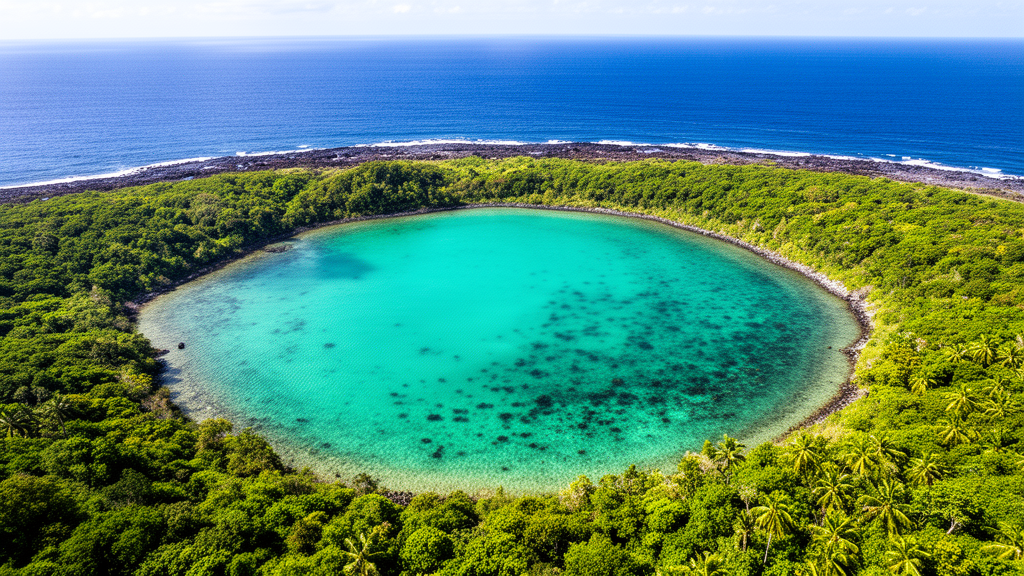
Some of the most revealing islands in science are not islands at all in the everyday sense. Scattered across the Palau archipelago in the western Pacific, hidden within karst depressions flooded by rising seas after the last ice age, lie more than a hundred marine lakes—bodies of seawater completely surrounded by land. A new study published in Frontiers of Biogeography uses these strange, young habitats to ask one of the oldest questions in ecology: what makes an island behave like an island? The answer, drawn from the fish communities living in these lakes, suggests that the boundary between ‘true’ islands and ‘habitat’ islands is far blurrier than classic theory has assumed.
The research, led by a team surveying 22 locations across Palau, compared fish communities in two types of marine lakes with communities in the open ocean. Stratified lakes, which have layered water columns with distinct salinity and oxygen profiles and only weak connections to the sea, turned out to be strikingly species-poor. Mixed lakes, which are well connected to the ocean through tunnels and mixed by tides or wind, held nearly as many species as the nearby coastal waters. The surveys, conducted in August 2013 following standardized rapid assessment protocols, recorded 249 fish species in total, drawn from a reference pool of 1,724 species known from Palauan waters.
The numbers tell a vivid story. Ocean locations harbored 166 species and mixed lakes 185, while stratified lakes averaged just over four species each—except for two remarkable outliers, T-Lake and Hot Water Lake, which held 17 and 18 species respectively. These two lakes, with intermittent stratification or a submerged tunnel connecting them to the sea, hint at something important: the categories themselves may sit along a continuum rather than representing discrete states. When the researchers removed these outliers from their statistical analyses, the separation between community types became even sharper, underscoring that the gradation is real and biologically meaningful.
What makes this study technically distinctive is its use of three complementary measures of diversity. Beyond simple species richness, the team quantified phylogenetic diversity, which measures the evolutionary spread of lineages in a community, and functional diversity, which captures the range of ecological traits present. They assembled a dated phylogeny of 1,627 taxa from the Open Tree of Life and built a trait matrix covering body shape, trophic level, dorsal spine counts, temperature and depth preferences, water habitat tolerance, and reproductive strategies. Missing trait values were filled in hierarchically, first with genus averages and then family averages, leaving only 0.2 percent of values absent in the final matrix.
The trait analysis produced some of the most intriguing results. Stratified lake fish communities were distinguished by higher proportions of species with parental care and egg-brooding strategies, more elongated body shapes, higher and more tightly clustered trophic levels, fewer dorsal spines, and greater euryhaline tolerance—the ability to handle a range of salinities. These traits map neatly onto three ecological filters: colonization, environmental persistence, and niche competition. Parental investment, for instance, produces larger eggs and better-surviving larvae, which helps offspring avoid the lethal hydrogen sulfide layer that lurks below the chemocline in most stratified lakes. The pattern echoes the famous Paradox of Rockall, in which a brooding gastropod manages to populate a distant island precisely because its young do not need to drift far.
Beta diversity—the turnover of species, lineages, and traits between locations—added another layer of insight. Stratified lake communities differed significantly from both ocean and mixed lake communities across all three diversity dimensions, confirming their status as genuinely distinct ecological worlds. Mixed lakes, by contrast, resembled the ocean in total and richness components of beta diversity but differed in replacement components, meaning that while they host similar kinds of species, the specific identities swap out from place to place. Salinity emerged as the single most consistent environmental correlate, significantly or nearly significantly correlated with beta diversity patterns in 15 of 18 pairwise analyses.
The species-area relationship, a cornerstone of island biogeography since MacArthur and Wilson’s equilibrium theory, behaved in unexpected ways. Mixed lakes showed a slope of 0.35, similar to values typical of true islands, while stratified lakes showed essentially no relationship between area and species richness at all. The researchers attribute this to the small-island effect and to the youth of these habitats. Marine lakes formed only 12,000 to 5,000 years ago as post-glacial seas flooded karst depressions, and the smallest cover less than 0.1 square kilometers. Compared with the youngest marine islands previously studied, which are around one million years old, these lakes are ecological infants whose communities are still assembling.
So do marine lakes behave like ‘complete’ islands—land surrounded by water or, in MacArthur and Wilson’s fuller definition, water surrounded by land—or like ‘habitat’ islands, patches of habitable environment embedded in a contrasting matrix? The evidence points in both directions. Stratified lakes share key attributes with true oceanic islands: geographic isolation behind an uninhabitable matrix of rock and anoxic water, depauperate communities built by colonization, and the potential for endemism, as evidenced by endemic invertebrate subspecies already described from these systems. Mixed lakes, with their high connectivity, species richness, trait redundancy, and lack of endemism, fit the habitat island mold almost perfectly.
The deeper implication is conceptual. The authors argue that an island may be best identified not by its geology but by how organisms experience and respond to its geographical and environmental conditions. A location may be an island for one species and not for another, depending on dispersal ability, salinity tolerance, and reproductive mode. This biophysical perspective reframes island biogeography as a spectrum rather than a dichotomy, with young, small islands like marine lakes occupying an intermediate zone that mature oceanic islands passed through long ago. Because so few natural settings capture the early stages of community assembly—Surtsey and Anak Krakatau being rare exceptions—marine lakes offer a globally distributed natural laboratory, with at least 200 known post-glacial examples.
For conservation, the findings carry practical weight. Stratified lakes, as potential hotspots of incipient endemism and as communities shaped by rare environmental filters, deserve targeted protection, particularly as climate perturbations and sediment infilling continue to alter their fragile stratification. For theory, the study demonstrates that the Equilibrium Theory of Island Biogeography and its successors can be meaningfully extended into marine systems, provided researchers embrace multiple diversity dimensions and accept that island identity may be a matter of degree. In the quiet, green waters of Palau’s lakes, the earliest chapters of island biogeography are being written in real time, one colonizing fish at a time.
Subject of Research: Island biogeography of fish communities in Palauan marine lakes
Article Title: Community diversity of marine fishes in complete and habitat islands
Article References: Carlson, B. J., Myers, R. F., & Dawson, M. N. (2026). Community diversity of marine fishes in complete and habitat islands. Frontiers of Biogeography, 19, Article e141935. https://doi.org/10.21425/fob.19.141935
Image Credits: AI Generated
Keywords: island biogeography, marine lakes, Palau, fish communities, species diversity, phylogenetic diversity, functional diversity, stratified lakes, habitat islands, beta diversity, community assembly, species-area relationship
Cite Scienmag News
Margaret Porter. (October 16, 2026). Seawater Surrounded by Land: Marine Lakes Reveal How Young Islands Assemble Their Life. Scienmag. https://scienmag.com/seawater-surrounded-by-land-marine-lakes-reveal-how-young-islands-assemble-their-life/
Margaret Porter. "Seawater Surrounded by Land: Marine Lakes Reveal How Young Islands Assemble Their Life." Scienmag, 16 October 2026, https://scienmag.com/seawater-surrounded-by-land-marine-lakes-reveal-how-young-islands-assemble-their-life/. Accessed 16 October 2026.
Margaret Porter. "Seawater Surrounded by Land: Marine Lakes Reveal How Young Islands Assemble Their Life." Scienmag. October 16, 2026. https://scienmag.com/seawater-surrounded-by-land-marine-lakes-reveal-how-young-islands-assemble-their-life/


