


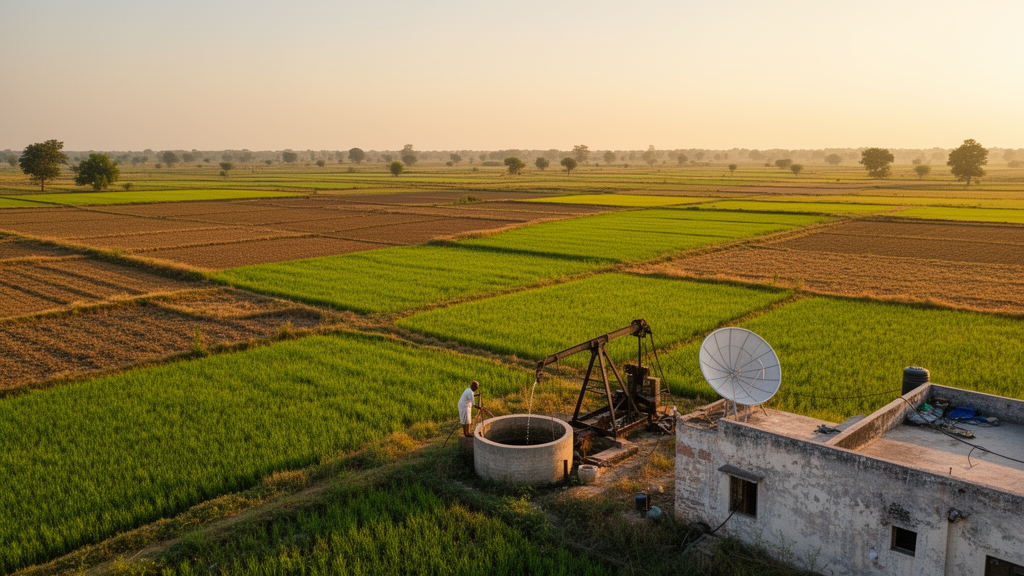
Deep beneath India’s farms and cities lies one of the planet’s most heavily exploited groundwater systems, yet a deceptively simple question has long frustrated hydrogeologists: when the water table drops by a meter, how much water does that actually represent? The answer depends on a parameter called specific yield, and a new study published in Hydrogeology Journal has now mapped it across the entire country by combining satellite gravity measurements with thousands of in situ well observations.
Specific yield, usually written as Sy, describes the fraction of water that an unconfined aquifer releases when it drains freely under gravity. A sandy aquifer might give up a large share of its stored water, while dense fractured rock releases only a trickle. Because Sy controls the conversion between water level changes and actual storage volumes, errors in this single number propagate directly into national groundwater budget estimates, recharge calculations, and depletion assessments. Despite its importance, reliable Sy values have remained scarce at regional scales, forcing practitioners to rely on hydrogeological maps or on values calibrated inside large models, both of which carry substantial uncertainty and often fail to capture the true spatial variability of aquifer properties.
A team led by Maya Raghunath Suryawanshi and Kuruva Satish Kumar at the Indian Institute of Science in Bengaluru, working with colleagues from ISRO centres and other IISc departments, took a different route. They applied the water table fluctuation method, a classical technique that normally works at the scale of a single well or field site, but scaled it up to whole mascon regions of roughly three degrees across India. The logic is elegant: if you know how much water storage changed over an area, and you know how much the water table rose or fell, the ratio between the two gives you the specific yield. The challenge has always been obtaining trustworthy storage changes over large regions, and this is where satellites enter the story.
The Gravity Recovery and Climate Experiment, GRACE, and its successor GRACE Follow-On measure tiny variations in Earth’s gravity field caused by the movement of water between reservoirs. By subtracting surface water, soil moisture, and other non-groundwater compartments, estimated here using the WaterGAP Global Hydrology Model, the researchers isolated the groundwater component of the satellite signal for each mascon. They then paired these storage anomalies with quality-controlled groundwater level records from the India Water Resources Information System, covering the period from 2003 to 2022. The well data had previously been rigorously filtered by the same group, who published the cleaned dataset in Scientific Data, ensuring that faulty or unrepresentative measurements would not contaminate the regression between storage change and water level change.
The resulting map of specific yield across India spans values from 0.003 to 0.15, a factor of fifty between the driest and most productive aquifers. The highest values appear in the north-eastern states and parts of peninsular India, where alluvial and weathered formations can store and release substantial water volumes. Western India, by contrast, shows the lowest values, consistent with hard rock terrains where the effective porosity accessible to the water table is small. These patterns matter enormously for water managers: a one meter decline in the water table removes far less water from a low-Sy hard rock aquifer than from a high-Sy alluvial one, so identical level trends imply very different depletion rates depending on location.
To validate their estimates, the team compared the satellite-derived Sy values against reference values taken from India’s national hydrogeological map. The agreement was close for many of the 39 mascons analysed, but a few showed notable deviations, which the authors interpret as evidence of genuine spatial heterogeneity within those large footprint areas rather than simple method failure. A mascon cell of roughly 300 kilometres across can encompass alluvial plains, crystalline uplands, and coastal sediments simultaneously, so a single map value may average over enormous internal diversity. Crucially, when the researchers propagated the uncertainties in both the GRACE storage changes and the water level observations, they found that 29 of the 39 mascon estimates fell within the uncertainty bounds of the reference values, a result that lends statistical credibility to the framework.
One of the most intriguing findings concerns resolution. GRACE mascon solutions are coarse, and a natural question is whether downscaling the satellite product to 0.5 degrees would sharpen the Sy estimates. The team tested a downscaled GRACE-FO product and found negligible improvement, indicating that the limiting factor is not the resolution of the gravity data alone but the combined signal-to-noise of the storage and level observations. For regional to continental scale applications, the native mascon framework is therefore adequate, and the extra complexity of downscaling brings no measurable benefit for this particular parameter. This is a practical lesson for the growing community working with GRACE derivatives: finer grids do not automatically mean better hydrogeology.
The authors are careful about the limits of their approach. The framework is constrained by the coarse spatial resolution of GRACE observations and by the limited temporal availability of groundwater level measurements, so it is intended for regional-scale rather than local-scale aquifer characterisation. A district water manager seeking to plan well placement cannot use a three-degree mascon value directly, but a state or national agency assessing basin-wide storage trends now has an observationally grounded Sy estimate where previously only map-based guesses existed. The method also requires that water level fluctuations genuinely reflect storage changes rather than being distorted by pumping patterns, well density, or local confining conditions, assumptions that the quality control of the well dataset helps to safeguard but cannot fully guarantee.
The broader significance of the study lies in what it enables. India is the largest consumer of groundwater in the world, and its agricultural economy, particularly the post-Green Revolution cereal systems, depends heavily on aquifer extraction. Previous satellite-based assessments of Indian groundwater depletion, including the landmark 2009 Nature study by Rodell and colleagues, had to assume Sy values from existing maps, embedding whatever errors those maps contained into the depletion estimates. With observationally derived, spatially varying Sy now available for the whole country, the conversion from water level trends to storage volumes can be revisited with greater confidence, and global hydrological models that represent groundwater dynamics can be calibrated against a new empirical benchmark.
Looking forward, the same framework can be applied wherever GRACE coverage overlaps with dense well monitoring networks, potentially extending to other major groundwater economies facing similar data scarcity. As the GRACE and GRACE-FO record lengthens and new missions are planned, and as national well databases grow more complete, the marriage of satellite gravimetry and in situ hydrogeology promises to keep refining our picture of the invisible water reserves on which hundreds of millions of people depend. For a country whose aquifers are being drawn down at rates that alarm scientists and policymakers alike, knowing precisely how much water each meter of decline represents is not an academic detail; it is the difference between sustainable management and silent depletion.
Subject of Research: Estimation of specific yield for Indian unconfined aquifers using GRACE satellite storage changes and in situ groundwater levels
Article Title: Estimating specific yield from GRACE-based storage change and groundwater levels across India
Article References: Estimating specific yield from GRACE-based storage change and groundwater levels across India. (n.d.). https://doi.org/10.1007/s10040-026-03195-z
Image Credits: AI Generated
DOI: 10.1007/s10040-026-03195-z
Keywords: GRACE, specific yield, groundwater, India, hydrogeology, satellite gravimetry, water table fluctuation method, aquifer storage, GRACE Follow-On, groundwater depletion, mascon, WaterGAP
Cite Scienmag News
Violet Maxwell. (October 16, 2026). Satellites and Wells Reveal How Much Water India’s Aquifers Can Actually Give Up. Scienmag. https://scienmag.com/satellites-and-wells-reveal-how-much-water-indias-aquifers-can-actually-give-up/
Violet Maxwell. "Satellites and Wells Reveal How Much Water India’s Aquifers Can Actually Give Up." Scienmag, 16 October 2026, https://scienmag.com/satellites-and-wells-reveal-how-much-water-indias-aquifers-can-actually-give-up/. Accessed 16 October 2026.
Violet Maxwell. "Satellites and Wells Reveal How Much Water India’s Aquifers Can Actually Give Up." Scienmag. October 16, 2026. https://scienmag.com/satellites-and-wells-reveal-how-much-water-indias-aquifers-can-actually-give-up/


