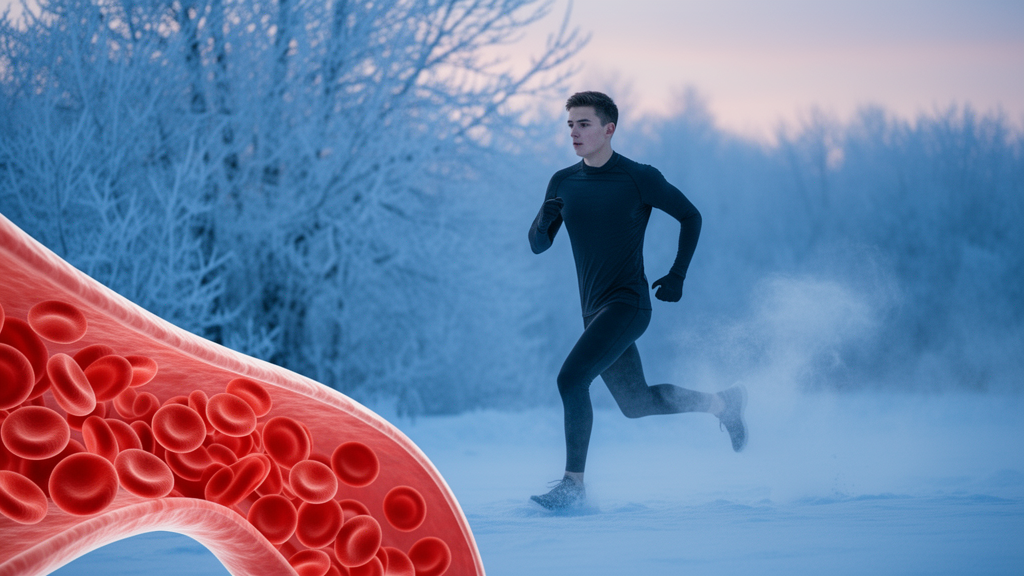
Winter athletes and cold-weather exercisers have long been warned that frigid air can thicken the blood, raise blood pressure, and tip the cardiovascular system toward danger. A new controlled experiment from Poland now suggests that, at least for young healthy men, a short and brutal sprint in temperatures as low as −10 °C does not make the blood measurably more prone to clotting than the same effort at a mild 18 °C. The study, published in Frontiers in Physiology, put thirty young men through an exhausting shuttle-run test in either deep cold or thermoneutral conditions and compared how their blood responded.
The research team, led by Aneta Teległów of the University of Physical Culture in Krakow together with colleagues from Jagiellonian University Medical College and the University of Agriculture in Krakow, focused on hemorheology, the study of how easily blood flows through vessels. Blood is not a simple liquid like water; it is a suspension of red cells, white cells, and platelets in plasma, and its viscosity depends on hematocrit, plasma protein concentration, red cell deformability, and aggregation. When any of these properties shift, the heart must work harder to push blood through the microcirculation, and the risk of thrombosis can rise.
Previous work had suggested reasons for concern. Cold exposure triggers peripheral vasoconstriction, raises arterial pressure, and has been linked in older studies to increases in platelet counts, red cell counts, and plasma fibrinogen, a key clotting protein. Strenuous exercise itself is known to transiently raise blood viscosity through hemoconcentration and to activate platelets. The researchers wanted to know whether combining the two stresses, maximal exertion and severe cold, would produce an amplified hemorheological response that could help explain why cardiovascular events cluster during winter sports and snow shoveling.
Thirty healthy, non-smoking male students aged around twenty-two were recruited and randomly assigned to one of two groups. The experimental group performed an incremental endurance shuttle-run test inside a climate chamber held at −10 °C, while the control group ran the identical protocol outdoors at 18 °C. The test began at eight kilometers per hour and increased by half a kilometer per hour each minute, with participants running twenty-meter shuttles until exhaustion. Fasting blood samples were drawn from an antecubital vein before and immediately after the run, and the researchers measured whole blood and plasma viscosity, hematocrit, red cell deformability and aggregation, fibrinogen concentration, platelet count and activation markers, and white cell counts.
The results were striking for what they did not show. Both groups displayed the expected exercise-induced hemoconcentration: plasma volume fell, hematocrit and hemoglobin rose, and platelet numbers increased, consistent with the well-documented splenic release of stored platelets during intense effort. Yet the magnitude of these changes was essentially the same whether the men had sprinted in deep cold or in mild air. Fibrinogen concentrations did not rise in either group, and there was no significant difference between the cold-exposed and control groups in any of the measured clotting or rheological variables.
Plasma viscosity, often considered a sensitive marker of cardiovascular risk, was unchanged by the cold exposure itself. The authors note that this finding aligns with some earlier reports but contradicts others that described viscosity increases during cold exposure at rest. One possible explanation is that the participants wore insulating clothing during the cold trial, blunting the skin-level cold stimulus, and that the short duration of the exercise bout was insufficient to trigger the fluid shifts and inflammatory responses that longer exposures produce. The young age and excellent health of the volunteers may also have allowed their compensatory mechanisms, including rapid plasma volume regulation, to fully offset any cold-induced hemoconcentration.
The study’s authors are careful to frame the findings within their limits. The cohort consisted exclusively of young, healthy, recreationally active men, a group whose cardiovascular systems respond flexibly to combined stress. The results cannot be extrapolated to older adults, people with coronary artery disease, or people with hypertension, in whom cold-induced vasoconstriction and impaired adaptive responses are known to raise event risk. Indeed, epidemiological data consistently show that winter cardiovascular mortality spikes precisely in populations whose hemorheological and vascular reserve is compromised.
Nevertheless, the work carries a practical message for the growing number of people who exercise outdoors in winter. For healthy young individuals, a brief high-intensity session in temperatures around −10 °C, dressed appropriately, does not appear to push blood rheology into a prothrombotic state beyond what the exercise itself already causes. The platelet increase observed in both groups reflects a normal, transient physiological response to maximal exertion rather than a cold-specific hazard, and it resolves as plasma volume normalizes.
The researchers suggest that future studies should examine longer cold exposures, female participants, older adults, and clinical populations to map where the protective compensatory mechanisms begin to fail. They also propose measuring additional markers such as catecholamines and inflammatory cytokines to clarify the signaling pathways linking cold, exertion, and blood rheology. Until then, the message for winter runners and athletes is cautiously reassuring: the deep cold of a January morning is unlikely to turn a hard sprint into a clotting crisis for a healthy young body, though anyone with cardiovascular risk factors should still treat cold-weather exertion with respect.
Subject of Research: Effects of acute sprint exercise in cold versus thermoneutral conditions on blood hemorheology in young men
Article Title: Acute hemorheological responses to an incremental shuttle-run test at -10 °C versus 18 °C in young healthy men
Article References: Teległów, A., Rembiasz, K., Pobędza, J., Cebula, Ł., Dziechciowski, Z., Czerwiński, A., Leśniowski, J., Marchewka, J., & Mika, P. (2026). Acute hemorheological responses to an incremental shuttle-run test at -10 °C versus 18 °C in young healthy men. Frontiers in Physiology, 17, Article 1935076. https://doi.org/10.3389/fphys.2026.1935076
Image Credits: AI Generated
DOI: 10.3389/fphys.2026.1935076
Keywords: hemorheology, blood viscosity, cold exposure, exercise physiology, platelets, fibrinogen, cardiovascular risk, shuttle-run test, plasma volume, winter sports, Acute, hemorheological
Cite Scienmag News
Phoebe Ingram. (October 16, 2026). Sprinting in Deep Cold Leaves Blood Flow Properties Unchanged in Young Men. Scienmag. https://scienmag.com/sprinting-in-deep-cold-leaves-blood-flow-properties-unchanged-in-young-men/
Phoebe Ingram. "Sprinting in Deep Cold Leaves Blood Flow Properties Unchanged in Young Men." Scienmag, 16 October 2026, https://scienmag.com/sprinting-in-deep-cold-leaves-blood-flow-properties-unchanged-in-young-men/. Accessed 16 October 2026.
Phoebe Ingram. "Sprinting in Deep Cold Leaves Blood Flow Properties Unchanged in Young Men." Scienmag. October 16, 2026. https://scienmag.com/sprinting-in-deep-cold-leaves-blood-flow-properties-unchanged-in-young-men/