


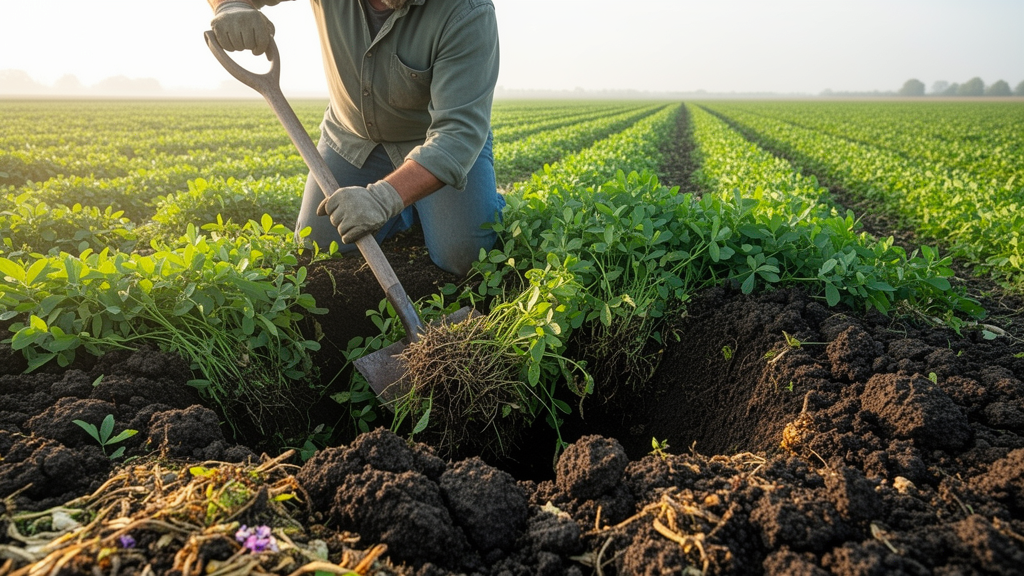
Green manuring has long been celebrated as one of agriculture’s most elegant tools: grow a cover crop, plow it into the soil, and let the buried biomass release its nutrients to feed the next harvest. But a new study suggests that farmers may have been asking the wrong question. For decades, the debate has centered on which species to plant. Now, researchers from Mendel University in Brno and their collaborators in Pakistan and China report that when the crop is harvested may matter more than what is harvested. In a carefully controlled 17-week pot experiment, they found that biomass maturity—a difference of just ten days of crop growth—could override crop identity in shaping decomposition, soil enzyme activity, and nutrient availability. The findings, published in the Spanish Journal of Soil Science, could reshape how growers time their cover crops to balance quick fertility gains against long-term carbon storage.
The research team, led by Antonin Kintl and Martin Brtnicky of Mendel University together with Adnan Mustafa of the Chinese Academy of Sciences, worked with three cover crops commonly grown in European rotations: safflower (Carthamus tinctorius), radish (Raphanus sativus), and white mustard (Sinapis alba). The plants were sown on the same day in August 2021 in fields near Brno, in the Czech Republic, but harvested at two subtly different stages. The first batch was cut after 77 days of growth, the second after 87 days. That ten-day gap, the equivalent of about 1.5 weeks of extra maturation, proved to be far from cosmetic. The aboveground biomass was cut at ground level, dried at 60 degrees Celsius to constant weight, and subjected to a battery of biochemical analyses before it ever touched the experimental soil.
The soil itself came from arable topsoil at the Agricultural Research station in Troubsko, a Haplic Luvisol with silty clay loam texture, total carbon of 14.0 grams per kilogram, and a near-neutral pH of 7.3. In each experimental box, the researchers placed two semipermeable mesh bags, each containing 20 grams of dry biomass—equivalent to 2 grams per kilogram of soil—and buried them under a thin layer of soil. The setup mimicked what happens in a real field when a cover crop is tilled in, but the mesh bags allowed the researchers to retrieve the residues and weigh exactly how much of the plant material had survived the 17-week incubation. Urea fertilizer was applied in two splits to a total dose of 150 kilograms of nitrogen per hectare, and the boxes were watered weekly to simulate alternating dry and moist periods typical of temperate spring conditions.
When the experiment ended, the results pointed unambiguously in one direction: maturity trumped species. In traits ranging from fat content and neutral detergent fiber to cellulose and hemicellulose, the difference between early- and late-harvested biomass was frequently larger than the difference between crops. The more mature biomass contained higher levels of carbohydrates and fats, and, counterintuitively, despite carrying higher indices of recalcitrance—the chemical features that normally make plant material hard to break down—it decomposed more completely, leaving less residual biomass behind. This finding challenges a cornerstone assumption of residue management: that older, more fibrous plant material necessarily lingers longer in the soil and releases its nutrients more slowly.
The decomposition numbers themselves were striking. Most of the buried biomasses lost between 77 and 87 percent of their mass over the course of the experiment. The lone exception was the early-harvested safflower, which decomposed far less completely, losing only about 62 percent of its original mass. That sluggish breakdown was associated with elevated neutral detergent fiber, acid detergent lignin, hemicellulose, and a high lignin-to-nitrogen ratio—markers of structural toughness. Intriguingly, the crops that degraded fastest, early-harvested radish and late-harvested white mustard, were not especially rich in nitrogen, overturning the common belief that nitrogen-rich residues always rot quickly. The researchers suggest that cruciferous crops such as radish and mustard may owe their easy degradability to glucosinolates, the sulfur-containing compounds characteristic of the mustard family, whose breakdown products can stimulate microbial activity.
Safflower told a different story. Even the later harvest, which contained relatively low lignin and fiber fractions by conventional measures, resisted decay. The authors point to a subtlety that bulk lignin measurements miss: the chemistry of phenolic cross-linking within plant cell walls, including ferulate-mediated bonds, can physically shield otherwise digestible carbohydrates from microbial enzymes. In other words, two residues with identical lignin contents may decompose at wildly different rates depending on how that lignin is woven into the cell wall architecture. This decoupling between measured lignin and actual decay has been observed in litter studies before, but seeing it play out in green manure crops carries practical consequences. It means safflower residues may serve best as a slow-release carbon bank, while cruciferous residues act more like a rapid nutrient infusion.
The soil responded to these differences in revealing ways. Early-harvested radish biomass boosted soil enzyme activities across the board, elevating beta-glucosidase, which governs carbon mineralization, along with N-acetyl-beta-D-glucosaminidase and arylsulfatase, markers of nitrogen and sulfur cycling, and raising total nitrogen availability. White mustard, especially at the later harvest, promoted the availability of phosphorus, magnesium, and potassium, alongside elevated N-acetyl-beta-D-glucosaminidase activity. The crop-specific responses were sharpest at the early harvest stage, suggesting that young crucifer residues deliver a pulse of easily mineralized nutrients precisely when a following cash crop would need them. Enzymatic stoichiometry told the same story from another angle: vector analysis of microbial nutrient limitation showed that late-harvested radish intensified microbial carbon demand, while late-harvested white mustard alleviated nitrogen limitation, indicating more balanced resource acquisition under mature mustard residues.
Not every expected effect appeared. Soil oxidizable carbon and total nitrogen were essentially unchanged across all treatments, a reminder that 17 weeks is too short a window for measurable shifts in total organic matter, which typically emerge over years of repeated green manuring. Soil pH also shifted only slightly, though the late-harvested amendments generally nudged it downward, an effect the researchers linked to altered magnesium-to-potassium ratios in the amended soils. And in a finding with direct relevance to phosphorus management, phosphatase activity was highest precisely where soil phosphorus was lowest—in early radish and late safflower treatments—demonstrating the well-documented feedback by which microbes ramp up phosphorus-mining enzymes when the nutrient runs short.
The broader implication is a trade-off that farmers can now manage with greater precision. Early-incorporated biomass delivers labile substrates that ignite microbial activity and accelerate nutrient cycling, ideal for feeding a crop in the same season. Later-incorporated biomass, particularly from white mustard, combines high carbohydrate and fat contents with greater structural resistance, favoring slower turnover and potentially longer-term stabilization of soil organic matter. Safflower occupies a niche of its own: it decomposes slowly, promising contributions to persistent carbon pools while offering only modest immediate fertility. The authors suggest that mixing cruciferous residues with safflower could balance rapid nutrient turnover with carbon sequestration, a strategy that green manure designers could exploit agronomically.
Perhaps the most important message is methodological. Common residue-quality indicators such as lignin, cellulose, and the carbon-to-nitrogen ratio, the workhorses of decomposition prediction, did not fully capture the variability the team observed. The researchers argue that integrating biochemical residue traits with enzymatic and stoichiometric assays is essential for predicting how residues will behave in soil. As growers worldwide lean on cover crops to reduce synthetic fertilizer inputs and build soil carbon, the humble question of harvest timing, long treated as a scheduling detail, now looks like a central lever. A few days of extra growth, the study shows, can quietly rewrite the chemistry of what goes into the ground and, with it, the fate of the nutrients and carbon that follow.
Subject of Research: The effect of biomass maturity stage on green manure decomposition and soil nutrient cycling
Article Title: Biomass maturity as a key driver of green manure decomposition and soil nutrient dynamics
Article References: Kintl, A., Kucerik, J., Holatko, J., Naveed, M., Sobotkova, J., Baltazar, T., Malicek, O., Mustafa, A., & Brtnicky, M. (2026). Biomass maturity as a key driver of green manure decomposition and soil nutrient dynamics. Spanish Journal of Soil Science, 16, Article 16036. https://doi.org/10.3389/sjss.2026.16036
Image Credits: AI Generated
Keywords: green manure, cover crops, soil fertility, decomposition, soil enzymes, carbon sequestration, radish, white mustard, safflower, nutrient cycling, soil organic matter, harvest timing
Cite Scienmag News
Alan Morgan. (October 15, 2026). Harvest Timing, Not Crop Choice, Decides How Green Manures Feed the Soil. Scienmag. https://scienmag.com/harvest-timing-not-crop-choice-decides-how-green-manures-feed-the-soil/
Alan Morgan. "Harvest Timing, Not Crop Choice, Decides How Green Manures Feed the Soil." Scienmag, 15 October 2026, https://scienmag.com/harvest-timing-not-crop-choice-decides-how-green-manures-feed-the-soil/. Accessed 15 October 2026.
Alan Morgan. "Harvest Timing, Not Crop Choice, Decides How Green Manures Feed the Soil." Scienmag. October 15, 2026. https://scienmag.com/harvest-timing-not-crop-choice-decides-how-green-manures-feed-the-soil/


