


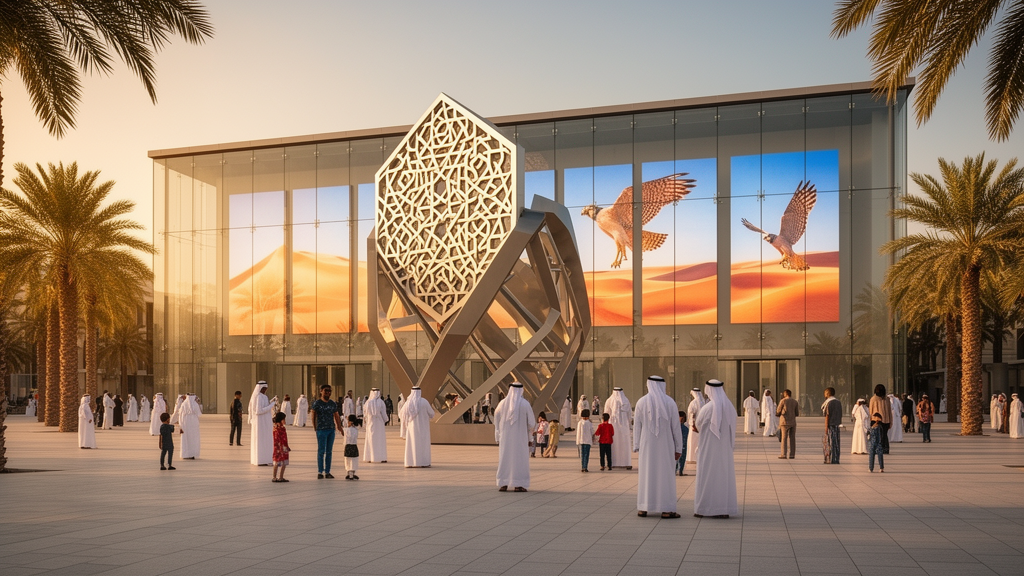
In the glittering skylines of Abu Dhabi and Dubai, where glass towers rise faster than almost anywhere else on Earth, a quiet battle is underway for the soul of the city. A new study from the United Arab Emirates University, published in Frontiers in Sustainable Cities, offers one of the most detailed quantitative portraits yet of how residents of a rapidly urbanizing nation hold on to their cultural identity—and the answer, surprisingly, may be painted on walls, carved into street furniture, and shared on smartphones.
The research team, led by geographer Khaula Alkaabi, surveyed 543 UAE residents about how public art, culturally responsive urban design, and digital public art platforms shape their sense of national identity. The sample skewed dramatically young: 72 percent of respondents were under 35, with nearly 70 percent aged between 18 and 24. That demographic focus was deliberate. Young people are the group most exposed to globalizing influences—streaming media, English-language signage, hybrid cultural identities—and therefore the group whose attachment to local heritage is most at risk, and most telling to measure.
The survey instrument was unusually rigorous for a social science study of this kind. It contained 87 items measuring eight separate constructs, from perceptions of public art types such as murals and Arabic calligraphy to evaluations of specific urban design elements like walkability, plazas, and heritage signage. Reliability was strong across the board, with Cronbach’s alpha values ranging from 0.810 to 0.939, and the Kaiser-Meyer-Olkin measure of sampling adequacy reached 0.963, an exceptionally high score indicating the data were well suited to factor analysis. Bartlett’s test of sphericity confirmed the correlations among items were far from random.
The statistical centerpiece was Structural Equation Modeling, a technique that allows researchers to test whether latent, unobservable concepts—like national identity—are genuinely predicted by measurable factors. Here the answer was emphatic. All three core constructs significantly predicted younger generations’ national identity: urban design showed the strongest effect with a standardized path coefficient of 0.40, followed by public art at 0.35, and identity-preservation strategies at 0.19, all significant at the p < 0.001 level. The model’s fit indices, including a comparative fit index of 0.924 and a root mean square error of approximation of 0.065, fell squarely within accepted thresholds.
The headline numbers are striking. Eighty-one percent of respondents agreed that public art enhances their sense of pride, while 65 percent valued digital public art platforms as tools for promoting Emirati culture. When asked which visual motifs anchored their identity, respondents pointed overwhelmingly to Arabic calligraphy, cited by 68 percent, and natural motifs drawn from the desert and coastal environment, cited by 74 percent. These are not abstract preferences; they map directly onto artworks visible across the UAE, from murals depicting pearl diving and traditional childhood games to heritage-inspired sculptures embedded in streetscapes and cultural districts.
What makes the study conceptually interesting is its framing of these three elements as an integrated ecosystem rather than separate interventions. Public art acts as the primary visual medium, communicating collective memory through images residents encounter on their daily routes. Urban design provides the physical stage—the walkable neighborhoods, public plazas, and wayfinding systems that determine whether people linger and interact with cultural narratives or hurry past them. Digital public art platforms, encompassing mobile apps, virtual exhibitions, and social media, extend the encounter beyond physical space, allowing cultural engagement to continue on the screens where young Emiratis already spend much of their lives.
The demographic analysis added nuance. Mann-Whitney U tests revealed a significant gender difference in perceptions of public art types, with female respondents rating them more favorably, but no such difference for urban design elements or digital platforms. Kruskal-Wallis tests showed that perceptions of specific urban design features and digital engagement varied significantly across the seven emirates, while views on public art itself were remarkably consistent nationwide. The authors caution that the sample was concentrated in Abu Dhabi, home to 58.6 percent of respondents and to heavy cultural investments such as the Louvre Abu Dhabi and the Saadiyat Cultural District, so national generalizations require care.
Respondents also voiced a clear anxiety about globalization. A one-sample Wilcoxon Signed-Rank test on globalization’s influence on national identity was highly significant, reflecting widespread concern that international cultural currents—language dominance, homogenized aesthetics, media saturation—may erode local traditions, particularly among the young. Yet the same respondents expressed confidence that embedding public art within culturally responsive urban design can counteract those pressures. In the theoretical language of the paper, the findings support a Global Citizenship framework in which engagement with the world enriches rather than dissolves heritage, echoing the UAE’s own policy posture of openness paired with cultural preservation.
The study did not support every hypothesis it tested. Hypotheses linking public art to community pride, urban design to identity, and planners’ heritage integration to identity preservation were all confirmed, but the demographic analysis produced mixed results, with some groups differing significantly in how art and design shaped their national identity and others not. The authors argue this variability itself is informative, suggesting that inclusive planning must account for gender and geography when deciding what gets built where—and that public art should function as public pedagogy, an informal classroom for history and values embedded in everyday space.
The practical implications reach well beyond the Gulf. Rapidly urbanizing cities worldwide face the same tension between modernization and memory, and the UAE’s data suggest a replicable formula: pair physical heritage elements with digital amplification, prioritize the urban design features—walkability, plazas, native landscaping—that create the conditions for cultural encounter, and treat public art not as decoration but as infrastructure for belonging. The authors call for expanding public art initiatives that reflect Emirati culture, deepening digital platform offerings, and integrating public art into educational programs. In a nation where more than 200 nationalities share the streets, the finding that murals and calligraphy can unite such a diverse population in shared pride is, by any measure, a result worth taking seriously.
Subject of Research: The role of public art, urban design, and digital platforms in preserving cultural and national identity in the rapidly urbanizing United Arab Emirates
Article Title: Cultural identity in rapidly urbanizing cities: the role of public art, urban design, and digital engagement
Article References: Alkaabi, K., Hussein, F., Senghore, S., Agiel, N., & Aljaberi, S. (2026). Cultural identity in rapidly urbanizing cities: the role of public art, urban design, and digital engagement. Frontiers in Sustainable Cities, 8, Article 1902431. https://doi.org/10.3389/frsc.2026.1902431
Image Credits: AI Generated
DOI: 10.3389/frsc.2026.1902431
Keywords: public art, urban design, cultural identity, national identity, digital engagement, UAE, structural equation modeling, Arabic calligraphy, globalization, youth, heritage preservation, sustainable cities
Cite Scienmag News
Courtney Benton. (October 15, 2026). Public Art and Digital Platforms Help safeguard Emirati Identity, Survey of 543 Residents Finds. Scienmag. https://scienmag.com/public-art-and-digital-platforms-help-safeguard-emirati-identity-survey-of-543-residents-finds/
Courtney Benton. "Public Art and Digital Platforms Help safeguard Emirati Identity, Survey of 543 Residents Finds." Scienmag, 15 October 2026, https://scienmag.com/public-art-and-digital-platforms-help-safeguard-emirati-identity-survey-of-543-residents-finds/. Accessed 15 October 2026.
Courtney Benton. "Public Art and Digital Platforms Help safeguard Emirati Identity, Survey of 543 Residents Finds." Scienmag. October 15, 2026. https://scienmag.com/public-art-and-digital-platforms-help-safeguard-emirati-identity-survey-of-543-residents-finds/


