


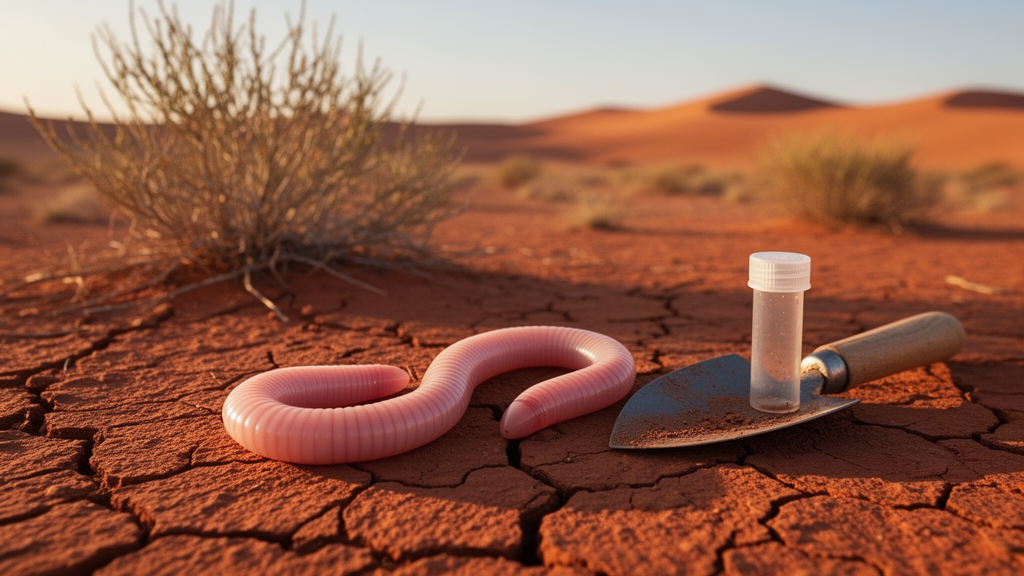
Deep in the arid foothills of the Tianshan mountains, where glacial meltwater feeds scattered oasis farmland hundreds of kilometres from the nearest humid forest, an unassuming soil dweller has rewritten the map of one of Asia’s most widespread earthworm families. Researchers surveying sites in China’s far northwest have described a brand-new species of the genus Drawida, a group of relatively primitive earthworms whose known range had never before stretched so deep into the dry interior of the continent. The find, published in the journal Subterranean Biology, extends the western boundary of the family Moniligastridae in East Asia and adds a striking chapter to the growing story of hidden biodiversity in some of the planet’s most heavily ploughed landscapes.
The new species, named Drawida xinjiangensis in honour of the Xinjiang Uygur Autonomous Region where it was first collected, belongs to the notoriously difficult Drawida japonica species complex. Members of this complex look so similar externally that for decades they were lumped together under a single name, Drawida japonica, recorded everywhere from Japan and Korea to central China. Modern genetic tools, however, have revealed that what once seemed like one cosmopolitan worm is actually a tight cluster of separate species, each shaped by its own evolutionary history. With the addition of D. xinjiangensis, the complex now contains six formally recognised species, and researchers suspect several more historical names may eventually be folded into the group.
Earthworms are often described as ecosystem engineers, organisms whose burrowing, feeding and casting fundamentally restructure the soil around them. Yet their global distribution remains surprisingly poorly charted, especially in western China and high-altitude regions such as the Qinghai-Tibet Plateau. China spans climatic zones from cold temperate to tropical, with topography ranging from eastern coastal plains to western plateaus and mountains, and that variety of soils and vegetation could harbour far more earthworm diversity than current checklists suggest. A 2006 checklist had reported Drawida japonica from Xinjiang, and a 2011 record placed the family in Ürümqi Prefecture, then the westernmost confirmed point for Chinese moniligastrids. But without precise locality data, and given what is now known about the D. japonica species complex, the true identity of those historical records remained an open question.
The team behind the new description solved that problem by combining classic anatomy with a battery of molecular techniques. Specimens were gathered by hand-sorting and digging at four localities across Xinjiang, Ningxia and Gansu provinces, immediately fixed in 95 percent ethanol, and archived at the Hebei Key Laboratory of Animal Diversity at Langfang Normal University. Under a stereomicroscope, researchers measured bodies to the nearest tenth of a millimetre and meticulously dissected internal structures, including gizzards, testis sacs, spermathecae and prostate glands, sketching each for comparison against every other member of the species complex.
That anatomical detective work turned up a distinctive set of traits. The new species ranges from 33 to 70 millimetres long with a body 3.5 to 5.0 millimetres wide, and its clitellum, the swollen reproductive band familiar to gardeners, sits in segments X to XIII and stands out for its unusual colour scheme: white on both sides with a dark brown middle. Internally, D. xinjiangensis carries two or three round, muscular, shining gizzards, a single pair of large testis sacs suspended on the septum between segments 9/10 or 10/11, and cylindrical white prostate glands nearly as long as, or longer than, the testis sacs themselves. That prostate-to-testis-sac volume ratio of roughly one to one proved a key diagnostic; the comparable ratios in its closest relatives range from one to two up to one to four. The species also differs from its congeners in body colour, the shape of the spermathecal atrium, and the form of its slender, loosely coiled vas deferens.
Morphology alone, however, is treacherous ground in this group, so the researchers turned to DNA. They sequenced four genetic markers: the mitochondrial barcode gene COI, the nuclear 28S ribosomal RNA gene, and two nuclear protein-coding loci, AKAP17 and FLAD1. On top of that, they assembled complete mitochondrial genomes for several specimens using high-throughput sequencing. The resulting COI genetic distances were unambiguous: D. xinjiangensis differs from every other member of the species complex by 17.1 to 21.2 percent under the standard Kimura two-parameter model, comfortably above the roughly 15 percent inter-specific threshold routinely applied in earthworm taxonomy. Within the new species itself, variation ranged from zero to just 0.6 percent.
Species delimitation analyses reinforced the verdict from three independent directions. The Assemble Species by Automatic Partitioning method and the Generalised Mixed Yule Coalescent method, both applied to single-locus data, and the Bayesian Phylogenetics and Phylogeography method, applied to the full four-gene dataset under the multispecies coalescent, all recovered the new species as a distinct evolutionary unit. Single-locus analyses of the nuclear 28S gene aligned perfectly with the morphological species boundaries, while COI-based analyses proved slightly messier, splitting some named species into additional units, a reminder that mitochondrial barcodes can overshoot when applied alone. The mitogenome of the new species, roughly 15,500 base pairs long, contained the canonical set of 37 genes, plus a roughly 873-base-pair putative control region that is typically absent in previously sequenced relatives. The authors prudently flag that assembling such AT-rich repetitive regions from short-read data is error-prone, and label the region provisional until confirmed by long-read sequencing, though the 13 protein-coding genes used in their phylogenies were complete and unaffected.
The phylogenetic picture is itself a lesson in how species boundaries and species trees can disagree. Mitochondrial genome analysis placed the new species as sister to D. henanensis, but with weak statistical support, a bootstrap value of just 38 percent. The nuclear 28S tree, by contrast, recovered D. xinjiangensis as a clean, independent monophyletic lineage, clearly separated from all other members of the complex. This kind of mito-nuclear discordance is increasingly documented in earthworms and can arise from mitochondrial introgression after historical hybridisation, incomplete lineage sorting of ancestral genetic variation, or simply limited phylogenetic signal in mitochondrial DNA. The combination of a well-supported independent lineage in the nuclear tree and stable morphological differences convinced the team that the species stands on its own, though they note that future whole-genome or reduced-representation datasets, such as ultraconserved elements or anchored hybrid enrichment, will be needed to fully untangle the family tree of the complex.
Perhaps the most intriguing question is how a moisture-loving earthworm lineage came to inhabit some of the driest ground in East Asia. All five known localities, from Shuanghe City in the northern Tianshan foothills to sites in Ningxia and Gansu, share a common feature: locally humid microhabitats maintained either by natural water sources or by human intervention. The type locality is a typical oasis fed by glacial meltwater from the Bortala and Jinghe rivers, supplemented by urban water systems, while the Alataw Pass, a natural corridor linking China to Central Asia, supports humid riparian habitats that could theoretically serve as a dispersal route toward Kazakhstan. But the authors also raise a caution that adds a layer of ecological suspense: every known site is anthropogenically modified farmland or urban green space, and earthworms are notorious hitchhikers in agricultural soil and plant material. Whether D. xinjiangensis is a native desert-edge specialist or a species ferried westward by human hands cannot yet be determined, and future population genomic work in natural habitats near the collection sites is planned to settle the question.
What is certain is that the discovery stretches the map. With this species, the family Moniligastridae, comprising 193 species in five genera, of which the genus Drawida alone accounts for 162, is now known from most regions of China except the Qinghai-Tibet Plateau, and its western frontier in East Asia now lies deep within arid and semi-arid territory roughly 420 kilometres beyond the previous westernmost record near Ürümqi. The finding is a vivid illustration of why integrative taxonomy, the practice of pairing careful morphology with multiple lines of molecular evidence, has become indispensable for cataloguing life on Earth: a worm that could have been dismissed as a familiar species on sight turns out to be a lineage new to science, quietly engineering the soil of oases at the edge of a desert. It is also a warning that even the most human-altered landscapes, irrigated fields and roadside plantings in one of the driest corners of a continent, can still conceal species we have never named, and that surveys of the world’s under-studied interiors are likely to keep surprising us.
Subject of Research: Integrative taxonomy and molecular phylogenetics of a new earthworm species of the genus Drawida from arid northwestern China
Article Title: Extension of west boundary of Moniligastridae ( Oligochaeta ) in East Asia: Integrative taxonomy discloses a new species of the genus Drawida Michaelsen, 1900 from Northwest China
Article References: Qiao, S., Zhang, Y., & Zhao, H. (2026). Extension of west boundary of Moniligastridae (Oligochaeta) in East Asia: Integrative taxonomy discloses a new species of the genus Drawida Michaelsen, 1900 from Northwest China. Subterranean Biology, 57, 221-240. https://doi.org/10.3897/subtbiol.57.196126
Image Credits: AI Generated
DOI: 10.3897/subtbiol.57.196126
Keywords: earthworms, Drawida xinjiangensis, Moniligastridae, integrative taxonomy, species delimitation, mitogenomics, Xinjiang, COI barcoding, phylogenetics, biodiversity, species complex, soil fauna
Cite Scienmag News
Margaret Porter. (October 15, 2026). New Earthworm Species From China’s Deserts Pushes an Ancient Worm Family Farther West Than Ever Recorded. Scienmag. https://scienmag.com/new-earthworm-species-from-chinas-deserts-pushes-an-ancient-worm-family-farther-west-than-ever-recorded/
Margaret Porter. "New Earthworm Species From China’s Deserts Pushes an Ancient Worm Family Farther West Than Ever Recorded." Scienmag, 15 October 2026, https://scienmag.com/new-earthworm-species-from-chinas-deserts-pushes-an-ancient-worm-family-farther-west-than-ever-recorded/. Accessed 15 October 2026.
Margaret Porter. "New Earthworm Species From China’s Deserts Pushes an Ancient Worm Family Farther West Than Ever Recorded." Scienmag. October 15, 2026. https://scienmag.com/new-earthworm-species-from-chinas-deserts-pushes-an-ancient-worm-family-farther-west-than-ever-recorded/


