


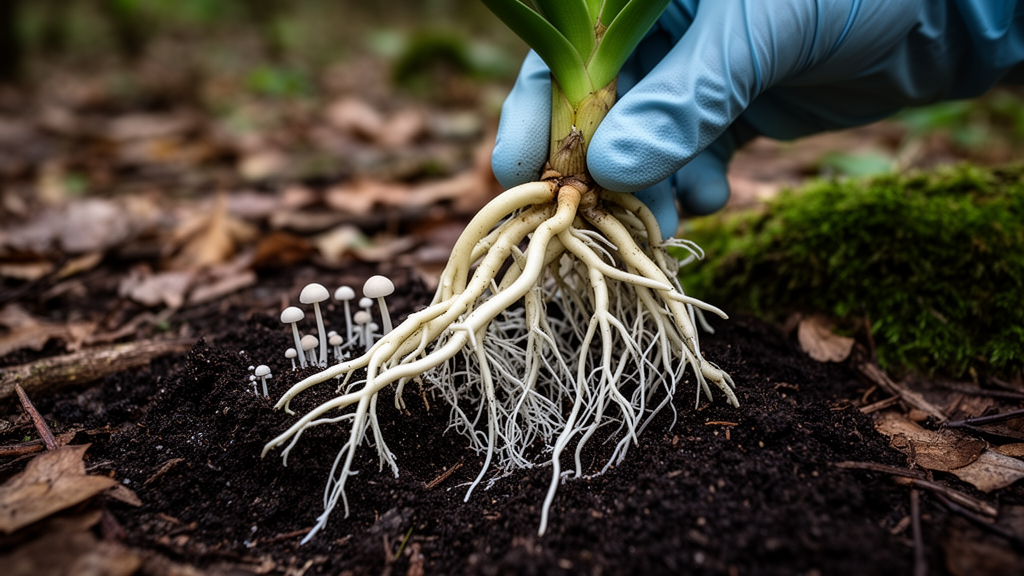
Deep in the soils of Kochi Prefecture, Japan, growing quietly in the roots of a small terrestrial orchid, lived a fungus that nobody could name. For more than a decade it appeared in DNA surveys as an anonymous line on a phylogenetic tree, a so-called dark taxon: something alive, widespread, and demonstrably distinct, but without a physical specimen to give it a formal place in the catalogue of life. Now, after successfully coaxing the organism into pure culture, a team of Japanese mycologists has finally given it a name and, remarkably, an entire new order of Basidiomycota. The lineage has been formally described as Reflexicalyptrales in the journal IMA Fungus, and it represents one of the rare instances in which a higher-level fungal lineage has been erected entirely from material cultured out of orchid mycorrhizae.
The story began in 2013, when researchers collecting whole plants of Nervilia nipponica, a partially mycoheterotrophic orchid distributed in Japan and Korea, noticed that its root cells were stuffed with fungal coils known as pelotons. Orchids famously depend on fungi to germinate, and many trade carbon with their partners, but the DNA extracted from these particular pelotons refused to match anything known. The researchers tentatively labeled the fungus “unidentified Agaricomycetes X,” or uAX, and distinguished four internal transcribed spacer sequence variants, types I through IV. Early multigene analyses showed only that the organism sat somewhere near several poorly resolved branches at the base of Agaricomycetes, the enormous class that contains most familiar mushrooms, brackets, and puffballs.
The breakthrough came from patience at the culture bench. The team sampled three orchid individuals, sliced their underground parts into longitudinal sections, and plated them on dilute nutrient medium at refrigerator temperatures. Only material from the base of a single inflorescence yielded viable hyphae, but from that tissue two pure culture strains were established, now deposited in Japan’s National Agriculture and Food Research Organization gene bank as MAFF425704 and MAFF425705. Sequencing of the ribosomal internal transcribed spacer and 28S genes confirmed that both isolates matched uAX type I with complete identity, finally giving the mystery lineage a living, growable representative that could be interrogated with every tool in the mycological arsenal.
With living material in hand, the researchers deployed transmission electron microscopy, the technique that has historically underpinned classification in Basidiomycota. Basidiomycete hyphae are separated by a distinctive structure called a dolipore septum, a barrel-shaped swelling around a central pore that is often surmounted by a cap. The architecture of this septal pore cap, whether it is continuous, perforated by openings, or absent altogether, has long served as a fingerprint for distinguishing major lineages. What the electron microscope revealed in Reflexicalyptra was unlike anything previously documented: a multi-pored, perforate cap whose outer margins bend outward, or reflex, away from the septum itself. Perforated caps are known from only a handful of Agaricomycetes orders, and imperforate caps characterize its closest relatives, but this reflexed configuration had never been reported anywhere in the phylum. The perforations themselves, roughly 300 nanometers across, are unusually large, and the cap is built from three layers: two electron-dense outer lines enclosing a less dense inner band. The researchers even reconstructed the cap in three dimensions from serial sections, sculpting a physical model from paper clay to visualize its geometry.
Molecular evidence reinforced what the ultrastructure suggested. The team assembled a four-locus dataset combining nuclear 5.8S and 28S ribosomal DNA with two protein-coding genes, translation elongation factor 1-alpha and the second largest subunit of RNA polymerase II, sampling representatives of every recognized Basidiomycota order. Maximum likelihood and Bayesian analyses agreed on the central conclusion: uAX forms a strongly supported, monophyletic clade that diverges early within Agaricomycetes and belongs to no existing order. Its closest relative is Tremellodendropsidales, an enigmatic clade of coral-like fungi, and together these two groups sit sister to Trechisporales and Sistotremastrales. The magnitude of the divergence is striking. While the four uAX types share 89 to 96 percent ITS sequence similarity with one another, similarity between uAX and Tremellodendropsidales falls to a mere 63 to 76 percent, far below the 80 percent threshold conventionally used to separate fungal orders.
Perhaps the most surprising dimension of the discovery came from database mining. When the team searched public sequence repositories for matches to the uAX ITS barcodes, they found the lineage was not a Japanese rarity at all. Closely related environmental sequences, recovered from soils, leaf litter, and living roots, had been archived from sites across Europe, Africa, Central America, Estonia, and South Africa, spanning temperate and tropical biomes. Type I sequences clustered mainly in forest soils and were also detected on maize roots and the roots of a tropical tree, while type IV matched material from oak and rockrose ectomycorrhizae as well as orchid roots. This pattern suggests the group is ubiquitously distributed worldwide and probably lives primarily as a saprotroph, decomposing organic matter in soil, rather than as an obligate mycorrhizal symbiont. Its association with Nervilia nipponica may be one opportunistic interaction among many, which raises a tantalizing question: if a distinct fungal order sits in common soils across the globe, why did it take an orchid in Japan to reveal it?
The answer, the authors argue, lies in the enduring gap between sequencing and taxonomy. High-throughput environmental sequencing routinely surfaces dozens of novel lineages, and one global soil study uncovered more than 40 potential new groups at or above the order level. But the International Code of Nomenclature for algae, fungi, and plants demands physical specimens from which morphological characters can be discerned before a new taxon can be formally published. Without cultures, these dark taxa remain nameless. Reflexicalyptrales breaks that pattern because the researchers secured the two things so many lineages lack: living isolates and fixed, cryopreserved type material. That combination allowed morphology, physiology, and phylogeny to be documented together, satisfying the formal requirements for naming an order, family, genus, and species in a single paper.
The cultures also yielded physiological and behavioral quirks that flesh out the portrait of this new lineage. Both strains grew best at 25 degrees Celsius, tolerated a range from 10 to 30 degrees, and stopped growing altogether at 5 and 35 degrees, a profile consistent with the temperate-to-tropical distribution inferred from environmental sequences. The hyphae are mostly binucleate, lack clamp connections, and measure just 1.5 to 4 micrometers in diameter. Attempts to induce mushroom-like fruiting bodies failed, but the fungus instead produced more than fifty sclerotia-like structures per dish on sawdust media, hard brown lumps coated in flower-like druse crystals. Given that analogous structures in other fungi, from the wood-rotting Trichaptum abietinum to the plant pathogen Sclerotinia sclerotiorum, are composed of calcium oxalate, the authors suspect Reflexicalyptra secretes similar crystals, although any ecological advantage remains unknown.
The formal taxonomy introduced in the paper is substantial. The order Reflexicalyptrales contains the family Reflexicalyptraceae and the genus Reflexicalyptra, whose name fuses the Latin for reflexed with calyptra, or cap, a direct nod to the ultrastructure that sets the lineage apart. The type species, Reflexicalyptra japonica, honors its Japanese origin and is anchored by a holotype culture cryopreserved in a metabolically inactive state. Because physical specimens are still lacking for types II through IV, the genus is conservatively defined to embrace all four clades, though the ITS phylogeny hints that the lineage may prove species-rich as more material is collected. For now, the discovery stands as both a milestone and a reminder: even well-studied soils beneath familiar forests can conceal whole branches of the fungal tree of life, waiting for someone to culture them, section them, and finally look closely enough to see what the DNA has been saying all along.
Subject of Research: Discovery and taxonomic description of a new Basidiomycota fungal order from orchid mycorrhizae
Article Title: Reflexicalyptrales ordo nov., a distinct Agaricomycetes lineage discovered from orchid mycorrhizae
Article References: Kinoshita, A., Fujimori, S., Seto, K., Ogura-Tsujita, Y., Maeda, A., Gale, S. W., Abe, J. P., Degawa, Y., & Yukawa, T. (2026). Reflexicalyptrales ordo nov., a distinct Agaricomycetes lineage discovered from orchid mycorrhizae. IMA Fungus, 17, Article e201939. https://doi.org/10.3897/imafungus.17.201939
Image Credits: AI Generated
DOI: 10.3897/imafungus.17.201939
Keywords: mycology, fungi, Reflexicalyptrales, orchid mycorrhiza, dark taxa, Basidiomycota, phylogenetics, transmission electron microscopy, septal pore cap, Nervilia nipponica, fungal taxonomy, environmental DNA
Cite Scienmag News
Roger Howard. (October 15, 2026). Hidden in an orchid’s roots, scientists uncover an entirely new order of fungi. Scienmag. https://scienmag.com/hidden-in-an-orchids-roots-scientists-uncover-an-entirely-new-order-of-fungi/
Roger Howard. "Hidden in an orchid’s roots, scientists uncover an entirely new order of fungi." Scienmag, 15 October 2026, https://scienmag.com/hidden-in-an-orchids-roots-scientists-uncover-an-entirely-new-order-of-fungi/. Accessed 15 October 2026.
Roger Howard. "Hidden in an orchid’s roots, scientists uncover an entirely new order of fungi." Scienmag. October 15, 2026. https://scienmag.com/hidden-in-an-orchids-roots-scientists-uncover-an-entirely-new-order-of-fungi/


