


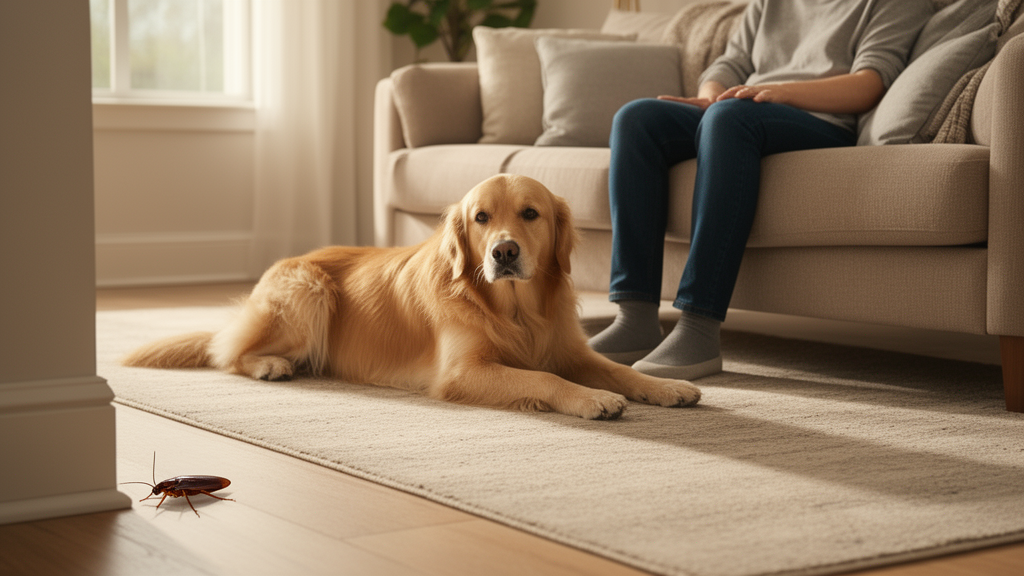
In a finding that turns the family home into a living allergy laboratory, researchers in Taiwan have shown that dogs and their owners, despite breathing the same air and sleeping under the same roof, mount strikingly different immune responses to the same cockroach allergens. The study, published in Frontiers in Allergy, recruited 68 owner-dog pairs sharing a household and compared the precise molecular targets of their allergy antibodies, revealing a hidden divergence in how two species exposed to identical indoor conditions read the allergen landscape around them.
The research team, led by Mey-Fann Lee of Taichung Veterans General Hospital and Nancy M. Wang of National Changhua University of Education, framed the work within the One Health perspective, which holds that human, animal, and environmental health are inseparably linked. Cockroaches, and particularly the American cockroach Periplaneta americana, are among the most important triggers of allergic rhinitis, asthma, and atopic dermatitis in people. Component-resolved diagnostics have identified ten major allergenic molecules from this insect, labeled Per a 1 through Per a 10, allowing clinicians to map exactly which proteins a patient’s immune system recognizes. What has remained almost entirely unknown is whether cohabiting dogs, which suffer from their own naturally occurring allergic disease resembling human atopic dermatitis, recognize the same molecules.
To find out, the team enrolled participants from the outpatient lobby of Taichung Veterans General Hospital between September 2024 and July 2025. Each participant owned at least one dog living in the same household. Owners completed a structured questionnaire covering demographics, allergic history, and observed cockroach activity, with special attention paid to environmental interfaces where dogs and cockroaches might intersect, such as kitchens, feeding bowls, and pet sleeping quarters. Blood was then drawn from both members of each dyad, and serum was tested for immunoglobulin E, the antibody class that drives allergic reactions, against crude American cockroach extract using immunoblotting, a technique that separates proteins by size and reveals which ones antibodies bind.
The household data alone painted a telling picture. More than half of the dyads, 52.9 percent, had concurrent allergic conditions in both the owner and the dog, while only 4.4 percent of households reported no allergic symptoms in either species. Cockroach activity was most frequently reported in kitchens at 61.4 percent, followed by living rooms, bedrooms, and bathrooms. Crucially, owners also reported cockroach activity near dog feeding bowls in 10 percent of homes and near dog sleeping areas in 4.3 percent, identifying specific pathways through which pets encounter allergens. Nearly a third of owners, 31.9 percent, had actually observed their dogs catching cockroaches, and 8.6 percent noticed more cockroach sightings after acquiring a dog, possibly because pet food residues provide additional resources for the insects.
The molecular comparison produced the study’s most surprising results. Both species recognized four allergens in common: Per a 1, Per a 3, Per a 4, and Per a 9. But the frequencies diverged dramatically. Dogs showed IgE recognition of Per a 4, a lipocalin-like protein, in 69 percent of cases, compared with only 18 percent of owners, and recognized Per a 9, an arginine kinase, in 40 percent of cases versus 9 percent of owners. Dogs also recognized Per a 1 more often, at 63 percent versus 34 percent. Humans, by contrast, more frequently recognized Per a 3, tied with Per a 1 at 34 percent, and Per a 7 at 26 percent, a protein dogs largely ignored. Neither species showed meaningful reactivity to Per a 5 or Per a 6.
Why would two species sharing the same allergen source develop such different antibody repertoires? The researchers propose that behavior and biology combine to shape recognition. Humans primarily encounter indoor aeroallergens through inhalation, drawing cockroach proteins into the respiratory tract. Dogs, however, spend prolonged periods in intimate contact with floor surfaces through walking, lying, sniffing, licking, and grooming, bringing their skin and oral mucosa into constant contact with household dust that may carry cockroach allergens. Experimental work has shown that allergen exposure through the skin can induce allergen-specific IgE responses, particularly when the epithelial barrier is compromised, and canine atopic dermatitis is characterized by precisely such barrier defects, including altered lipid composition and increased water loss through the skin.
The authors also found a suggestive environmental link: dogs from households reporting cockroach activity near feeding bowls showed higher frequencies of IgE recognition of Per a 4 and Per a 9, the very allergens dogs most often targeted. This supports the idea that dogs’ distinctive recognition patterns may partly reflect their distinct exposure routes rather than fundamentally different allergen sources. Still, the team is careful to frame these mechanisms as hypotheses. The study did not directly measure exposure routes, barrier function, or antigen presentation, and environmental allergen concentrations could not be reliably quantified because owner-collected dust samples proved too variable for dependable analysis.
These limitations matter, and the researchers are candid about them. The volume of serum that could ethically be collected from pet dogs was limited, so the analysis prioritized qualitative immunoblotting over quantitative measurement of canine allergen-specific IgE. Inhibition assays that would confirm binding specificity were not feasible. The nine allergens tested also represent only a subset of the 23 American cockroach allergens currently registered in the WHO/IUIS Allergen Nomenclature Database. Even so, the comparative conclusion stands: shared exposure does not produce identical recognition profiles, and species-specific factors clearly shape which allergen molecules each host targets.
Beyond its immunological insights, the work carries practical implications. Because dogs spend so much time in contact with floors, dust, and the hidden corners of the household, the authors suggest they may act as biological sentinels of indoor allergen exposure, with shifts in their IgE profiles potentially signaling changes in household allergen burden before humans notice symptoms. The findings also argue for pest management that goes beyond human-centric spaces: cleaning feeding stations and pet sleeping areas, the study suggests, could reduce the allergen load affecting the entire household dyad, protecting both canine and human health simultaneously.
Ultimately, the study opens a genuine translational frontier. Paired human-dog investigations offer a natural experiment in which exposure is held roughly constant while host biology varies, allowing researchers to disentangle the effects of behavior, barrier function, and immune processing from the environment itself. If future longitudinal studies with standardized dust sampling and quantitative assays bear out these initial findings, the humble household dog may become an unexpected ally in understanding, and preventing, the environmental allergies that plague millions of people and their pets alike.
Subject of Research: Comparative IgE recognition of American cockroach allergens in cohabiting human-dog pairs
Article Title: Species-specific IgE recognition of cockroach allergens in human–dog dyads sharing the same household
Article References: Lee, M.-F., Hsu, J. L., Lin, C.-C., Chu, Y.-W., & Wang, N. M. (2026). Species-specific IgE recognition of cockroach allergens in human–dog dyads sharing the same household. Frontiers in Allergy, 7, Article 1932833. https://doi.org/10.3389/falgy.2026.1932833
Image Credits: AI Generated
DOI: 10.3389/falgy.2026.1932833
Keywords: cockroach allergens, Periplaneta americana, IgE, One Health, human-dog dyads, atopic dermatitis, immunoblotting, allergen recognition, household exposure, comparative allergy, Per a 4, Per a 9
Cite Scienmag News
Kristina Jarvis. (October 15, 2026). Dogs and owners in the same home recognize cockroach allergens differently. Scienmag. https://scienmag.com/dogs-and-owners-in-the-same-home-recognize-cockroach-allergens-differently/
Kristina Jarvis. "Dogs and owners in the same home recognize cockroach allergens differently." Scienmag, 15 October 2026, https://scienmag.com/dogs-and-owners-in-the-same-home-recognize-cockroach-allergens-differently/. Accessed 15 October 2026.
Kristina Jarvis. "Dogs and owners in the same home recognize cockroach allergens differently." Scienmag. October 15, 2026. https://scienmag.com/dogs-and-owners-in-the-same-home-recognize-cockroach-allergens-differently/


