


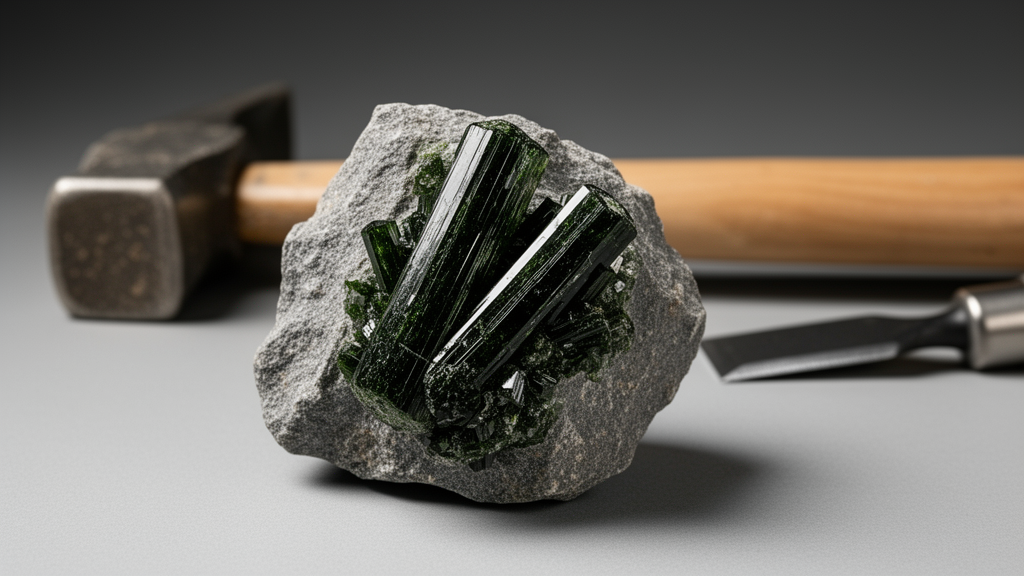
Deep in the southern Abukuma Mountains of Northeast Japan, an unremarkable-looking outcrop of dark ultramafic rock has turned out to preserve a remarkable chemical memory. A team of Japanese geologists led by Akira Wakazono of Kanazawa University has shown that a poikilitic hornblende pyroxenite, hosted in the Nishidohira metamorphic rocks near the town of Hitachi, formed through the reaction of pre-existing ultramafic rock with an unusual, silica-rich magma known as an adakitic melt. The finding, published in Frontiers in Geochemistry, links this small body of amphibole-rich rock to one of the most consequential magmatic episodes in the geological history of the Japanese islands, driven by the subduction of a young, hot oceanic plate beneath Eurasia roughly 120 million years ago.
Poikilitic hornblende ultramafic rocks, classically called cortlandtites after their first description along the Hudson River in New York, are among the more enigmatic rock types found in orogenic belts. Their defining texture is unmistakable under the microscope: enormous grains of hornblende, a hydrous calcium-magnesium-iron amphibole, that completely enclose smaller, rounded crystals of olivine and pyroxene. The rounded phases represent earlier-formed crystals, while the giant amphibole grew late, wrapping around everything in its path. Such rocks are minor but recurring constituents of granitic and metamorphic terranes, of the deep crustal and upper mantle sections of supra-subduction ophiolites, and even of xenoliths brought up from beneath active volcanic arcs. Because amphibole can hold enormous quantities of water in its crystal structure, these rocks are direct archives of the volatiles that circulate through subduction zones and drive arc magmatism.
The Abukuma occurrence had been described petrographically in earlier decades, but its origin remained unresolved. What makes this locality special is context: the poikilitic hornblende pyroxenite sits in contact with regionally metamorphosed rocks of the Nishidohira unit, and nearby are amphibole-rich gabbros that appear to be genetically related to it. Together they offer a natural laboratory for studying how amphibole-bearing magmas differentiate from the upper mantle down into the lower crust. The research team collected samples well away from the contacts with the surrounding metamorphic rocks and from thin leucocratic veins that cut the body, minimizing any contamination from later fluids, and then subjected the rocks to an exhaustive campaign of X-ray element mapping, electron microprobe analysis, laser ablation trace element measurements, and uranium-lead dating of zircon.
The resulting mineral inventory is strikingly unusual for an ultramafic rock. Olivine makes up roughly five percent of the mode, pyroxenes about fifty percent, and amphibole about forty-five percent, with only trace amounts of biotite, orthopyroxene and ilmenite. Crucially, no plagioclase is present at all, a detail that would prove central to the interpretation. The amphibole grains display vivid color zoning under transmitted light, from dark brown-black cores through brown margins to pale green rims. The dark cores are titanium-rich pargasite containing 1.3 to 2.1 weight percent TiO2, and they are riddled with exsolution lamellae of ilmenite, evidence that the original crystals were even more titanium-rich before decompression forced the iron-titanium oxide out of solution. The green rims and vermicular intergrowths are far poorer in titanium and aluminum, and their chemistry points to crystallization from an evolved, water-rich residual melt or fluid rather than a primitive magma.
The textural relationships tell a sequential story. The rounded olivine grains, with forsterite contents of only 65 to 76 percent, are too iron-rich to represent residual mantle peridotite and instead point to a cumulate origin, crystals settled out of an earlier magma. High-aluminum clinopyroxene and the dark high-titanium pargasite are in chemical equilibrium and crystallized first from the infiltrating melt. Later, as the melt fractionated and released hydrous fluids, low-aluminum vermicular clinopyroxene and low-titanium amphibole replaced the earlier phases, and orthopyroxene formed by reaction of olivine with a silica-rich melt or fluid. The absence of europium and strontium anomalies in the early amphibole and clinopyroxene confirms that no plagioclase had crystallized before the amphibole, consistent with the total lack of plagioclase in the rock.
The analytical centerpiece of the study is the reconstruction of the melt from which the dark amphibole grew. Amphibole incorporates many trace elements in predictable proportions relative to the melt around it, so with experimentally calibrated partition coefficients, the researchers could invert the crystal chemistry to recover the liquid composition. Using empirical thermobarometric equations and the open-source Thermobar package, they estimated a melt containing roughly 59 to 67 weight percent silica, 17 to 18 percent alumina, and 2 to 4 percent magnesium oxide at around 1000 degrees Celsius. The calculated trace element signature shows high light rare earth element to heavy rare earth element ratios, a weak positive strontium anomaly, and pronounced depletions in high-field-strength elements such as niobium, zirconium and titanium. That combination is the fingerprint of an adakite.
Adakites are intermediate to felsic arc rocks, first defined in 1990, characterized by high strontium but low yttrium and heavy rare earth contents, and generally attributed to partial melting of young, hot subducted oceanic basalt under amphibole or eclogite facies conditions. Alternative pathways exist, including melting of thickened lower crust or extensive garnet and amphibole fractionation, but all require unusual pressure and temperature conditions in the sub-arc system. The melt inferred from the Abukuma amphibole matches adakitic compositions from the Japanese arc record almost exactly, and critically, the spatial and temporal context clinches the connection. Adakitic granites and high-magnesium andesites, dated at 128 to 113 million years, are already documented in the nearby Kitakami Mountains to the northeast, where isotopic modeling indicates derivation from partial melting of subducted basaltic crust with a sedimentary contribution.
Zircon crystals recovered from both the poikilitic hornblende pyroxenite and the associated hornblende gabbro yielded concordant uranium-lead ages of 117.5 plus or minus 0.4 and 116.3 plus or minus 0.5 million years respectively, with all grains showing thorium-uranium ratios above 0.1 that confirm a magmatic rather than metamorphic origin. These ages overlap with the Kitakami adakitic pulse and place the formation of the ultramafic body squarely within the Early Cretaceous. The Irishiken granodiorite that intrudes the region nearby, dated in this study at 105.9 plus or minus 0.6 million years, is younger and marks a later thermal event that previous work has linked to the rapid exhumation of the Nishidohira metamorphic rocks. Thermobarometry on the reconstructed dark amphibole composition, corrected for ilmenite exsolution, gives pressures of 0.4 to 0.7 gigapascals and temperatures of 870 to 940 degrees Celsius, conditions consistent with the amphibole stability field in a magnesian andesitic melt and with the partial resorption of olivine that its rounded shapes record.
The relationship between the two rock types at the locality resolves a broader petrological question. Experiments show that when hydrous basaltic melt reacts with peridotite, hornblende-rich ultramafic rocks form where the melt is scarce and reaction dominates, whereas hornblende gabbro crystallizes where melt is abundant. The Abukuma pair fits this model precisely: at low melt-to-rock ratios, adakitic liquid invading pre-existing ultramafic rock converted it to poikilitic hornblende pyroxenite, buffered to high magnesium numbers by the host; at high melt-to-rock ratios, the same liquid pooled and crystallized as hornblende gabbro, with early amphibole, titanite and apatite sequestering calcium and trace elements before plagioclase finally appeared. Similar relationships between dunitic xenoliths and adakite-related microgabbro in the Kitakami Mountains show the process operating on a regional scale.
Taken together, the evidence portrays the southern Abukuma Mountains as a preserved slice of a plumbing system that tapped slab-derived melts during an extraordinary episode of Early Cretaceous subduction. At that time, the eastern margin of the Eurasian Plate was consuming the Izanagi, or Kula, oceanic plate, and the widespread adakitic magmatism across both the Kitakami and Abukuma regions implies that a young, hot segment of that plate was melting as it descended. The poikilitic hornblende pyroxenite, with its giant amphibole crystals acting as chemical sponges for water and incompatible elements, is thus not a geological curiosity but a key witness to how slab melts transform the deep crust and mantle beneath volcanic arcs. For anyone seeking to understand how continents are built from the inside out, this modest Japanese outcrop now offers one of the clearest windows available into that hidden, melt-rock conversation.
Subject of Research: Petrogenesis of poikilitic hornblende pyroxenite formed by adakitic melt–ultramafic rock interaction in the Early Cretaceous Abukuma Mountains, Japan
Article Title: Poikilitic hornblende pyroxenite in the southern end of the Abukuma Mountains, Northeast Japan, as result of adakitic magmatism
Article References: Wakazono, A., Fukuyama, M., Itano, K., Harigane, Y., Tamura, A., & Morishita, T. (2025). Poikilitic hornblende pyroxenite in the southern end of the Abukuma Mountains, Northeast Japan, as result of adakitic magmatism. Frontiers in Geochemistry, 3, Article 1697337. https://doi.org/10.3389/fgeoc.2025.1697337
Image Credits: AI Generated
DOI: 10.3389/fgeoc.2025.1697337
Keywords: poikilitic hornblende pyroxenite, adakite, Abukuma Mountains, amphibole, U-Pb zircon dating, Early Cretaceous, subduction zone, Izanagi plate, ultramafic rocks, melt-rock interaction, Japan, arc magmatism
Cite Scienmag News
Violet Maxwell. (October 15, 2026). Giant Amphibole Crystals in Japan Record a 120-Million-Year-Old Slab-Melt Invasion. Scienmag. https://scienmag.com/giant-amphibole-crystals-in-japan-record-a-120-million-year-old-slab-melt-invasion/
Violet Maxwell. "Giant Amphibole Crystals in Japan Record a 120-Million-Year-Old Slab-Melt Invasion." Scienmag, 15 October 2026, https://scienmag.com/giant-amphibole-crystals-in-japan-record-a-120-million-year-old-slab-melt-invasion/. Accessed 15 October 2026.
Violet Maxwell. "Giant Amphibole Crystals in Japan Record a 120-Million-Year-Old Slab-Melt Invasion." Scienmag. October 15, 2026. https://scienmag.com/giant-amphibole-crystals-in-japan-record-a-120-million-year-old-slab-melt-invasion/


