


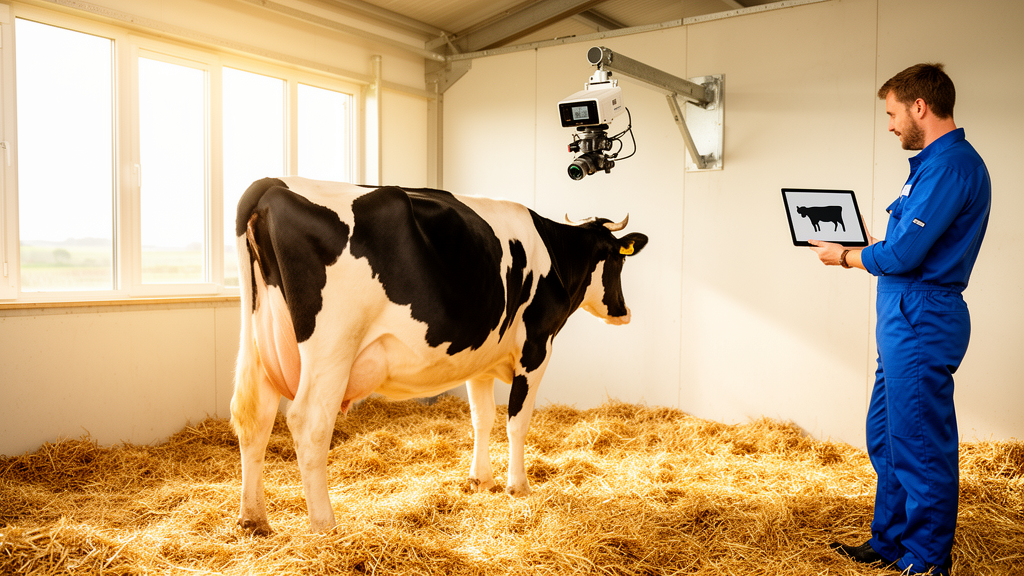
Every experienced cattle producer knows the ritual. An animal walks through the chute, and a trained eye sweeps across its ribs, backbone, hooks, pins and the fat pads around the tail-head to assign a body condition score, a number that quietly governs breeding decisions, nutritional management and the animal’s own welfare. The trouble is that this number lives in the eye of the beholder. Two seasoned evaluators can disagree, and even the same evaluator drifts over a long day of scoring. A new study from the University of Tennessee AgResearch system proposes a way to take some of that subjectivity out of the chute: a computer vision framework that reads the same anatomical landmarks a human expert does, but does so from video, feature by feature, and then explains exactly which cues drove its judgment.
The research, published in Smart Agricultural Technology, is notable less for a flashy classifier than for its insistence on anatomical honesty. Most prior automated body condition scoring systems have extracted features from whole-body silhouettes or concentrated on a single region such as the tail-head, an approach that risks discarding the spatial variation in fat deposition that experts implicitly weigh. The problem is especially acute for beef cattle. Nearly all previous automation work has targeted dairy cows, which are scored on a 1-to-5 scale tuned to milk production, whereas beef cattle use a broader 1-to-9 scale with different anatomical markers, fat deposition patterns and target ranges. A model trained on dairy animals cannot simply be transplanted; the biology of the score itself differs.
To build a beef-appropriate system, the team filmed 396 female beef cattle at three University of Tennessee research facilities: the Middle Tennessee, Highland Rim and Plateau AgResearch and Education Centers. A fixed dome camera mounted two meters above the chute recorded RGB video at 2592 by 1520 pixels and 30 frames per second as each animal passed. Forty animals were later dropped for inadequate image quality, leaving 356 animals whose body condition scores ranged from 4 to 9, assigned on site by two experienced evaluators working to a consensus after visual inspection and palpation of the backbone, ribs and tail-head fat. From the video, two camera views proved most informative: a rear view showing the hips, pins and rump fat, and a top view capturing the spine and back curvature.
The pipeline begins with detection. The researchers trained YOLOv8 and YOLOv11 object detectors on 11,820 annotated images to locate three regions of interest in every frame: the tail-head, the spine and the whole body. After 100 epochs of training, YOLOv8 edged out its successor with a precision of 0.79, recall of 0.81 and mean average precision of 0.82 at an intersection-over-union threshold of 0.5, and was retained for the rest of the work. Before any measurements were taken, the Segment Anything Model 2 was applied to segment the animal from the cluttered background of the chute, suppressing noise from infrastructure and handlers that could otherwise corrupt the geometric measurements downstream.
With clean regions in hand, the framework extracts four kinds of anatomical descriptors. The spine analysis asks a deceptively simple question: is a backbone ridge visible? Each cropped spine image is converted to grayscale, smoothed with a Gaussian filter, and segmented with a marker-controlled watershed algorithm that separates body from background. Transitions between foreground and background in each image row yield candidate seam points, and two criteria decide whether a ridge exists: the fraction of image rows supporting a seam, and the orientation deviation of a line fitted to those points. The result was biologically striking. Visible ridges appeared in 26.8 percent of BCS 4 animals and a mere 2.3 percent of BCS 5 animals, and in no animal with a score of 6 or above, a significant association confirmed by chi-square testing. The detection rate is modest by design; a ridge acts as a red-flag cue that the animal is almost certainly lean rather than as a standalone classifier.
The tail-head region, where fat pads called fat pone accumulate as cattle gain condition, yielded two features. First, the researchers estimated a tail-head angle by feeding RGB frames through Depth Anything V2, a monocular depth estimation model that infers relative depth from ordinary images. Depth clustering with k-means isolates the dorsal surface, morphological filtering cleans the mask, and the topmost body pixels in each column trace a dorsal ridge that is smoothed with a spline. Three landmarks, a peak flanked by two points at the midpoints on either side, define an interior angle via vector geometry. Under the final parameter configuration, the mean angle climbed steadily with condition, from 123.55 degrees at BCS 4 to 151.00 degrees at BCS 9, reflecting the broader, flatter dorsal profile of well-fed animals. A sensitivity analysis across nine parameter conditions confirmed the trend was robust, with Spearman correlations between angle and score ranging from 0.312 to 0.507, all significant. Second, fat pone were counted using a pencil-sketch enhancement that exaggerates raised textures, followed by thresholding and contour detection. Only large, angled, pone-like ellipses qualified; the mean count rose from 0.56 at BCS 4 to 4.50 at BCS 9, and the share of animals with at least one detected pone jumped from roughly one-third at lower scores to 71 percent at BCS 8 and 100 percent at BCS 9.
The third feature family captures global conformation. Depth-based iso-contours slice the animal’s dorsal surface into five nested arcs, each of which is summarized by roundness descriptors computed from area and perimeter. Lean cattle displayed narrower arcs with sharper curvature near the spine, while over-conditioned animals showed broader, smoother, more circular outlines. Roundness of the second and third contours rose with condition, from a mean of 1.34 at BCS 5 to 1.57 at BCS 9 for C2, and the variability shrank as animals grew fat, while the outermost contour stayed remarkably stable across all scores. Crucially, a Spearman correlation analysis among all five final features found only weak overlap, the strongest being a moderate 0.40 between C2 and C3 roundness, meaning the spine, tail-head and body-contour descriptors each carry largely independent information.
The classification stage grouped animals into four management categories: BCS 4 as a lower borderline zone, 5 to 6 as the ideal green zone, 7 as an upper borderline, and 8 to 9 as over-conditioned. Four machine learning models, decision tree, random forest, support vector machine and XGBoost, were trained on 284 animals with nested cross-validation and tested on an independent set of 72. XGBoost posted the highest overall accuracy at 0.625, largely by recognizing 39 of 45 green-zone animals, while random forest achieved the best balanced accuracy, 0.459, and macro-F1, 0.421. An ablation experiment made the central argument of the paper explicit: no single region sufficed, and the combined multi-region feature set delivered the best class-balanced discrimination, beating spine-only, tail-head-only and contour-only configurations on balanced accuracy and macro-F1.
The most forward-looking element is the explainability layer. Gain-based importance ranked ridge visibility as the most influential feature for XGBoost’s tree splits, a normalized gain of 0.456, while SHAP analysis, which measures each feature’s average contribution to individual predictions, crowned the central angle, with a mean absolute SHAP value of 1.208. The apparent contradiction dissolves on inspection: ridge visibility acts as a powerful but narrow trigger that fires mainly for lean animals, whereas the tail-head angle contributes broadly across the whole score range. Both patterns held steady across five cross-validation folds, lending confidence that the model is, in a meaningful sense, looking at the same things a human scorer looks at.
The authors are careful about limits. The validation set held only 72 animals with few examples at the extremes, the depth maps are inferred rather than measured, and no independent ground truth existed for the extracted features themselves. They frame the framework as a methodological foundation for future development and external validation, not a deployable replacement for conventional scoring. Even so, the study sketches a credible path toward chute-side cameras that score cattle objectively, consistently and transparently, turning the scorer’s practiced glance into quantifiable geometry, one spine, one tail-head and one body contour at a time.
Subject of Research: Automated body condition scoring of beef cattle using region-specific computer vision features
Article Title: Region-specific feature analysis for automated body condition scoring of beef cattle using computer vision
Article References: Islam, M. N., Schrick, F. N., Edwards, J. L., Burns, R. T., Qi, H., & Gan, H. (2026). Region-specific feature analysis for automated body condition scoring of beef cattle using computer vision. Smart Agricultural Technology, 15, Article 102628. https://doi.org/10.1016/j.atech.2026.102628
Image Credits: AI Generated
DOI: 10.1016/j.atech.2026.102628
Keywords: beef cattle, body condition scoring, computer vision, deep learning, YOLO, depth estimation, explainable AI, SHAP, precision livestock farming, machine learning, XGBoost, smart agriculture
Cite Scienmag News
Blake Davidson. (October 15, 2026). Cameras Learn to Read a Cow’s Spine, Tail-Head and Body Shape to Score Its Condition. Scienmag. https://scienmag.com/cameras-learn-to-read-a-cows-spine-tail-head-and-body-shape-to-score-its-condition/
Blake Davidson. "Cameras Learn to Read a Cow’s Spine, Tail-Head and Body Shape to Score Its Condition." Scienmag, 15 October 2026, https://scienmag.com/cameras-learn-to-read-a-cows-spine-tail-head-and-body-shape-to-score-its-condition/. Accessed 15 October 2026.
Blake Davidson. "Cameras Learn to Read a Cow’s Spine, Tail-Head and Body Shape to Score Its Condition." Scienmag. October 15, 2026. https://scienmag.com/cameras-learn-to-read-a-cows-spine-tail-head-and-body-shape-to-score-its-condition/


