


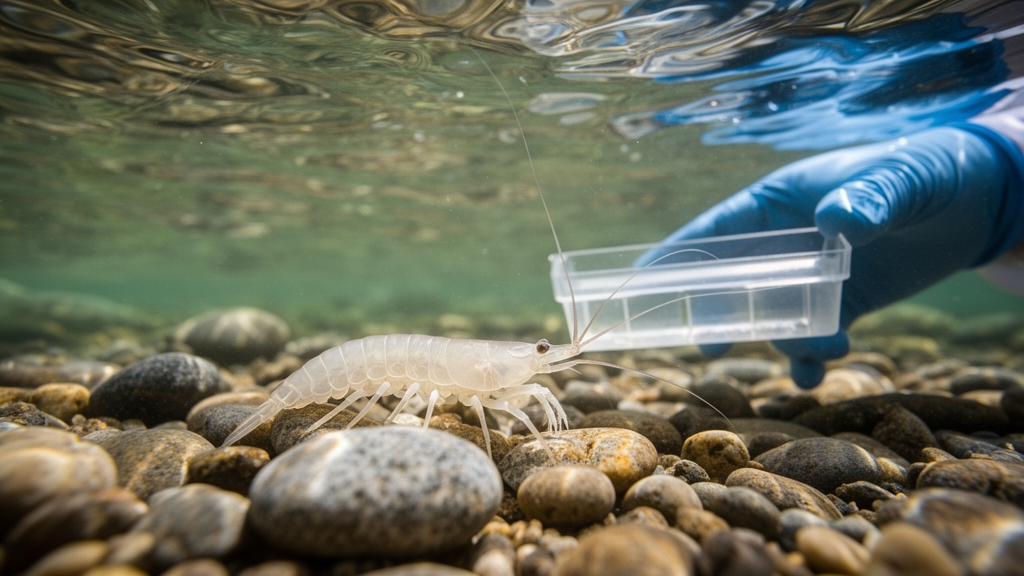
Beneath the pebbles and gravel of Crimea’s mountain rivers, in a dark, waterlogged layer where surface water and groundwater quietly mingle, scientists have uncovered a hidden menagerie. A new study published in the journal Zoosystematics and Evolution reports the first survey of hyporheic crustaceans in the rivers of the Crimean Peninsula, and it delivers a surprise: a specialized, previously undocumented community of amphipods, including two species new to science. The finding rewrites assumptions about what lives in these shallow, often drought-prone rivers and adds two branches to the evolutionary tree of a genus famed for its subterranean lifestyle.
The hyporheic zone, the porous sediment beneath and alongside a riverbed, is one of the least explored habitats in freshwater ecology. Water percolating through it creates an ecotone where light, temperature, oxygen, and dissolved chemicals shift abruptly, and the size of sediment grains determines how permeable and habitable it is. Specialized species can thrive there, but sampling is notoriously difficult. In Crimea, researchers had long doubted that the hyporheic zone held much life at all, since many peninsula rivers shrink dramatically in summer or dry out entirely under an arid climate where the southwestern mountains receive roughly 1,000 to 1,200 millimeters of rain per year and the northern plains only about 250.
That skepticism turned out to be unfounded. A team led by Ivan Marin and Dmitry Palatov sampled the middle and lower reaches of the Alma, Kacha, and Belbek rivers on the southwestern foothills, as well as small mountain rivers along the southern coast, including the Ulu-Uzen and Demerdzhi near Alushta and the Uchan-Su near Yalta. Their method was strikingly simple: they turned over large stones on the riverbed, then quickly netted the water filling the depressions, and dug deep pits in coastal pebble deposits, filtering the inflow. The results were immediate. Amphipods of the genus Niphargus appeared in river after river, along with members of the recently established gammarid genus Litorogammarus near the Alushta coast, marking the first true riverine hyporheic niphargids ever recorded from Crimea.
Two of the finds proved to be undescribed species and are now formally named Niphargus almensis, after the Alma River, and Niphargus uchansi, after the Uchan-Su River. The holotype male of N. almensis measures 12.0 millimeters, with paratypes ranging from 9.0 to 10.5 millimeters, while the largest N. uchansi male reached 11.0 millimeters. Both belong to the tarkhankuticus ingroup, a clade of niphargids distributed along the coastal areas of the Black Sea, from Crimea and the southern Caucasus to the northern coast of Türkiye, and both are closely related to N. tarkhankuticus, which was described in 2022 from wells and subterranean watercourses on the Tarkhankut Upland in western Crimea.
Morphologically, the newcomers are distinctive. Unlike the classic pale, eyeless, fully stygomorphic body plan expected of subterranean crustaceans, both new species retain small yellow eyes and faint pigmented spots on the head, and they bear what the authors interpret as photosensitive yellow patches that may allow them to detect light. Their separation from N. tarkhankuticus rests on a suite of characters, including the presence or absence of eyes and head spots, differences in the armature of the epimeral plates and the telson, the proportions and spination of uropods I through III, and the shape of the gnathopods and mandibles. N. uchansi, for example, carries two inner spines on each lobe of the telson where N. almensis has one, and the two species differ further in the spines along the ventral margin of the third epimeral plate.
To confirm that these differences signal genuinely distinct species rather than variation within one lineage, the team combined microscopy with molecular genetics. They extracted genomic DNA from muscle tissue, amplified a roughly 586-base-pair fragment of the mitochondrial cytochrome c oxidase subunit I gene with the universal Folmer primers, and ran phylogenetic analyses using maximum likelihood and Bayesian methods under the GTR+G+I model. Several independent species delimitation approaches, including ABGD, ASAP, PTP and its Bayesian variant, and GMYC, plus morphological evidence, converged on the same answer: six well-defined lineages within the tarkhankuticus ingroup, strongly supported by both posterior probabilities of 1.00 and maximum-likelihood bootstrap values of 100 percent.
The genetic distances told a consistent story. Interspecific divergence within the ingroup ranges from 4.2 to 12.6 percent at COI, while the two new species differ from each other by about 5.5 percent, and from N. tarkhankuticus by roughly 4.2 and 5.2 percent respectively. Even the lowest observed divergence, around 4 percent between N. almensis and N. tarkhankuticus, was deemed sufficient to treat the two as distinct biological species, given additional differences in ecology, distribution, and anatomy. Molecular clock estimates, calibrated with divergence rates for the COI marker, place the origin of the whole ingroup in the Miocene, roughly 8.5 to 6 million years ago, while the Crimean representatives split from one another between the middle Pliocene and the early Pleistocene.
The youngest split, between N. almensis and N. tarkhankuticus, is also the most telling. The authors estimate it occurred in the Pleistocene, about 2 to 1.5 million years ago, driven by rising sea levels and increasing salinity in the Black Sea. As the sea transgressed, the paleo-rivers of western Crimea were cut off from one another, breaking gene flow between the amphipods inhabiting their channels. What remains today are two sister species stranded in different drainage systems: one confined to the perennial gravel beds of the Alma River and its tributary, the Bodrak, where it can reach densities of 20 to 30 individuals per square decimeter, the other surviving in wells on the Tarkhankut Upland. Their biogeography is a fossil record of an ancient river network preserved in living animals.
The ecology of these amphipods is equally remarkable. N. almensis lives in pebble layers up to 50 to 100 centimeters thick in the middle Alma at elevations of 180 to 240 meters, where water flows year-round and water temperatures hover around 12 to 14 degrees Celsius. N. uchansi was found almost at the surf line of the Uchan-Su, just two to three meters from where the river meets the Black Sea, sheltering in cavities beneath large boulders in colder water of roughly 8 to 10 degrees Celsius. Pebble-beach and estuarine habitats are essentially unheard of among niphargids elsewhere, and the researchers suspect that more members of the tarkhankuticus clade await discovery in the river mouths of the southern Crimean coast. Additional undescribed Niphargus species from the tauricus, carpathicus, and stygius ingroups, as well as the Litorogammarus populations, are still being worked up.
The broader message is one of urgency. The peninsula hosts roughly 50 known troglo- and stygobiotic invertebrates, and its subterranean and hyporheic fauna had never been systematically sampled in riverbeds. The discovery of a unique, evidently endemic community in these gravelly substrates shows that even shallow, drought-prone rivers can shelter ancient lineages found nowhere else on Earth. The authors warn that careless economic activity, gravel extraction, channel modification, or water abstraction could erase these animals, along with millions of years of accumulated genetic diversity, before they are ever catalogued. For now, the hyporheic zone of Crimea’s rivers has claimed its place as one of the region’s most unexpected biodiversity reservoirs, and the first insights suggest many more secrets remain beneath the stones.
Subject of Research: Hyporheic amphipod diversity and description of two new Niphargus species in Crimean mountain rivers
Article Title: First insights into the hyporheic crustaceans of the mountainous rivers of the Crimean Peninsula, with the description of two new species of the genus Niphargus Schiödte, 1849 ( Malacostraca , Amphipoda , Niphargidae )
Article References: Marin, I., & Palatov, D. (2026). First insights into the hyporheic crustaceans of the mountainous rivers of the Crimean Peninsula, with the description of two new species of the genus Niphargus Schiödte, 1849 (Malacostraca, Amphipoda, Niphargidae). Zoosystematics and Evolution, 102(5), 1177-1202. https://doi.org/10.3897/zse.102.206462
Image Credits: AI Generated
Keywords: Niphargus, amphipoda, hyporheic zone, Crimean Peninsula, new species, COI barcoding, molecular phylogeny, Black Sea biogeography, stygobiotic fauna, species delimitation, Pleistocene divergence, freshwater biodiversity
Cite Scienmag News
Gavin Prescott. (October 15, 2026). Hidden Amphipods in Crimean Riverbeds Reveal Two New Ancient Species. Scienmag. https://scienmag.com/hidden-amphipods-in-crimean-riverbeds-reveal-two-new-ancient-species/
Gavin Prescott. "Hidden Amphipods in Crimean Riverbeds Reveal Two New Ancient Species." Scienmag, 15 October 2026, https://scienmag.com/hidden-amphipods-in-crimean-riverbeds-reveal-two-new-ancient-species/. Accessed 15 October 2026.
Gavin Prescott. "Hidden Amphipods in Crimean Riverbeds Reveal Two New Ancient Species." Scienmag. October 15, 2026. https://scienmag.com/hidden-amphipods-in-crimean-riverbeds-reveal-two-new-ancient-species/


