


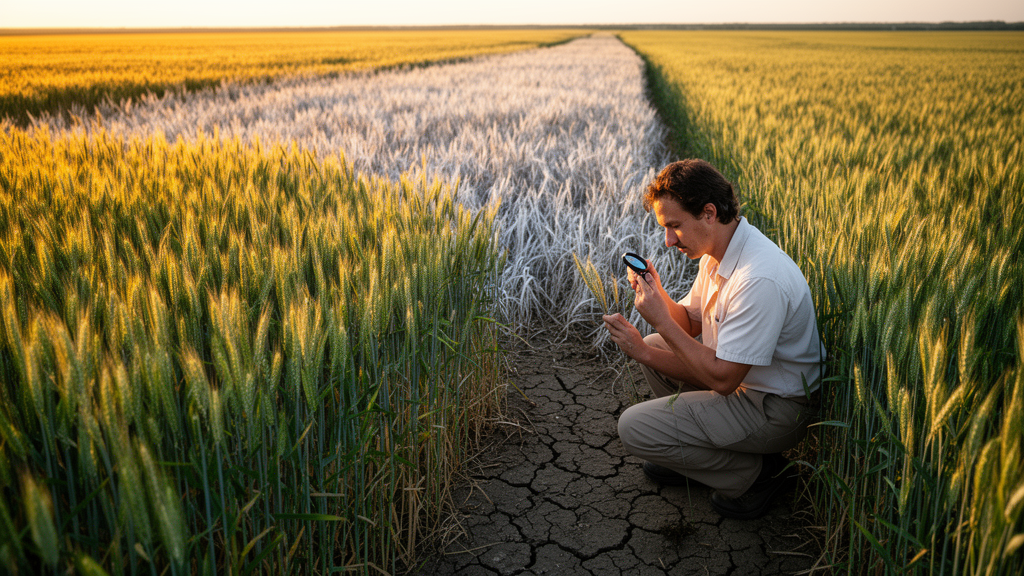
Barley has quietly survived for thousands of years in some of the harshest farming landscapes on Earth, from the windswept plateaus of the Himalayas to the parched plains of the Middle East. Now, a team of researchers in Nepal has shown that this ancient cereal still holds genetic secrets that could help agriculture weather a hotter, drier future. In a controlled drought experiment, the scientists evaluated fourteen traditional barley landraces and found that two of them, AFU 202501 and Saptari Local, coped with water deficit through strikingly different but equally effective strategies. The findings, published in Discover Agriculture, offer a technical roadmap for breeders seeking to develop climate-resilient barley varieties for drought-prone regions.
Barley (Hordeum vulgare L.) is one of the oldest domesticated cereals and is widely recognized for its adaptability to marginal environments, including drought-prone and low-input agricultural systems. Globally, barley is primarily used for animal feed and malting, but in Nepal and other Himalayan regions it serves as an important food and fodder crop, particularly in high-altitude and resource-constrained environments. In districts such as Mustang, Dolpa and Humla, barley is a staple crop cultivated under low-input conditions, where water scarcity and poor soil fertility limit the productivity of major cereals such as rice and wheat. Its ability to grow under harsh conditions, including poor soils, limited moisture and short growing seasons, makes it a strategic crop for climate-resilient agriculture.
Drought is one of the most critical abiotic stresses limiting crop productivity worldwide, particularly in arid and semi-arid regions. In barley, drought stress can reduce grain yield by 49 to 87 percent, depending on the timing and severity of stress, by affecting physiological and developmental processes such as photosynthesis, flowering and grain filling. In Nepal, limited irrigation infrastructure and declining winter rainfall further exacerbate water stress conditions, making drought tolerance a priority trait for crop improvement. The country’s agriculture is largely rain-fed and highly vulnerable to climate variability, with diverse agro-ecological zones from the Terai plains to the mid-hills and high mountains experiencing increasing climatic uncertainty, including erratic rainfall and recurrent droughts.
Barley landraces and their wild relatives represent valuable genetic resources for improving drought tolerance. These traditional varieties have evolved under diverse environmental conditions and farmer selection, resulting in substantial genetic variability and local adaptation. Previous studies have documented significant diversity in morphological and agronomic traits among Himalayan barley landraces, highlighting their potential as sources of stress tolerance. The utilization of such indigenous germplasm is critical for developing climate-resilient varieties adapted to local conditions, and the new study set out to evaluate the performance of barley landrace accessions under contrasting water regimes, compare and identify reliable drought stress indices for genotype selection, and characterize traits associated with drought response under controlled conditions in the Terai region of Madhesh province of Nepal.
The researchers grew fourteen barley landraces in 5-liter pots containing a mixed soil-sand-farmyard manure medium in a 1:1:1 ratio, arranged in a factorial Completely Randomized Design with three replications under polyhouse conditions. Two factors were tested: barley landraces as Factor A and water regime (drought stress versus well-watered control) as Factor B, resulting in 28 treatment combinations. Drought stress was imposed as repeated drought episodes at three critical growth stages: crown root initiation, tillering, and grain filling, because these stages are highly sensitive to water deficit and have a significant influence on final yield determination. Soil moisture was monitored using a tensiometer installed in the root zone. The control treatment was maintained at 80 to 100 percent field capacity, corresponding to 10 to 30 kPa, while drought stress was imposed by withholding irrigation until soil water tension reached approximately 60 kPa (about 40 percent field capacity). Stress was maintained for 7 to 10 days at each growth stage, and irrigation was resumed until the next designated growth stage. This design allowed the experiment to evaluate repeated and sequential drought episodes throughout crop development rather than independent stage-specific drought treatments, meaning that responses observed at later growth stages may reflect both the current drought episode and the cumulative effects of preceding episodes.
Among the fourteen landraces, only eight completed the full growth cycle up to harvest. Six landraces, after exposure to stress, showed no flowering and fruiting behavior and died before maturity. Landraces were excluded from maturity and yield analysis only when all three replicates failed to survive or reach reproductive maturity under drought stress conditions. Phenological observations including days to flowering were recorded during the crop growth period. Chlorophyll content was measured in the youngest fully expanded leaves using a SPAD meter before and after the imposition of stress. Days to maturity were recorded when plants reached physiological maturity, characterized by complete grain hardening and senescence. At harvest, grain yield per plant was measured from individual pots after sun drying for three days and adjusted to constant moisture at 12 percent.
The study revealed significant genotypic variation in response to drought stress. Days to flowering ranged from 74.5 days in the compact Saptari Local to 101.5 days in NGRC 5999 under control conditions. Under drought stress, the reduction in days to flowering varied substantially among genotypes, from a modest 9.2 percent in AFU 202501 to a severe 22.0 percent reduction in NGRC 6010, demonstrating the genetic basis of growth maintenance under water limitation. Phenological responses to drought showed similar genotypic variation, with days to maturity spanning a 16.8-day range among landraces under optimal conditions. Water deficit accelerated maturity by an average of 7.08 percent, but this response varied significantly among landraces, from just 5 days in Saptari Local to 11 days in NGRC 5999. This differential phenological plasticity suggests varying strategies for coping with terminal drought stress.
The stress treatment also induced marked changes in physiological parameters, particularly affecting the photosynthetic apparatus. Chlorophyll content, as measured by SPAD values, showed progressive degradation under drought conditions, with an initial 7.65 percent reduction observed at 79 days after sowing that intensified to 17.18 percent by 86 days after sowing. This pattern suggests cumulative damage to the photosynthetic machinery under prolonged water deficit. Chlorophyll content measurements revealed substantial genotypic differences in photosynthetic maintenance under stress. At 79 days after sowing, SPAD values ranged from 52.39 to 66.45 among genotypes, with this variation becoming more pronounced by 86 days after sowing as stress progressed. AFU 202501 showed moderate growth reduction coupled with high chlorophyll retention (93.2 percent of control values) and stable yield performance. In contrast, Saptari Local employed an early maturity strategy combined with compact architecture, maintaining 88.4 percent of its photosynthetic efficiency under stress, showing a drought avoidance mechanism. NGRC 6010 exhibited poor performance across all parameters, with severe growth inhibition, inadequate chlorophyll maintenance (72.3 percent), and low yield stability.
The analysis of variance revealed highly significant differences among landraces for all stress tolerance indices and yield-related parameters, demonstrating substantial genetic variability in drought response and yield performance under both optimal and stressed conditions. Among all genotypes, Saptari Local recorded the lowest Stress Susceptibility Index value (0.125), indicating excellent drought tolerance and minimal yield reduction under stress. AFU 202501 showed a relatively low SSI value (0.568), indicating good drought tolerance and yield stability across environments. In contrast, Muktinath exhibited an SSI value of 1.695, followed by NGRC 6002 (1.571) and NGRC 6010 (1.501), indicating severe sensitivity to drought stress. The Stress Tolerance Index, which combines yield potential and stress performance, was highest in AFU 202501 (1.782) and Gaushala Local (1.375), suggesting these genotypes maintain productivity under both favorable and stress conditions. Under optimal conditions, Gaushala Local and AFU 202501 produced the highest yields, while under stress, AFU 202501 maintained superior performance followed by Saptari Local. The Yield Stability Index revealed Saptari Local (0.943) and AFU 202501 (0.740) as the most stable landraces, with values approaching 1 indicating minimal yield reduction under stress.
Pearson’s correlation analysis revealed strong positive associations among drought tolerance indices including STI, GMP, MP, HM, YSI, RDI, and YI. The Stress Tolerance Index showed highly significant positive correlations with GMP (r = 0.98), MP (r = 0.98), HM (r = 0.97), and YSI (r = 0.95), indicating their consistency in identifying drought-tolerant genotypes. GMP and MP exhibited an almost perfect positive correlation (r = 0.99), suggesting that both indices evaluate similar yield stability responses under stress conditions. In contrast, susceptibility-related indices such as SSI and SDI showed negative correlation with tolerance indices, particularly with YSI and RDI (r = -1.0), indicating that higher susceptibility was associated with greater yield reduction under drought stress. TOL and SSPI displayed comparatively weaker relationships with yield stability indices, suggesting limited reliability for selecting stable drought-tolerant genotypes. A Hierarchical Cluster Analysis using Ward’s minimum variance method classified the eight barley landraces into four distinct performance-based clusters based on all eleven drought indices. Cluster 1 (High Productivity Group) comprised AFU 202501 and Gaushala Local, exhibiting the highest overall yield potential across both stress and non-stress environments. Cluster 2 (Pure Yield Stability Outlier) consisted of Saptari Local, demonstrating an elite yield-preservation mechanism under moisture deficit. Cluster 3 (Intermediate Steady Group) comprised NGRC 5999 and NGRCO 7576, maintaining mid-tier balanced indices. Cluster 4 (Highly Drought-Susceptible Group) bound Muktinath, NGRC 6002 and NGRC 6010 tightly together, characterized by heavily suppressed geometric productivity and high environmental vulnerability.
The phenological responses observed in the study support the drought escape versus avoidance paradigm. Saptari Local’s early maturity and minimal phenological shift under drought exemplify a conservative escape strategy, similar to that described for xerophytic barley landraces. In contrast, NGRC 5999’s greater plasticity in maturity duration reflects a different adaptive strategy, potentially sacrificing yield potential for survival under severe stress. AFU 202501’s combination of physiological stability and moderate growth reduction suggests it possesses a partial dehydration avoidance mechanism, making it particularly valuable for environments with intermittent drought. From an applied perspective, the results support the use of chlorophyll retention and phenological monitoring as selection tools for drought tolerance. Chlorophyll retention at late growth stages and yield stability particularly suggest that late-season photosynthetic maintenance may be a reliable indicator of drought tolerance, consistent with findings in wheat.
Although yield-based stress indices provide practical and integrative measures of drought tolerance, yield itself is a complex trait with low heritability and strong environmental influence. Reliance solely on yield may obscure the underlying physiological mechanisms of stress adaptation. In this study, the integration of chlorophyll retention and phenological responses with yield-based indices provided deeper insights into drought tolerance strategies. AFU 202501 combined high yield stability with superior chlorophyll retention, suggesting enhanced photosynthetic resilience, while Saptari Local exhibited drought escape through early maturity. These findings highlight that combining yield-based indices with chlorophyll traits improves the reliability of selection and enables better understanding of drought tolerance mechanisms.
The study revealed substantial variation among barley landrace accessions in response to drought stress, reflecting distinct adaptation strategies. AFU 202501 demonstrated high yield potential and stability across conditions, while Saptari Local maintained yield under stress through early maturity, indicating a drought-escape strategy. In contrast, Muktinath and NGRC 6010 landraces were highly sensitive to water deficit, suffering yield losses of up to 87 percent. These results emphasize the importance of aligning the selection of landraces with breeding objectives, whether targeting yield potential, stability, or stress avoidance. The integration of yield-based indices with phenological and chlorophyll-related traits provides a useful framework for identifying drought-adapted germplasm. Incorporating such traditional germplasm into modern breeding programs offers a strategic pathway to strengthen food security in drought-prone regions, and these genotypes could serve as valuable parental materials for developing climate-resilient barley varieties to enhance food security in water-limited environments.
Subject of Research: Evaluation of yield based stress indices of barley landraces under drought condition
Article Title: Evaluation of yield based stress indices of barley landraces under drought condition
Article References: Evaluation of yield based stress indices of barley landraces under drought condition. (n.d.). https://doi.org/10.1007/s44279-026-00796-w
Image Credits: AI Generated
DOI: 10.1007/s44279-026-00796-w
Keywords: barley, drought stress, landraces, stress indices, SPAD, chlorophyll retention, drought escape, plant breeding, climate resilience, Nepal, Evaluation, yield
Cite Scienmag News
Alan Morgan. (October 15, 2026). Barley Landraces Reveal Two Winning Strategies Against Drought Stress. Scienmag. https://scienmag.com/barley-landraces-reveal-two-winning-strategies-against-drought-stress/
Alan Morgan. "Barley Landraces Reveal Two Winning Strategies Against Drought Stress." Scienmag, 15 October 2026, https://scienmag.com/barley-landraces-reveal-two-winning-strategies-against-drought-stress/. Accessed 15 October 2026.
Alan Morgan. "Barley Landraces Reveal Two Winning Strategies Against Drought Stress." Scienmag. October 15, 2026. https://scienmag.com/barley-landraces-reveal-two-winning-strategies-against-drought-stress/


