


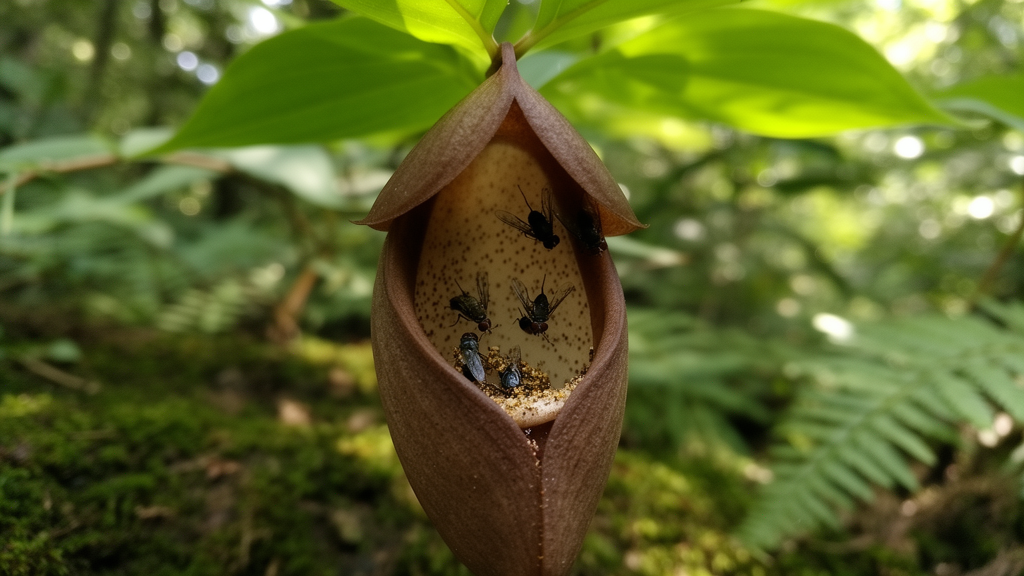
In the steamy lowlands of southern China, a South American vine is running one of the most elaborate cons in the plant kingdom. Aristolochia gibertii, a member of the birthwort family, produces pendulous, pipe-shaped flowers that snare small flies, hold them captive for a day, and then send them off dusted with pollen — all without paying them so much as a proper meal. A new study published in BMC Plant Biology reveals the intricate mechanical, chemical, and temporal machinery behind this deception, and shows that the vine has managed a remarkable feat in its adopted home: recruiting completely unfamiliar native insects as its pollen couriers.
The research, led by Xiaoxia Deng and Changqiu Liu of the Guangxi Institute of Botany together with Huayan Chen of the South China Botanical Garden, Chinese Academy of Sciences, and colleagues including Smithsonian paleobiologist Conrad Labandeira, examined an introduced population of A. gibertii in southern China. The team combined floral anatomy, histochemistry, volatile chemistry, insect visitor surveys, and controlled bagging experiments to dissect exactly how the plant’s trap works. Their findings provide a textbook demonstration of what ecologists call ecological fitting — the ability of a species to slot into new ecological interactions in a new range without any shared evolutionary history with its partners.
Aristolochia trap flowers are botanical prisons with a timetable. The study found that flowers of A. gibertii are strictly protogynous, meaning the female phase precedes the male phase. When a flower first opens, its stigma is receptive but its own anthers have not yet released pollen. Erect, downward-pointing retrorse trichomes line the floral tube, forming a one-way bristle barrier that lets insects push deep into the chamber but prevents them from climbing back out. Flies that enter during the female phase are effectively confined, and as they blunder around the chamber they contact the receptive stigmatic lobes, depositing any pollen carried from flowers they visited the previous day.
The trap’s release mechanism is as precisely timed as its capture. When the flower shifts into its male phase, the trichomes collapse, clearing the escape route. At the same moment, the anthers dehisce and shed pollen onto the departing visitors, while the stigmatic lobes elevate, split, and reflex downward and the stigma senesces. This choreography accomplishes two things at once: the flower loads its captives with pollen exactly when they can finally leave, and it destroys the receptive surface of its own stigma so that self-pollination is physically prevented. The result is an obligate outcrossing system — bagged flowers that were left to self-autonomously set no fruit at all, confirming that the vine is entirely dependent on its insect messengers.
The chemical dimension of the deception proved equally sophisticated. Using volatile analysis, the researchers documented a marked shift in scent composition between the two sexual phases. During the female phase, the dominant compound is cis-β-ocimene, an odorous terpene, while the male phase sees an increase in limonene and other terpenoids. Crucially, both phases emit fermentation-related volatiles, including acetoin and 2,3-butanediol — compounds that are signature products of microbial fermentation and yeast growth. To a small fly whose nervous system is tuned to locate rotting fruit, fungi, and microbial rich feeding sites, these odors mimic exactly the cues it uses to find food and egg-laying substrate. The flower, in effect, smells like a promising patch of yeast.
And the flies come. Visitor surveys revealed that drosophilid flies — the family that includes the famous fruit fly Drosophila melanogaster — accounted for more than 70 percent of all visitors, with the species Drosophila ficusphila serving as the primary pollen vector. This is the crux of the ecological fitting story: A. gibertii evolved its trapping and scent systems in South America, presumably in concert with drosophilid and other dipteran visitors there. Yet transplanted to China, thousands of kilometers from any co-evolutionary partner, it still successfully exploits local drosophilids because those native generalists share the same sensory biases — an attraction to yeast and fermentation odors — that the vine’s chemistry was built to exploit. The trap needs no history with its victims, only the right sensory key.
The plant does offer its captives a token of hospitality, though it is more of a retainer than a wage. Minute nectaries within the flower secrete trace amounts of nectar, enough to sustain trapped flies through their day of confinement but nowhere near a substantial reward. This detail matters for understanding the economics of deceptive pollination: the plant keeps its pollinators alive long enough to perform their service, while withholding anything like the payment a rewarding flower would provide. The flies pay the full cost of their time and effort, receiving only a brief nectar trickle and, presumably, the illusion of a fermentation bounty that never materializes.
Deceptive pollination strategies are widespread among angiosperms, ranging from orchids that mimic female insect pheromones to brood-site mimics that smell like carrion or dung. What makes the Aristolochia system particularly valuable for researchers is its functional integration: the trapping mechanism, the sexual phase timing, the stigma and anther choreography, and the phase-specific volatile blends all operate as a coordinated unit. The new study frames this as a mechanistic model for multi-trait integration in deception strategies, showing how morphology, chemistry, and phenology must be locked together for the swindle to succeed. Remove any one element — the trichomes, the protogyny, the yeast-mimicking odors — and the pollination system breaks.
The findings also carry implications for understanding biological invasions and plant-animal interactions in the Anthropocene. As global trade and horticulture move plant species across continents at unprecedented rates, the question of whether introduced plants can reproduce in their new ranges is central to predicting which species naturalize and spread. A. gibertii demonstrates that a plant relying on specialized pollination services can, if its mechanism happens to align with the sensory ecology of novel fauna, achieve efficient reproduction without its historical partners. Generalist sensory biases among native insects provide a broad receptive surface for such ecological fitting — a vulnerability, or perhaps an inevitability, that invasion biologists can now study at the level of individual volatile compounds and trichome mechanics.
From an evolutionary perspective, the study adds a layer to a story that stretches deep into time. The Aristolochia trap-flower architecture is an ancient lineage of fly-pollinated deception, and Conrad Labandeira’s involvement underscores the deep-historical framing of the work: the coordinated trapping structures of these plants represent a long-standing solution to the problem of getting flies to move pollen between individuals that offer them nothing. That the same blueprint functions in a Chinese population among flies the plant has never encountered in evolutionary time is a striking testament to how robust and portable these integrated trait complexes can be. A swindle, it turns out, works just as well on strangers as on old acquaintances — provided the marks share the same weaknesses.
Subject of Research: Deceptive trap-flower pollination and ecological fitting in the introduced vine Aristolochia gibertii
Article Title: Ecological fitting in a deceptive trap flower: Aristolochia gibertii recruits native drosophilid flies outside South America
Article References: Deng, X., Xiao, L., Labandeira, C., Liao, S., Liu, C., & Chen, H. (2026). Ecological fitting in a deceptive trap flower: Aristolochia gibertii recruits native drosophilid flies outside South America. BMC Plant Biology. https://doi.org/10.1186/s12870-026-09814-x
Image Credits: AI Generated
DOI: 10.1186/s12870-026-09814-x
Keywords: Aristolochia gibertii, deceptive pollination, trap flowers, ecological fitting, drosophilid flies, Drosophila ficusphila, floral volatiles, protogyny, trapping trichomes, pollination biology, biological invasions, BMC Plant Biology
Cite Scienmag News
Gavin Prescott. (October 15, 2026). Deceptive Trap Flower Recruits Native Fruit Flies as Pollinators in China. Scienmag. https://scienmag.com/deceptive-trap-flower-recruits-native-fruit-flies-as-pollinators-in-china/
Gavin Prescott. "Deceptive Trap Flower Recruits Native Fruit Flies as Pollinators in China." Scienmag, 15 October 2026, https://scienmag.com/deceptive-trap-flower-recruits-native-fruit-flies-as-pollinators-in-china/. Accessed 15 October 2026.
Gavin Prescott. "Deceptive Trap Flower Recruits Native Fruit Flies as Pollinators in China." Scienmag. October 15, 2026. https://scienmag.com/deceptive-trap-flower-recruits-native-fruit-flies-as-pollinators-in-china/


