


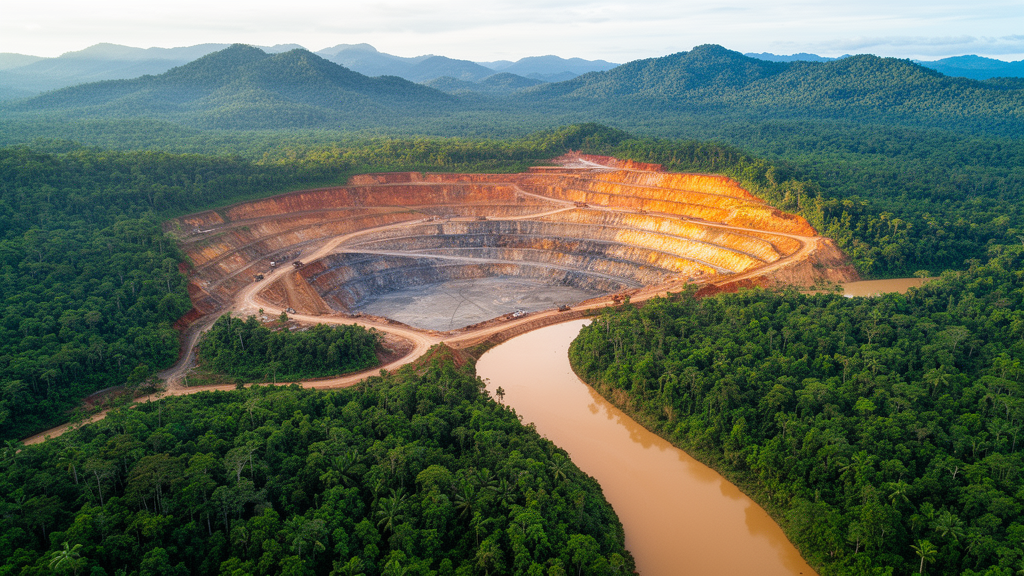
A sweeping global analysis published in Nature Communications has delivered one of the clearest quantitative portraits yet of how mining collides with the world’s most important places for biodiversity. Led by Kaixuan Pan of the Naturalis Biodiversity Center and Leiden University, the study mapped approximately 145,000 square kilometers of land currently occupied by mining operations and cross-referenced those footprints against post-2020 conservation priority zones, the areas that international frameworks have identified as most critical for halting and reversing the loss of species. The headline finding is stark: 34 percent of the world’s active mining land, some 49,000 square kilometers, sits directly inside these conservation priority zones.
The scale of the overlap becomes even more striking when translated into species. The mining areas that intersect conservation priority zones overlap with the ranges of more than 2,300 species, many of which are already classified as threatened with extinction. This means that for thousands of plants, animals, and other organisms, the very landscapes that conservation science has flagged as indispensable for their survival are simultaneously being carved up by extraction of metals, non-metallic minerals, and coal. Because mining does not merely occupy land but also generates dust, acid drainage, water contamination, noise, and fragmentation of habitats, the ecological footprint of each operation typically extends far beyond its official boundaries.
The researchers traced these impacts across 14 of the world’s major biomes, revealing that the burden is not distributed evenly. Fragile ecosystems emerge as disproportionately affected relative to their total extent. Mangroves, among the most carbon-rich and biologically productive coastal ecosystems on Earth, and the Mediterranean biome, a global biodiversity hotspot with exceptionally high endemism, show particularly high relative impacts from mining activity. In ecosystems of this kind, where species have evolved under narrow environmental conditions and where habitat extent is already drastically reduced, each additional hectare lost to extraction carries a heavier conservation cost than it might in a more widespread biome.
What sets the study apart is its dual focus on present and future risk. The authors did not stop at current mining land. They also assessed land that is potentially exploitable for mining, using spatial data on known and inferred mineral deposits, and measured how much of that prospective land falls within conservation priority zones. The numbers are sobering. For metals, 43 percent of potentially exploitable land, amounting to roughly 12 million square kilometers, overlaps with conservation priority zones. For non-metallic minerals the figure is 29 percent, about 2 million square kilometers, and for coal it is 37 percent, approximately 4 million square kilometers. In other words, unless new mining is deliberately steered away from sensitive landscapes, future extraction will almost inevitably encroach on the very areas that global commitments have sworn to protect.
The timing of this analysis is critical. The United Nations has committed to halting and reversing biodiversity loss by 2030, and the Kunming-Montreal Global Biodiversity Framework, adopted in December 2022, enshrines ambitious targets including the conservation of substantial portions of the planet’s land and oceans. Yet mining remains a major driver of biodiversity decline, and the demand for mined materials is set to grow rather than shrink. The energy transition itself, with its need for lithium, cobalt, nickel, copper, and rare earth elements for batteries, wind turbines, and solar panels, is accelerating the expansion of extraction into new frontiers. The study’s findings expose a fundamental tension at the heart of sustainability policy: the materials needed to decarbonize the economy and the ecosystems needed to buffer the planet against collapse are increasingly competing for the same ground.
Quantifying this competition has long been a blind spot in global conservation strategy. Conservation planning exercises typically rely on protected area networks, species range maps, and threat assessments such as the IUCN Red List, but mining pressure has often been tracked incompletely or at resolutions too coarse to reveal local conflicts. Previous research has shown that mining has undermined forest conservation both inside and beyond protected areas, but a comprehensive, mineral-by-mineral accounting of how current and potential extraction aligns with the post-2020 conservation agenda has been lacking. By combining spatial datasets on operating mines and exploitable deposits with maps of conservation priority zones and species ranges, the new analysis closes that gap and provides a common evidence base for policymakers, industry stakeholders, and conservation organizations alike.
The methodological logic behind the study deserves attention. The authors distinguished between three broad categories of extraction: metals, non-metallic minerals, and coal, because these differ profoundly in their geography, economics, and environmental profiles. Metal mining is expanding fastest and is concentrated in biodiversity-rich regions of the tropics and southern hemisphere; non-metallic minerals such as sand, gravel, and phosphate rock are the most voluminously extracted materials on Earth; and coal remains a dominant driver of land degradation despite its declining role in many energy systems. By overlaying these separate footprints and prospectivity layers onto conservation priority maps, the team could not only measure present conflicts but also forecast where future conflicts are most likely to erupt, giving decision-makers a forward-looking rather than purely retrospective tool.
The policy implications are direct. The authors frame their results as actionable insights for aligning mining practices with global conservation goals, including the UN Sustainable Development Goals and the Kunming-Montreal Global Biodiversity Framework. Concretely, the maps of overlap could inform strategic environmental assessment at landscape and national scales, guide the designation of no-go zones for extraction in the highest-priority areas, and shape disclosure requirements so that companies in mineral supply chains can demonstrate that their sourcing does not compromise priority ecosystems. The results also speak to the growing body of policy work on critical raw materials, suggesting that demand-side measures such as recycling, material efficiency, and reduced consumption of primary metals could relieve pressure on biodiverse landscapes before new mines are even proposed.
For the more than 2,300 species whose ranges intersect with active mining in priority zones, the findings carry immediate weight. Many of these species face a compounding set of pressures: habitat loss from agriculture and urbanization, climate change shifting the conditions they depend on, and now the documented encroachment of extraction into refuges that conservation planning has identified as their best remaining hope. Because the overlaps span 14 biomes on multiple continents, no single jurisdiction or industry sector can address the problem alone. The study effectively converts a diffuse, anecdotal concern, that mining threatens biodiversity somewhere, into a spatially explicit, quantified risk assessment that names where the conflicts are concentrated and how much land is at stake.
Ultimately, the research delivers a clear message to the international community as it pursues the 2030 biodiversity commitments. Current mining already occupies a third of the land-based conservation priority estate it touches, and the prospective footprints for metals, non-metals, and coal are many times larger still, with more than four in ten of the world’s exploitable metal deposits lying within priority zones. Whether the coming decade sees mining steered around the planet’s irreplaceable ecosystems, or sees those ecosystems steadily sacrificed to extraction, will depend on whether the evidence assembled here is translated into binding spatial planning, responsible sourcing rules, and genuine coordination between the conservation and minerals policy communities. The data now exist; the task of acting on them has only begun.
Subject of Research: Spatial overlap between global mining activity and biodiversity conservation priority zones
Article Title: Post-2020 conservation priorities are threatened by global mining
Article References: Post-2020 conservation priorities are threatened by global mining. (n.d.). https://doi.org/10.1038/s41467-026-77626-6
Image Credits: AI Generated
DOI: 10.1038/s41467-026-77626-6
Keywords: biodiversity, mining, conservation priority zones, Kunming-Montreal Global Biodiversity Framework, species extinction risk, mangroves, Mediterranean biome, metals, coal, land use, spatial analysis, sustainable development
Cite Scienmag News
Margaret Porter. (October 15, 2026). Global Mining Overlaps a Third of the World’s Conservation Priority Zones. Scienmag. https://scienmag.com/global-mining-overlaps-a-third-of-the-worlds-conservation-priority-zones/
Margaret Porter. "Global Mining Overlaps a Third of the World’s Conservation Priority Zones." Scienmag, 15 October 2026, https://scienmag.com/global-mining-overlaps-a-third-of-the-worlds-conservation-priority-zones/. Accessed 15 October 2026.
Margaret Porter. "Global Mining Overlaps a Third of the World’s Conservation Priority Zones." Scienmag. October 15, 2026. https://scienmag.com/global-mining-overlaps-a-third-of-the-worlds-conservation-priority-zones/


