


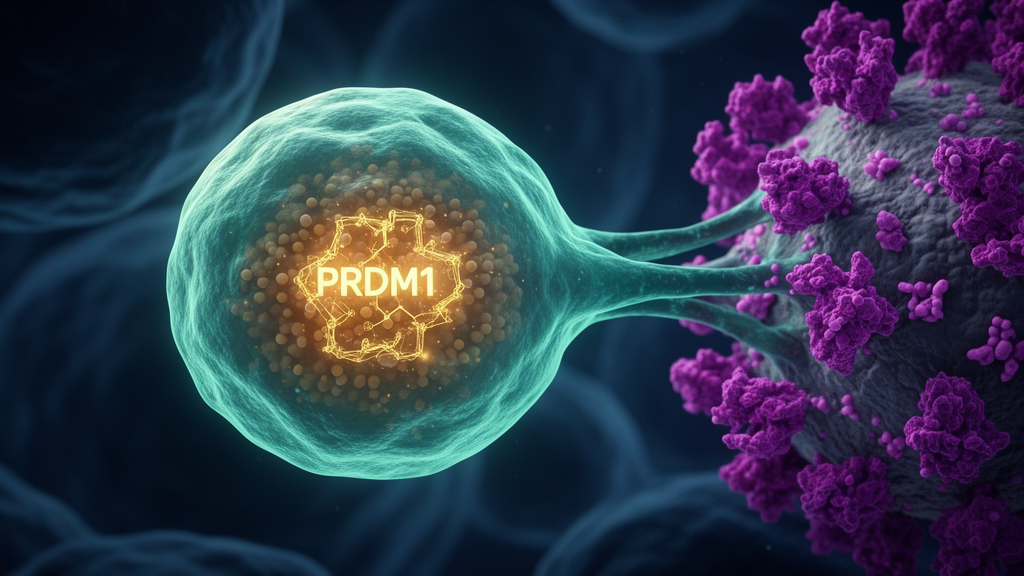
Natural killer cells are the immune system’s rapid-response assassins, patrolling the bloodstream and tissues for virus-infected cells and emerging tumors without ever needing the elaborate training that T cells require. Yet even these innate killers depend on a precise genetic choreography to mature from immature precursors into fully armed effector cells. A new review published in Molecular Biology Reports by Ning Zhao and Youwei Wang of Tianjin University brings together decades of research on PRDM1, a transcriptional repressor that has emerged as one of the central architects of natural killer cell biology, and argues that understanding this single regulatory hub could unlock new therapeutic strategies for cancer immunotherapy and autoimmune disease.
PRDM1, better known to many immunologists as BLIMP-1 or PRDI-BF1, was not discovered in lymphocytes at all. Its story began in the late 1980s, when researchers studying the human beta-interferon gene identified a protein that bound to positive regulatory domains of the interferon promoter and shut the gene down after viral induction. In 1991, AD Keller and Tom Maniatis characterized this novel repressor, and by 1994 the group of CA Turner and colleagues had recognized the same molecule, then named Blimp-1, as the factor capable of driving B lymphocytes to terminally differentiate into antibody-secreting plasma cells. That discovery cemented PRDM1’s reputation as a master regulator of lymphocyte differentiation, a role that has since been extended to T cells, innate lymphoid cells, and, crucially, natural killer cells.
Structurally, PRDM1 belongs to the PRDM family of transcriptional regulators, defined by a conserved PR domain at the amino terminus and a series of zinc finger motifs toward the carboxyl terminus. The zinc fingers provide sequence-specific DNA binding; remarkably, work from Keller and Maniatis showed that only two of the protein’s five zinc fingers are required for specific recognition of its target motifs. The PR domain, a relative of the SET domains found in histone methyltransferases, and the intervening regions mediate protein-protein interactions that allow PRDM1 to recruit an arsenal of chromatin-modifying machinery. This combination of direct DNA recognition and cofactor recruitment is what gives the protein its power as a transcriptional silencer.
Mechanistically, PRDM1 represses gene expression through several coordinated routes. It binds directly to promoters and regulatory regions of target genes, and it recruits co-repressors of the Groucho family, as demonstrated by B Ren and coworkers in 2000. In parallel, studies by Yu and colleagues showed that repression involves the recruitment of histone deacetylases, enzymes that strip acetyl groups from histone tails and compact chromatin into a transcriptionally silent state. PRDM1 also engages the histone H3 methyltransferase G9a, as reported by I Gyory and colleagues in Nature Immunology in 2004, adding repressive methylation marks to the chromatin landscape. Through this trio of mechanisms, direct binding, co-repressor recruitment, and epigenetic remodeling, PRDM1 can lock target genes into long-term silencing programs that define a cell’s identity.
In natural killer cells, PRDM1’s expression is itself tightly controlled by upstream transcription factors and cytokine signaling. The interleukin-21 pathway provides a well-characterized example: H Kwon and colleagues showed in 2009 that IL-21-induced regulation of the Prdm1 gene depends on functional cooperation between the STAT3 and IRF4 transcription factors. Other regulators of NK cell maturation, including T-bet, Zeb2, SMAD4, and the coactivator SRC-3, operate in overlapping networks that converge on the terminal differentiation program. PRDM1 sits at a critical junction in this hierarchy, translating environmental cytokine cues into stable changes in gene expression that push NK cells along their developmental trajectory.
The functional consequences of PRDM1 activity in NK cells are broad. Work by A Kallies and colleagues published in Blood in 2011 established a role for Blimp-1 in the transcriptional network controlling natural killer cell maturation, and subsequent studies have shown that PRDM1 influences effector cytokine production in human NK cells, as MA Smith and coworkers reported in the Journal of Immunology in 2010. PRDM1 also directly represses CD25, the IL-2 receptor alpha chain, thereby decreasing the sensitivity of human NK cells to IL-2-driven expansion, a finding from B Akman and colleagues in 2021 with clear implications for how NK cells are cultured and expanded for adoptive immunotherapy. Additionally, PRDM1 regulates transcription of CS1, also known as SLAMF7 or CD319, an immunotherapeutic target of major importance in multiple myeloma, linking this transcription factor directly to clinically exploited surface molecules.
Recent single-cell and functional studies have sharpened the picture further. Research presented by X Liu and colleagues at Blood meetings and published in Leukemia in 2026 demonstrated key regulatory roles for PRDM1 in human NK-cell differentiation and activation, including the promotion of primary human circulating CD56-dim NK-cell differentiation, the subset that carries out most cytotoxic killing in the blood. Related work by J He and colleagues in 2024 showed that Prdm1 positively regulates liver group 1 innate lymphoid cells, preserving their functional heterogeneity and supporting cancer immune surveillance in the liver. Beyond differentiation, PRDM1 participates in the universal transcriptional program of tissue residency shared with its partner Hobit, as LK Mackay and colleagues reported in Science in 2016, suggesting it helps NK cells establish themselves in tissues where they provide frontline defense.
The review’s authors are careful to draw an important distinction between what has been shown in vitro and what knockout phenotypes actually mean in vivo. The direct molecular functions of PRDM1, its DNA binding, co-repressor recruitment, and chromatin remodeling, have been characterized largely in isolated systems. In living animals, phenotypes observed in knockout mice reflect the integrated outcome of PRDM1 loss throughout NK cell development, differentiation, and homeostasis, in which compensatory mechanisms may operate. Consequently, such phenotypes cannot be attributed solely to the direct cell-intrinsic functions of the protein. This caveat matters for interpreting the literature and for designing experiments that aim to dissect PRDM1’s specific contributions at each stage of the NK cell lifespan.
PRDM1’s clinical significance extends well beyond normal NK cell biology, particularly in NK-cell malignancies. Extranodal NK/T-cell lymphoma, nasal type, an aggressive cancer frequent in East Asian and Latin American populations, frequently shows downregulation of PRDM1 through multiple mechanisms: genetic deletion of the 6q21 region where the gene resides, promoter hypermethylation, and aberrant expression of microRNAs such as miR-223 and miR-30a-5p. C Kucuk and colleagues established in 2011 that PRDM1 functions as a tumor suppressor gene in natural killer cell malignancies, and K Karube and coworkers identified PRDM1 and FOXO3 as tumor-suppressor candidates in NK-cell neoplasms through genomic and functional analyses. Paradoxically, in hepatocellular carcinoma, Q Li and colleagues reported in Nature Communications in 2022 that PRDM1 can induce cancer immune evasion by modulating the USP22-SPI1-PD-L1 axis, a reminder that the same regulatory factor can play opposing roles depending on cellular context.
The synthesis offered by Zhao and Wang underscores why PRDM1 has become such a compelling target for translational immunology. A comprehensive map of the PRDM1 regulatory network provides profound insight into how NK cells achieve their mature, cytotoxic identity and how that identity can be corrupted in disease. For cancer immunotherapy, strategies that enhance PRDM1-dependent maturation could yield more potent NK cell products for adoptive transfer, while careful attention to contexts where PRDM1 promotes immune evasion will be essential. For autoimmune disorders, where dysregulated lymphocyte differentiation contributes to pathology, modulating PRDM1 activity offers a potential point of intervention. As the authors note, the historical arc from an interferon-gene repressor to a master regulator of innate immunity illustrates how deep mechanistic understanding of a single transcription factor can illuminate an entire field and point toward new medicines.
Subject of Research: The role of the transcription factor PRDM1 in natural killer cell maturation, gene regulation, and disease
Article Title: Role of PRDM1 in natural killer cells
Article References: Role of PRDM1 in natural killer cells. (n.d.). https://doi.org/10.1007/s11033-026-12926-0
Image Credits: AI Generated
DOI: 10.1007/s11033-026-12926-0
Keywords: PRDM1, BLIMP-1, natural killer cells, transcription factor, gene regulation, chromatin remodeling, NK cell differentiation, tumor suppressor, cancer immunotherapy, NK/T-cell lymphoma, epigenetics, innate immunity
Cite Scienmag News
Nathaniel Bowman. (October 15, 2026). Master Switch PRDM1 Steers Natural Killer Cell Maturation and Cancer Defense. Scienmag. https://scienmag.com/master-switch-prdm1-steers-natural-killer-cell-maturation-and-cancer-defense/
Nathaniel Bowman. "Master Switch PRDM1 Steers Natural Killer Cell Maturation and Cancer Defense." Scienmag, 15 October 2026, https://scienmag.com/master-switch-prdm1-steers-natural-killer-cell-maturation-and-cancer-defense/. Accessed 15 October 2026.
Nathaniel Bowman. "Master Switch PRDM1 Steers Natural Killer Cell Maturation and Cancer Defense." Scienmag. October 15, 2026. https://scienmag.com/master-switch-prdm1-steers-natural-killer-cell-maturation-and-cancer-defense/


