


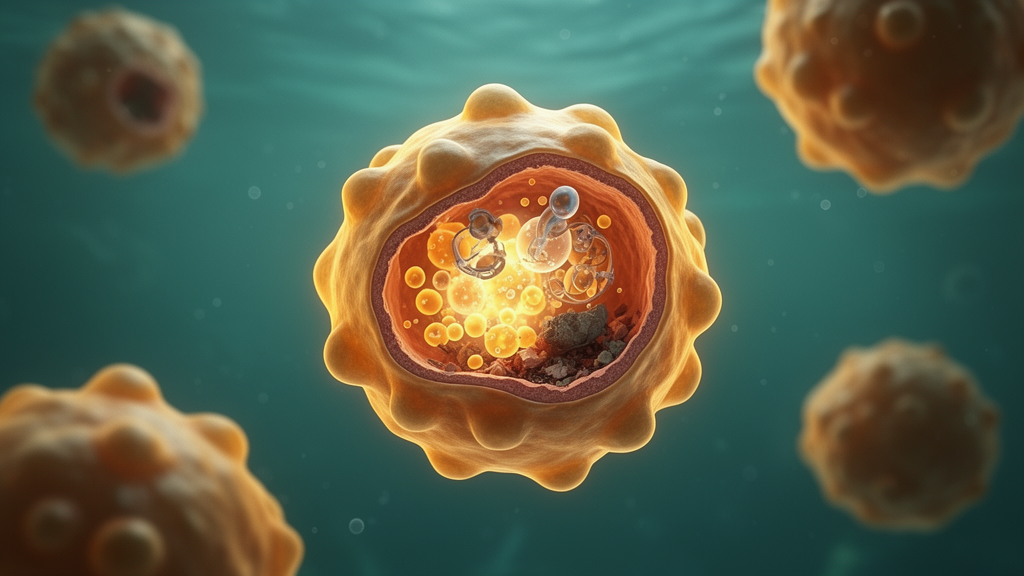
Pancreatic ductal adenocarcinoma, the most common and deadliest form of pancreatic cancer, remains one of medicine’s most formidable opponents. Its five-year survival rates hover in the single digits, and the reason is grimly consistent: by the time most patients are diagnosed, the disease has already begun to spread. A new study published in BMC Cancer by Lizhi Lin, Monika Bauden, Roland Andersson and Daniel Ansari of Lund University, working with a collaborator at Wenzhou Medical University, has now zoomed in on one of the earliest and least understood steps of that metastatic journey — the moment a tumor cell detaches from its surroundings and, against all odds, refuses to die.
For most cells in the human body, being torn loose from the extracellular matrix, the protein scaffold that anchors them to tissue, is a death sentence. Biologists call this programmed suicide anoikis, from the Greek word for homelessness. It is a built-in safeguard that prevents cells from drifting to foreign locations and colonizing them. Metastasizing cancer cells must therefore disable anoikis before they can travel through the bloodstream or lymphatic system and seed new tumors. This anoikis resistance is widely regarded as a critical prerequisite for metastasis, yet the molecular machinery that detached pancreatic cancer cells deploy to stay alive has remained only partially mapped. The new study set out to fill that gap at the level of the entire transcriptome.
The researchers’ experimental strategy was elegantly demanding. They took two established pancreatic cancer cell lines, Capan-1 and PSN-1, and subjected them to repeated rounds of long-term suspension culture — growing the cells in a free-floating state rather than attached to a surface, the condition that normally triggers anoikis. Cells that could not survive this ordeal were eliminated; those that endured were propagated through multiple cycles. What emerged were two independently derived anoikis-resistant populations, each forged by the same selective pressure. This approach mimics, in simplified form, what circulating tumor cells experience in the bloodstream, and it allowed the team to ask which genes and pathways are consistently rewired when pancreatic cancer cells learn to live without attachment.
With the resistant models in hand, the team performed transcriptomic profiling using RNA sequencing, the workhorse technique that measures the activity of every gene in a cell by cataloging its messenger RNA molecules. They applied a normalization strategy based on the trimmed mean of M-values, a method designed to correct for compositional differences between libraries, and quantified gene expression in transcripts per million. Differential expression analysis then compared the anoikis-resistant cells with their attachment-dependent parents, flagging genes whose activity rose or fell as a consequence of the suspension selection. But the researchers went beyond single-gene comparisons, recognizing that cellular adaptation is orchestrated at the level of entire biological programs rather than isolated genes.
That systems-level view came from gene set variation analysis, or GSVA, a computational method that scores the collective activity of predefined gene sets — in this case canonical pathways curated from pathway databases — in each sample. The results were strikingly consistent across the two independently derived resistant models. Both showed reproducible enrichment of autophagy-associated transcriptional programs and, at the same time, suppression of cell cycle-related pathways. Autophagy, literally self-eating, is the cellular recycling system in which double-membraned vesicles called autophagosomes engulf damaged organelles and misfolded proteins and deliver them to lysosomes for degradation and reuse. For a detached cell cut off from the nutrient and survival signals supplied by the extracellular matrix, this recycling machinery can be a lifeline, generating energy and building blocks while clearing the molecular debris of stress.
The simultaneous downregulation of cell cycle genes tells a complementary story. Detached cells in transit are not trying to divide; they are trying to survive. Suppressing proliferation conserves resources and may reduce the genomic stress that accompanies replication under hostile conditions. Together, the two transcriptional shifts — autophagy up, cell cycle down — describe a coordinated stress-adaptive state, a kind of hibernation program that allows pancreatic cancer cells to endure the journey between the primary tumor and distant organs. The fact that both independently selected models converged on the same program suggests it is not a random artifact of one cell line but a conserved, reproducible feature of anoikis resistance in this disease.
Differential expression combined with integrative pathway analysis then narrowed the field to a set of core genes associated with autophagy regulation and cytokine signaling. Among the signaling threads highlighted by the study is the NF-kappaB pathway, a master regulator of inflammatory and survival responses that has long been implicated in pancreatic cancer progression. Cytokine signaling in detached cells is particularly intriguing because it hints at how surviving cells might later prepare the soil for metastatic outgrowth, recruiting support from surrounding tissues once they arrive at a new site. By connecting autophagy genes to cytokine networks, the study sketches a two-phase model: first, detached cells use self-digestion to survive; later, they may use inflammatory signaling to establish themselves.
The most clinically resonant finding came when the researchers turned to survival analysis using publicly available, de-identified RNA sequencing datasets from pancreatic cancer patients. Two genes stood out. Elevated expression of UBC, the gene encoding ubiquitin C — the central, workhorse protein of the ubiquitin-proteasome system that tags other proteins for destruction and also feeds into autophagy regulation — was associated with poor overall survival. So was elevated expression of ATG14, a core component of the autophagy initiation machinery that helps nucleate the autophagosome membrane. That both a ubiquitin gene and an autophagy gene independently predict worse outcomes in patients lends epidemiological weight to the cell-culture findings: the stress-adaptive programs that let cells survive detachment in a dish appear to mark, or perhaps actively drive, the aggressive biology that kills patients.
The study’s implications run in two directions. Scientifically, it reinforces a growing appreciation that metastasis is not merely an act of invasion but an act of endurance, requiring tumor cells to remodel their internal economy before they ever leave home. The convergence on autophagy and ubiquitin-associated programs suggests these systems could be attractive therapeutic targets — drugs that inhibit autophagy initiation or proteasomal recycling might, in principle, strip detached tumor cells of their survival kit and prevent metastatic seeding. Clinically, UBC and ATG14 join a short list of candidate prognostic biomarkers whose expression could, after validation in larger cohorts, help stratify patients by metastatic risk and guide the intensity of adjuvant treatment. The authors are careful to frame these as findings that suggest rather than prove; the work was conducted in cell line models and public datasets, and the Swedish Ethical Review Authority approved the protocol with a waiver of individual consent precisely because no new patient material was collected.
Limitations remain, as they must in any early-stage study. Suspension-selected cell lines capture one facet of metastatic competence, and the tumor microenvironment — stromal cells, immune cells, extracellular vesicles — is absent from the dish. The transcriptome, moreover, is only one layer of regulation; protein abundance and post-translational modifications may tell a richer story. Yet the study’s design, with two independent models, pathway-level analysis and external survival validation, gives its central conclusion unusual robustness for the field: pancreatic cancer cells that master the art of detachment do so by switching on their recycling machinery and switching off their growth engine. As the authors and their funders, including the Swedish Cancer Society and the Swedish Research Council, make the work openly available under a Creative Commons license, the hope is that other laboratories will pick up the thread — testing autophagy inhibitors in detachment models, validating UBC and ATG14 in clinical cohorts, and ultimately turning a cancer cell’s survival trick against it.
Subject of Research: Anoikis resistance and autophagy-associated transcriptomic programs in pancreatic ductal adenocarcinoma metastasis
Article Title: Transcriptomic profiling reveals autophagy-associated programs and prognostic biomarkers in anoikis-resistant pancreatic cancer cells
Article References: Lin, L., Bauden, M., Andersson, R., & Ansari, D. (2026). Transcriptomic profiling reveals autophagy-associated programs and prognostic biomarkers in anoikis-resistant pancreatic cancer cells. BMC Cancer. https://doi.org/10.1186/s12885-026-17107-7
Image Credits: AI Generated
DOI: 10.1186/s12885-026-17107-7
Keywords: pancreatic cancer, anoikis resistance, autophagy, transcriptomics, metastasis, UBC, ATG14, biomarkers, RNA sequencing, gene set variation analysis, ubiquitin-proteasome system, prognosis
Cite Scienmag News
Nathaniel Bowman. (October 14, 2026). How Pancreatic Cancer Cells Survive Detachment: Autophagy Emerges as Key to Spread. Scienmag. https://scienmag.com/how-pancreatic-cancer-cells-survive-detachment-autophagy-emerges-as-key-to-spread/
Nathaniel Bowman. "How Pancreatic Cancer Cells Survive Detachment: Autophagy Emerges as Key to Spread." Scienmag, 14 October 2026, https://scienmag.com/how-pancreatic-cancer-cells-survive-detachment-autophagy-emerges-as-key-to-spread/. Accessed 14 October 2026.
Nathaniel Bowman. "How Pancreatic Cancer Cells Survive Detachment: Autophagy Emerges as Key to Spread." Scienmag. October 14, 2026. https://scienmag.com/how-pancreatic-cancer-cells-survive-detachment-autophagy-emerges-as-key-to-spread/


