


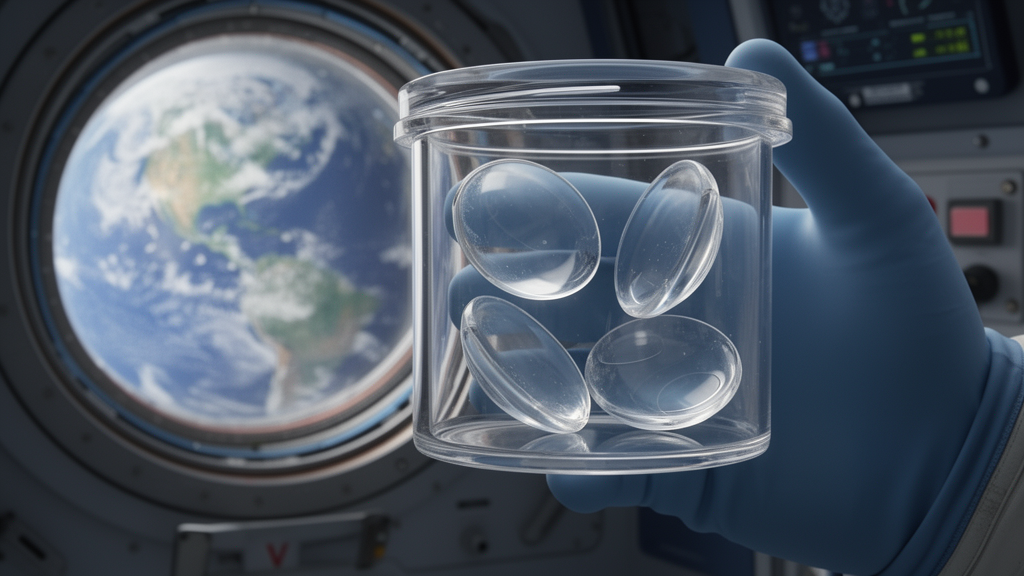
As humanity prepares for longer journeys to the Moon and Mars, one of medicine’s most routine procedures is being reconsidered for an environment where it has never been performed. An eye surgeon with a lifelong passion for space has presented the results of the first controlled experiment to expose modern intraocular lenses directly to the harsh conditions outside the International Space Station, offering a preview of the challenges that future space-based cataract surgery will have to overcome. Dr Morgan Micheletti of the Berkeley Eye Center in Houston, Texas, told the 44th Congress of the European Society of Cataract and Refractive Surgeons in London that cataract surgery will eventually become a necessity as astronauts and civilian travellers spend months in space.
The reasoning behind the project is straightforward yet profound. A transit to Mars can require almost a year, and returning to Earth for a vision-limiting cataract, an injury, or another surgical eye problem may simply not be realistic. Dr Micheletti told the congress that he believes someone will need cataract surgery on Mars within his lifetime, and that treatment will ultimately need to happen where the patient is. Astronaut candidates, he noted, do not need perfect uncorrected vision, and refractive correction or certain prior refractive surgeries are compatible with selection. More importantly, good vision at launch does not prevent aging, radiation exposure, injury or disease later in the mission. As human spaceflight expands beyond career astronauts, the travelling population will become more diverse, and the medical systems that support it must be designed and validated long before the first patient needs them. In his words, we cannot wait until someone is on Mars to ask whether the lens, equipment and sterile supplies survived the trip.
To begin answering that question, Dr Micheletti launched the Joint Assessment Of Material Exposure In Space, or JAMES, project. The experiment flew 135 unpackaged intraocular lenses to the International Space Station, where they were mounted in special carriers positioned at three different exterior locations. The carriers, named CLAIRE, short for Carrier for Lens Analysis in Interstellar Research Expeditions, held lenses at three distinct test sites: Ram, where the lenses were exposed to high levels of atomic oxygen; Zenith, where they received substantial ultraviolet radiation from the Sun; and Underdeck, where they were partially shielded from direct atomic oxygen and solar ultraviolet by being mounted beneath the exposure platform. This placement strategy allowed the researchers to observe how different combinations of space-environment stressors affect lens materials.
Dr Micheletti was careful to explain that the study was not intended to recreate how a packaged intraocular lens would normally be shipped to Mars. Instead, the purpose was to identify potential failure modes under harsh exposure so that better packaging, shielding, storage and material selection strategies can be designed. Testing the lenses inside the station would not answer the same question, because the interior is controlled and pressurised. The team wanted to minimise packaging and, ideally, determine whether these products can be shipped without climate-controlled crew-cabin storage, because mass and volume carry significant costs in spaceflight. Every kilogram launched toward deep space demands fuel, money and payload capacity, so medical supplies that can survive the journey without elaborate protective enclosures would represent a meaningful engineering advantage.
On Earth, 45 intraocular lenses were removed from their original packaging and placed in a control carrier called WILLIAM, the Worldly Interface for Lens Logistics and Integrated Astronomical Monitoring. These control lenses remained at room temperature and atmospheric pressure for the duration of the experiment. After approximately six months in orbit, the 135 flight lenses returned to Earth for laboratory analysis. The current analysis included 61 of the space-flown lenses and 20 of the 45 terrestrial controls, a total of 81 lenses. Dr Liliana Werner and her team at the Intermountain Ocular Research Center at the University of Utah examined each lens for overall clarity, how well the lens materials remained intact, and whether any deposits or surface changes had developed during the mission.
The results revealed a spectrum of responses to the space environment. Most of the lenses, 42 of the 61 analysed, showed no notable exposure-associated findings when examined. The remaining 19 lenses displayed three principal patterns of change. In the most directly exposed Ram tray, eight of the nine lenses showed cracks and localised surface roughening consistent with early atomic oxygen erosion. All eight were acrylic lenses, including five hydrophobic and three hydrophilic designs, while the ninth lens, made of silicone, showed yellow discoloration instead. Atomic oxygen, the highly reactive form of oxygen that predominates in low-Earth orbit, is a well-known hazard for spacecraft surfaces, and these findings suggest it can degrade certain ophthalmic materials even over a relatively short orbital stay.
The second pattern involved yellow discoloration in five space-exposed lenses, including two hydrophobic acrylic and three silicone lenses. Four of these were located in the Zenith tray and one in the Ram tray. Spectrophotometry measurements showed lower light transmission in the affected lenses, particularly between 400 and 500 nanometres, the blue region of the visible spectrum that is essential for colour perception and contrast. This finding is especially relevant for a device whose entire purpose is to transmit light clearly to the retina. A yellowed lens inside an eye would act somewhat like a permanent filter, subtly altering the colour and quality of the vision it delivers, which could matter for pilots, scientists or anyone performing precision tasks in space.
The third and perhaps most puzzling pattern emerged among the light-adjustable lenses. All six of these space-exposed lenses, located across all three positions on the station’s exterior, developed a similar cobblestone or bubble-wrap appearance on both surfaces and along the optic edge. Neither of the two corresponding terrestrial controls showed this appearance. The mechanism behind the change remains unknown, and the researchers note that an explanation unrelated to direct space exposure cannot yet be excluded. Light-adjustable lenses are a sophisticated class of intraocular lenses whose optical power can be fine-tuned after implantation using ultraviolet light, making any unexplained surface alteration on their polymers particularly worthy of investigation before such devices are trusted on a mission where no replacement is available.
Dr Micheletti stressed that this was an exploratory, descriptive study, not designed to compare different makes or types of lenses or to test a formal hypothesis. The analysis covered a selected subset of the payload, sample sizes were small and uneven, and in some carrier positions there was only one lens of a given model. The lenses were deliberately unpackaged, so handling or environmental contamination could not be fully excluded, and the control lenses did not undergo launch, return or flight handling, which limits attribution of the observed changes specifically to external exposure. Beyond transmission spectrophotometry, image-quality, mechanical and clinical-performance testing has not yet been completed. The findings, he cautioned, should not be used to rank manufacturers or lens models and do not imply any safety concern for routine cataract surgery on Earth. What they do suggest is that lens material and exposure location may influence the changes observed, and that packaging, shielding and storage are the next protective strategies to test. The engineering challenge, he said, will be providing enough protection without adding unnecessary mass, because every kilogram sent into space carries a cost.
The significance of the work was underlined by Dr Joaquín Fernández, ESCRS Secretary, CEO of Qvision and Medical Director of the Andalusian Ophthalmology Institute at Vithas Hospitals in Almería, Spain, who was not involved in the research. He observed that as more people travel into space and for longer periods, eye surgery will likely be required at some point, making it imperative to understand how lenses and other surgical materials behave beyond Earth’s atmosphere, and he described the research as forward-thinking and certain to play an important role in preparations for deep space exploration. The JAMES study is, to the investigators’ knowledge, the first controlled experiment to expose multiple modern intraocular lens materials directly to the external low-Earth-orbit environment and return them for laboratory analysis. While published clinical reports have described astronauts who flew with implanted lens devices, those devices were protected inside the eye and body, so preimplantation exposure had never been studied. Dr Micheletti now hopes to investigate how a phacoemulsification system, the ultrasound and fluidics platform at the heart of modern cataract surgery, performs during the brief microgravity of parabolic flights, with the longer-term path leading to sustained microgravity testing and eventually an in-orbit surgical experiment. His guiding philosophy is deliberate: first the materials, then the equipment, then the procedure, and ultimately the surgery, in the hope of helping make the first eye operation beyond Earth a reality.
Subject of Research: Exposure of intraocular lenses to the low-Earth-orbit environment outside the International Space Station to assess their suitability for space-based cataract surgery.
Article Title: ‘Space: The final frontier’ for cataract surgery!
Article References: ‘Space: The final frontier’ for cataract surgery!. (n.d.). Original publication
Image Credits: AI Generated
DOI: Not provided
Keywords: intraocular lenses, cataract surgery, International Space Station, space medicine, atomic oxygen, ultraviolet radiation, light-adjustable lenses, Mars missions, ophthalmology, JAMES project, low-Earth orbit, ESCRS
Cite Scienmag News
Ophelia Keating. (October 9, 2026). Intraocular Lenses Endure Six Months in Space for Future Cataract Surgery. Scienmag. https://scienmag.com/intraocular-lenses-endure-six-months-in-space-for-future-cataract-surgery/
Ophelia Keating. "Intraocular Lenses Endure Six Months in Space for Future Cataract Surgery." Scienmag, 9 October 2026, https://scienmag.com/intraocular-lenses-endure-six-months-in-space-for-future-cataract-surgery/. Accessed 9 October 2026.
Ophelia Keating. "Intraocular Lenses Endure Six Months in Space for Future Cataract Surgery." Scienmag. October 9, 2026. https://scienmag.com/intraocular-lenses-endure-six-months-in-space-for-future-cataract-surgery/


