


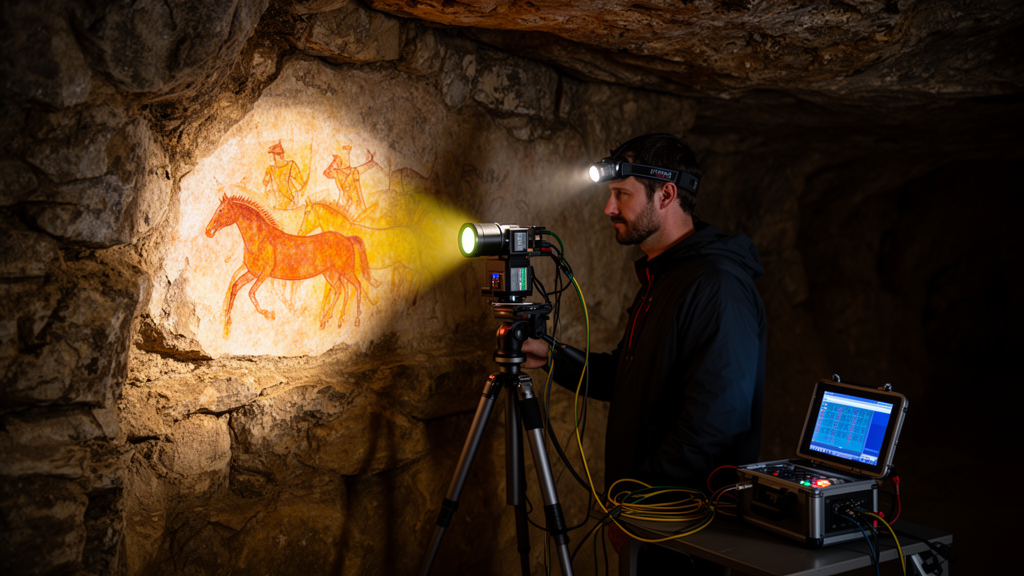
Deep in the granite foothills of the Altai Mountains in Xinjiang, China, a cave wall has been quietly holding onto secrets that the human eye alone could never recover. A team of Chinese researchers has now used hyperspectral imaging, a technique borrowed from remote sensing and satellite science, to peel back layers of faded pigment and reveal a painted chronology stretching from the early Bronze Age to the era of Mongol rule. Their study of the Tangbaletasi Cave Paintings, published in npj Heritage Science, suggests that this remote shelter was not a single artistic moment but a palimpsest of beliefs, revisited and repainted across millennia by communities with profoundly different worldviews.
The site itself is dramatic. Two sets of paintings, designated C1 and C2, adorn the inner walls of naturally formed caves along an east-west oriented granite ridge in Fuyun County, roughly 70 kilometres from the county town. The two panels are separated by about 40 metres of vertical elevation and 112 metres of horizontal distance, and a circular stone mound tomb built of white pebbles lies approximately 100 metres from the cave entrances. Panel C1 stretches roughly 20 metres in length and 11.8 metres in width, while C2 contains 51 independent compositions distributed along both walls and even onto the ceiling. The paintings’ good state of preservation, unusual for open rock art in this harsh environment, is precisely what makes the site such a valuable archive.
The technical heart of the study lies in how the team saw the invisible. Working in two stages, the researchers first captured high-resolution digital photographs of the entire rock art panels using a Canon EOS 5D Mark IV camera, magnifying the images block by block to flag suspicious micro-traces and areas of superimposition. These regions of interest were then scanned with a Specim IQ hyperspectral camera, which records reflected light in 180 narrow spectral bands between 400 and 930 nanometres, far beyond the discrimination of human vision. After radiometric calibration against a standard white reference and removal of noisy bands, the resulting data cubes were processed using Independent Component Analysis, a statistical method that performs blind source separation to extract distinct pigment signatures, and the Spectral Angle Mapper algorithm, which classifies regions sharing identical or similar spectral compositions using a maximum spectral angle threshold of 0.8 radians.
The payoff was immediate and striking. In panel C2, hyperspectral imaging revealed two motifs, labelled C2-50 and C2-51, that are completely invisible to the naked eye. Crucially, one visible figure, C2-41, was found to be superimposed over the hidden C2-51. The ICA components showed that the red and green areas correspond to genuinely different pigments rather than variations of a single material, and the spectral curves confirmed the distinction. Because the outlines of C2-41 are continuous and intact while C2-51 appears fragmented and truncated, the team concluded that the hidden motifs predate the horned anthropomorphic figures that dominate the panel, evidence of a painting sequence older than anything previously documented at the site.
The same analytical machinery resolved a long-standing ambiguity in panel C1. One blurred motif, C1-12, had resisted identification for years, its faint traces lost against the naturally reddish granite. Hyperspectral processing revealed it to be a crossed vajra, one of the most recognisable symbols in the Tibetan Buddhist visual system, representing indestructible wisdom and the firmness of the dharmadhatu. Alongside it, the panel preserves three instances of Sanskrit mantras rendered in Tibetan script, complete with termination marks and, in one case, a Tibetan seed syllable, features central to the textual traditions of Buddhist mantra practice. These are not casual doodles but technically literate reproductions of an institutionalised religious vocabulary.
Dating the imagery required a different toolkit. In the absence of direct scientific dating, the researchers built a relative chronology through iconographic comparison anchored to two benchmarks: the Chemurchek culture, which flourished between roughly 2500 and 1700 BCE, and the broader Early Bronze Age from about 3000 to 1000 BCE. The bell-shaped anthropomorphic figure C1-2, positioned at the centre of C1’s rear wall, closely resembles figures carved on stone slabs at the Khar Chuluut-1 monumental ceremonial enclosure in Mongolia’s Bayan-Ölgii Province, structures that radiocarbon dating places before the mid-third millennium BCE. A comparable motif also appears at Dundebulake-1 in Altai Prefecture, Xinjiang. Because northern Xinjiang formed part of the wider Chemurchek cultural interaction sphere, the team attributes C1-2 to the early Chemurchek period, making it one of the oldest images in the cave.
The horned anthropomorphic figures that crowd panel C2 tell a slightly later story. These figures, marked by short horn-like lines on the head, frequently cluster around X-shaped symbols and appear in groups; some display rounded abdomens with small circular marks that earlier scholars have interpreted as possible indications of pregnancy, while three figures hold bows and arrows. Their closest parallels lie in the Samus, Karakol, and Okunev cultures of the Altai and southern Siberian Bronze Age, spanning roughly 2500 to 1000 BCE. The researchers also demonstrated that apparent colour differences among some figures, such as motifs C2-45 through C2-48, are deceptive: ICA analysis confirmed they share the same pigment composition, with the visual variation caused by water rusting rather than separate painting episodes, a cautionary lesson in how weathering can manufacture false chronologies.
Perhaps the most tantalising question concerns the three-eyed face C1-1, with its seventeen radiating head lines, concentric-circle eyes, a third eye on the forehead, and an arc-shaped beard. Its formal traits echo the sun-headed and multi-eyed figures of the Okunev tradition, often discussed within shamanic interpretive frameworks, and some team members noted a visual resemblance to Tibetan Buddhist wrathful deities such as White Mahakala. Yet the authors are deliberately cautious. The weathering of C1-1 is substantially heavier than that of the confirmed Buddhist motifs, and its pigment appearance differs markedly, arguing for a different and earlier phase of execution. The similarity, they conclude, is best understood as formal resemblance rather than evidence of religious continuity, and the motif’s precise meaning and dating remain open pending scientific dating.
The Tibetan Buddhist layer, by contrast, can be situated historically. Under the Yuan dynasty, which ruled from 1271 to 1368, imperial patronage carried Tibetan Buddhist ideas and iconography into frontier zones well beyond the Tibetan Plateau, and a second wave of transmission accompanied the eastward migration of the Torghut tribe during the mid to late Qing dynasty, which brought lamas and monasteries into the Altai. Within this framework, the researchers hypothesise that the Buddhist motifs at Tangbaletasi could have first appeared as early as the Yuan period. Notably, the later painters did not erase what came before: earlier images remained visible beneath and beside the mantras and vajra-crosses, producing a genuine coexistence of visual systems within a single cave space.
What was the cave for? The team is careful to frame its answer as a working hypothesis grounded in converging spatial evidence rather than a single smoking gun. The site conforms to regional patterns documented for anthropomorphic rock art across the Altai, occupying a consistent elevation band, lying close to water sources, and opening onto a south-facing rock face. Its proximity to a burial mound echoes wider Inner Asian associations between image-bearing sites and commemorative landscapes. Inside, the compositions, horned figures arranged in clusters around fire-like symbols, symbolic avatars rather than portraits of real people, suggest collective, non-domestic activity rather than everyday life. The authors acknowledge their limitations honestly: no direct scientific dating was performed, and no excavation data underpin the functional interpretation. But the picture that emerges is compelling, a mountain shelter where Bronze Age ritual specialists, and centuries later Buddhist practitioners, each found reason to leave their mark on the same sacred stone, layer upon layer, across four thousand years of human belief.
Subject of Research: Chronology and function of the Tangbaletasi Cave Paintings in Xinjiang's Altai region using hyperspectral imaging and iconographic analysis
Article Title: Chronology and function of Tangbaletasi cave paintings via hyperspectral and iconographic analyses
Article References: Huang, F., Fu, Y., Zhou, G., Li, L., Chai, Y., Liu, C., Wang, J., Peng, J., & Zhuoya, B. (2026). Chronology and function of Tangbaletasi cave paintings via hyperspectral and iconographic analyses. npj Heritage Science, 14(1), Article 540. https://doi.org/10.1038/s40494-026-02433-7
Image Credits: AI Generated
DOI: 10.1038/s40494-026-02433-7
Keywords: Tangbaletasi Cave Paintings, rock art, hyperspectral imaging, Altai Mountains, Bronze Age, Chemurchek culture, Tibetan Buddhism, Yuan dynasty, Independent Component Analysis, pigment analysis, archaeology, Xinjiang
Cite Scienmag News
Courtney Benton. (October 9, 2026). Hidden Paintings Revealed: Hyperspectral Camera Unlocks Secrets of Altai Cave Art Spanning 4,000 Years. Scienmag. https://scienmag.com/hidden-paintings-revealed-hyperspectral-camera-unlocks-secrets-of-altai-cave-art-spanning-4000-years/
Courtney Benton. "Hidden Paintings Revealed: Hyperspectral Camera Unlocks Secrets of Altai Cave Art Spanning 4,000 Years." Scienmag, 9 October 2026, https://scienmag.com/hidden-paintings-revealed-hyperspectral-camera-unlocks-secrets-of-altai-cave-art-spanning-4000-years/. Accessed 9 October 2026.
Courtney Benton. "Hidden Paintings Revealed: Hyperspectral Camera Unlocks Secrets of Altai Cave Art Spanning 4,000 Years." Scienmag. October 9, 2026. https://scienmag.com/hidden-paintings-revealed-hyperspectral-camera-unlocks-secrets-of-altai-cave-art-spanning-4000-years/


