


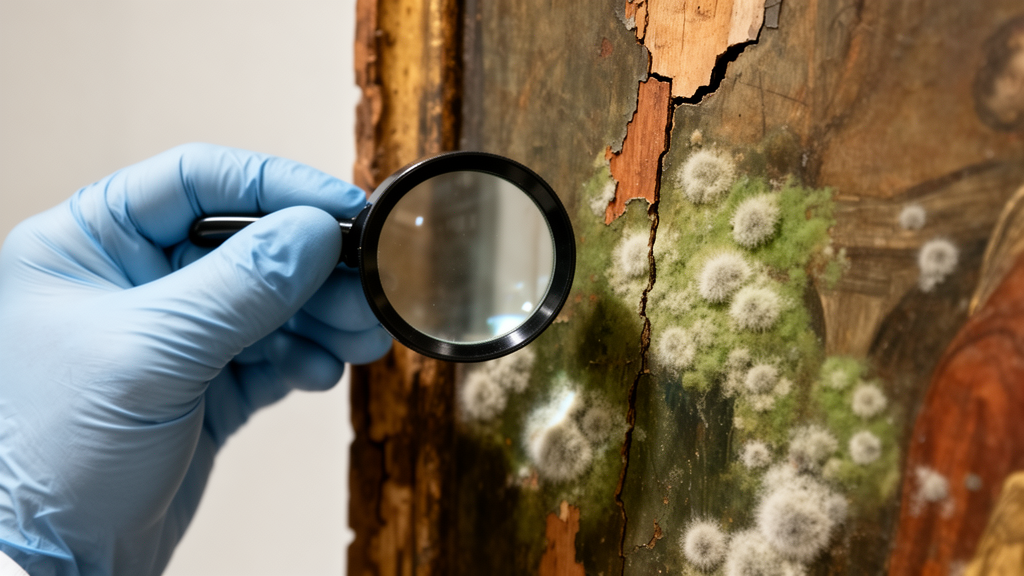
Deep inside the storage and conservation facilities of the State Tretyakov Gallery in Moscow, two fungal strains were recovered from a 16th-century tempera icon, and they have now become the focus of a study that could change how conservators protect centuries-old panel paintings. The fungi, named Syncephalastrum contaminatum STG-160 and Cladosporium sphaerospermum STG-161, were isolated directly from the icon’s surface, where the rich mixture of organic binders and mineral pigments had provided everything they needed to grow. A team of researchers from the Federal Research Centre Fundamentals of Biotechnology of the Russian Academy of Sciences, working with the Tretyakov Gallery, has now published a detailed investigation of how these two organisms tolerate heavy metal ions and how one of them appears equipped, at the genetic level, to extract iron from the very pigments that give the icon its color.
Tempera painting, the technique behind countless Byzantine and early Russian icons, combines egg-based binders with finely ground earth and mineral pigments laid over wooden panels. From a microbiologist’s perspective, this structure is a remarkably complete nutrient medium. The proteins and lipids in the egg binder supply carbon and nitrogen, while the pigments themselves, many of them iron oxides and other metal-containing minerals, supply trace elements. Add the porous, hygroscopic wood beneath and the fluctuating humidity of historic buildings, and the result is a surface that fungi can colonize given only the slightest lapse in environmental control. Once established, these organisms do not merely sit on the paint; their metabolic activity can discolor pigments, degrade binders, and physically disrupt fragile paint layers.
The central question the researchers posed was deceptively simple: how much heavy metal exposure can each fungus withstand before its growth is halved? This measure, known as the inhibitory concentration 50, or IC50, is a standard pharmacological and toxicological benchmark. For Syncephalastrum contaminatum STG-160, the IC50 values were 4.26 millimoles per liter for ferric iron, 10.8 for zinc, 0.22 for cobalt, and effectively zero for cadmium, meaning even trace amounts of cadmium suppressed the organism. Cladosporium sphaerospermum STG-161 told a different story: its IC50 values were 0.81 for iron, 2.16 for zinc, 0.11 for cobalt, and 0.017 for cadmium. In other words, STG-160 is a robust tolerator of iron and zinc but highly sensitive to cadmium, while STG-161 shows a striking degree of cadmium resistance.
These numbers matter because the pigments in historic icons are not chemically inert. Earth pigments such as ochres and siennas are iron oxides; zinc white and zinc-containing compounds appear in later restorations; and trace metals from ground layers, gilding preparations, and environmental deposition can all leach into the paint. A fungus that tolerates high concentrations of iron and zinc can thrive precisely in those pigment areas that a more sensitive organism would avoid. Conversely, a fungus resistant to cadmium, an element rarely abundant in traditional palettes but present through industrial contamination or certain restoration materials, may colonize zones that conservators had considered relatively safe. Mapping metal tolerance onto pigment composition therefore offers a predictive tool: it tells conservators which colored regions of a painting are most likely to sustain fungal growth and thus demand the most thorough biocide treatment.
Perhaps the most intriguing finding came from the genome of STG-160. The researchers identified gene clusters responsible for the synthesis of siderophores, small molecules that fungi and bacteria secrete to scavenge iron from their environment. Siderophores bind ferric iron with extraordinary affinity, allowing the producing organism to pull this vital nutrient out of insoluble minerals, including the very iron oxide pigments used in earth-colored paints. Once bound, the iron is transported back into the cell and reduced to the ferrous form the fungus needs for respiration and enzyme function. In practical terms, STG-160 carries the molecular machinery to mine the icon’s own pigments for food, a process that can leave behind pitting, discoloration, and chemical alteration of the paint layer.
STG-161, by contrast, showed no detectable siderophore production. This absence is consistent with its different tolerance profile: rather than actively extracting iron from pigments, it appears to rely on other nutritional strategies and to distinguish itself instead through its notable resistance to cadmium. The contrast between the two organisms illustrates a broader principle in heritage microbiology. Fungi isolated from the same object, even from the same small patch of paint, can occupy different ecological niches. One may be a pigment-dissolving specialist, the other a generalist capable of surviving toxic conditions. Effective conservation strategy has to account for both.
To connect laboratory measurements with real artwork conditions, the team also worked with mock paint layers, experimental preparations that reproduce the structure and composition of tempera paint without risking damage to the original icon. These mock layers allowed the researchers to observe how the fungi behave on materials resembling the actual paint surface, and to combine those observations with the heavy metal tolerance data. The combined results make it possible to identify pigment areas that require more thorough treatment with biocides, increasing the aesthetic value of the artwork and ensuring appropriate conditions for its display and storage. Rather than applying fungicides uniformly across an entire panel, conservators can target the iron-rich and zinc-rich regions where STG-160 flourishes and the cadmium-affected zones where STG-161 persists.
The study, published in npj Heritage Science, arrives at a moment when museums worldwide are reassessing the microbial risks to their collections. Climate control systems, aging buildings, and the sheer sensitivity of organic binders mean that fungal contamination remains one of the most persistent threats to panel paintings, manuscripts, and polychrome sculpture. Traditional approaches rely on visual inspection and broad-spectrum biocides, but visual signs of fungal growth often appear only after substantial damage has occurred. The approach demonstrated here, combining genomic analysis, quantitative metal tolerance testing, and mock-layer experiments, points toward a more predictive model in which the chemical composition of a painting itself indicates where microbial attack is most likely.
There is also a broader scientific resonance in the findings. The ability of STG-160 to deploy siderophores against iron oxide pigments echoes processes observed in geology and soil science, where fungi weather rocks and mobilize metals on a planetary scale. The same chemistry that slowly transforms stone in the natural world is at work, at a much smaller scale, on the surface of a devotional painting that has survived for nearly five centuries. Understanding this chemistry in detail does more than protect a single icon; it illuminates the universal interactions between microorganisms, minerals, and organic materials that govern the fate of all cultural heritage.
For the Tretyakov Gallery and institutions like it, the practical message is clear. Fungal strains recovered from artworks should not be treated as anonymous contaminants but as distinct organisms whose metal tolerances and genetic capabilities determine where they will strike next. By profiling each isolate, measuring its IC50 values for the metals present in the pigments, and checking for siderophore gene clusters, conservators can build a risk map of the artwork and direct their interventions with surgical precision. The 16th-century icon that yielded STG-160 and STG-161 has thus contributed something unexpected to modern conservation science: a demonstration that the smallest inhabitants of a painting can reveal, through their genes and their tolerances, exactly where its future vulnerabilities lie.
Subject of Research: Heavy metal tolerance and siderophore-mediated pigment degradation by fungi isolated from a 16th-century tempera icon
Article Title: Syncephalastrum contaminatum STG-160 and Cladosporium sphaerospermum STG-161 from the 16th century icon—risks of tempera pigment degradation
Article References: Avdanina, D., Ermolyuk, A., & Troyan, E. (2026). Syncephalastrum contaminatum STG-160 and Cladosporium sphaerospermum STG-161 from the 16th century icon—risks of tempera pigment degradation. npj Heritage Science. https://doi.org/10.1038/s40494-026-03022-4
Image Credits: AI Generated
DOI: 10.1038/s40494-026-03022-4
Keywords: tempera icons, cultural heritage, fungi, siderophores, heavy metal tolerance, pigment degradation, IC50, Cladosporium sphaerospermum, Syncephalastrum contaminatum, biocides, conservation science, npj Heritage Science
Cite Scienmag News
Roger Howard. (October 9, 2026). Fungi Feasting on a 16th-Century Icon Reveal How Heavy Metals Shape Artwork Decay. Scienmag. https://scienmag.com/fungi-feasting-on-a-16th-century-icon-reveal-how-heavy-metals-shape-artwork-decay/
Roger Howard. "Fungi Feasting on a 16th-Century Icon Reveal How Heavy Metals Shape Artwork Decay." Scienmag, 9 October 2026, https://scienmag.com/fungi-feasting-on-a-16th-century-icon-reveal-how-heavy-metals-shape-artwork-decay/. Accessed 9 October 2026.
Roger Howard. "Fungi Feasting on a 16th-Century Icon Reveal How Heavy Metals Shape Artwork Decay." Scienmag. October 9, 2026. https://scienmag.com/fungi-feasting-on-a-16th-century-icon-reveal-how-heavy-metals-shape-artwork-decay/


