


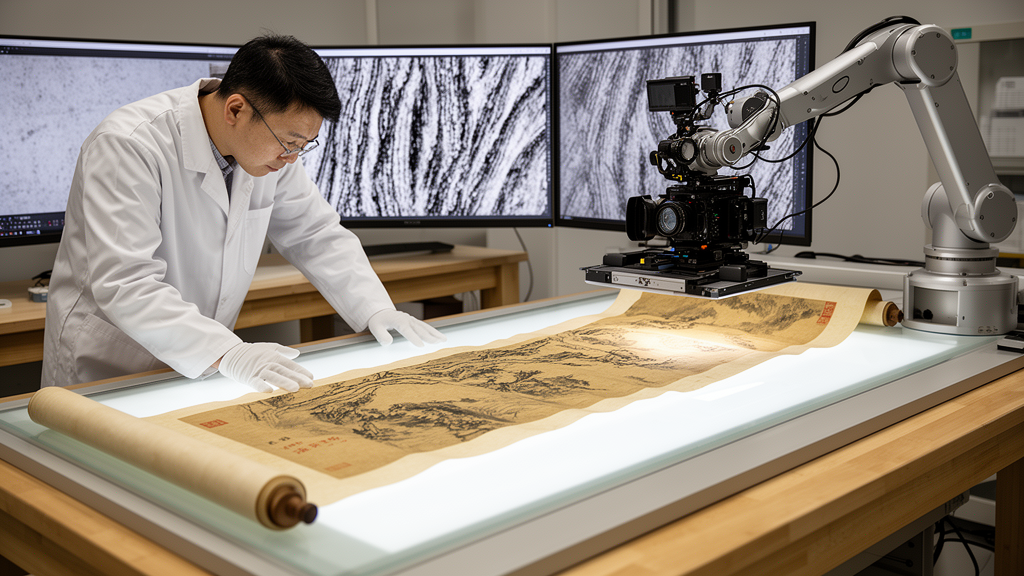
A thousand-year-old scrap of paper bearing a few lines of ink has just been put through a computational interrogation, and the results are stirring fresh debate about how science can judge art. In a study published in npj Heritage Science, researchers led by Jiayue Ma and Chuan Zhao of Hebei University of Science and Technology, together with Xiaotian Tian of Sangmyung University, applied a computer vision framework to Gongfu Tie, a celebrated letter attributed to the Song Dynasty poet and calligrapher Su Shi. Rather than relying on connoisseurship alone, the team measured the physical fingerprints of the brushwork itself, quantifying the geometry, ink density, and boundary texture of individual characters to see whether the disputed letter behaves statistically like the works that scholarship has already authenticated.
Gongfu Tie has long occupied an ambiguous place in the study of Su Shi, one of the most revered literary and calligraphic figures of the eleventh century. Attribution questions of this kind are notoriously difficult because traditional authentication rests on stylistic judgment, provenance records, seals, and the trained eye of experts, all of which are subjective and can disagree. The new study does not claim to replace that expertise, but it offers something the eye cannot easily provide: reproducible numbers. The researchers built a reference dataset from authenticated works of Su Shi and then asked whether the disputed letter’s characters fall inside or outside the statistical envelope defined by those verified exemplars.
The core of the method is a multidimensional feature set that captures three complementary aspects of a written character. The first is the aspect ratio, a structural measure of how a character’s bounding box is proportioned. Calligraphers develop habitual proportions, and deviations in this basic geometry can betray a hand other than the master’s. The second feature is the black-to-white pixel ratio, a tonal measure that reflects how much ink covers the writing surface relative to empty space. This quantity is sensitive to brush pressure, ink loading, and the density of strokes, all of which vary in characteristic ways between an original and a careful imitation.
The third and arguably most revealing feature is the fractal dimension, which quantifies the complexity of a stroke’s boundary. When a calligrapher writes with a brush, ink bleeds into the paper fibers and produces edges that are irregular, organic, and statistically self-similar across scales. When a copyist traces or reproduces a work, however, the contours tend to become regularized: the copying process smooths out the microscopic roughness that the original brush left behind. A fractal dimension computed on the character’s outline captures exactly this difference, rising with genuine boundary complexity and falling when contours have been artificially cleaned up. It is this sensitivity that makes the framework particularly suited to detecting tracing and reproduction artifacts, which are among the most common ways forgeries enter the historical record.
What distinguishes this study from earlier quantitative attempts is its insistence on using all three features jointly. Previous computational approaches often leaned on a single indicator, which the authors argue is fundamentally limiting. A forger might match the proportions of a character while failing to reproduce its ink distribution, or reproduce tonal density while leaving behind unnaturally smooth boundaries. By characterizing structure, tone, and boundary complexity simultaneously, the framework builds a morphological profile that is much harder to fake across the board. The features are also interpretable, meaning that researchers can see which property of a character drives a given result, rather than receiving an opaque verdict from a black-box classifier.
The analytical pipeline combined classical statistics with unsupervised machine learning. After extracting the feature values from characters in the disputed letter and the authenticated reference set, the team performed statistical comparisons to test whether the disputed characters fell within the ranges established by the verified works. They then applied K-means clustering, an algorithm that partitions data points into groups based on similarity, to see whether the disputed characters grouped with the reference material or formed their own separate cluster. Cluster validity evaluation was used to confirm that the resulting groupings were statistically meaningful rather than artifacts of the algorithm’s settings. This combination of methods provides a layered form of evidence: a character must pass multiple independent tests before the analysis would flag it as anomalous.
The verdict, as reported in the study, leans toward authenticity. The character Shi, which appears in the disputed letter and is also the calligrapher’s own name, falls within the statistical ranges of the reference dataset and exhibits clustering behavior consistent with the authenticated works of Su Shi. In other words, on the structural, tonal, and boundary-complexity measures that the framework tracks, the disputed character looks like the genuine article. The authors are careful in their framing: the analysis concerns authenticity-related features, not a definitive certificate of authenticity, and the framework is presented as a computational perspective that complements rather than replaces traditional scholarship.
The significance of the work extends well beyond one letter. Chinese calligraphy is a cornerstone of cultural heritage, and museums, collectors, and scholars routinely face attribution disputes involving works that are centuries old. Physical and chemical analysis can date inks and papers, but such methods are often invasive, and they cannot by themselves distinguish a master’s hand from a skilled contemporary copy made on period materials. Morphological analysis of digitized images offers a non-invasive alternative that requires nothing more than high-resolution photography, making it applicable even to works that are too fragile to travel or too precious to sample. As digitization of museum collections accelerates worldwide, the pool of measurable material is growing rapidly, and frameworks like this one can be scaled across entire corpora.
There are, of course, caveats worth keeping in mind. The reliability of any statistical comparison depends on the size and quality of the reference dataset, and authenticated works by any single historical figure are finite in number. Image quality, scanning conditions, and the physical state of the paper can all influence measured features, so careful preprocessing and standardization are essential. The authors’ emphasis on reproducibility and interpretability addresses some of these concerns, since a transparent pipeline can be re-run, audited, and refined as more verified material becomes available. The study also received no external funding and its authors declare no competing interests, which strengthens confidence in the independence of the analysis.
Still, the demonstration that a disputed Song Dynasty letter can be probed with aspect ratios, ink ratios, and fractal dimensions marks a genuine shift in how heritage science approaches the oldest of questions: is this really the master’s hand? The method turns connoisseurship into measurable evidence, gives curators a new tool for triage, and opens the door to quantitative re-examination of contested works across the entire history of brush writing. For Gongfu Tie, the numbers so far whisper what many scholars have hoped, that the letter belongs among the works of Su Shi. For the field at large, the message is louder: the brush leaves a statistical signature, and now it can be read.
Subject of Research: Quantitative computer vision analysis of the authenticity of the Chinese calligraphy work Gongfu Tie attributed to Su Shi
Article Title: Quantitative analysis of authenticity-related features in Su Shi’s Gongfu Tie
Article References: Ma, J., Ju, Z., Tian, X., & Zhao, C. (2026). Quantitative analysis of authenticity-related features in Su Shi’s Gongfu Tie. npj Heritage Science. https://doi.org/10.1038/s40494-026-03027-z
Image Credits: AI Generated
DOI: 10.1038/s40494-026-03027-z
Keywords: Su Shi, Gongfu Tie, Chinese calligraphy, authentication, computer vision, fractal dimension, K-means clustering, heritage science, npj Heritage Science, ink analysis, attribution, cultural heritage
Cite Scienmag News
Blake Davidson. (October 8, 2026). Computer Vision Puts a Song Dynasty Masterpiece to the Authenticity Test. Scienmag. https://scienmag.com/computer-vision-puts-a-song-dynasty-masterpiece-to-the-authenticity-test/
Blake Davidson. "Computer Vision Puts a Song Dynasty Masterpiece to the Authenticity Test." Scienmag, 8 October 2026, https://scienmag.com/computer-vision-puts-a-song-dynasty-masterpiece-to-the-authenticity-test/. Accessed 8 October 2026.
Blake Davidson. "Computer Vision Puts a Song Dynasty Masterpiece to the Authenticity Test." Scienmag. October 8, 2026. https://scienmag.com/computer-vision-puts-a-song-dynasty-masterpiece-to-the-authenticity-test/


