


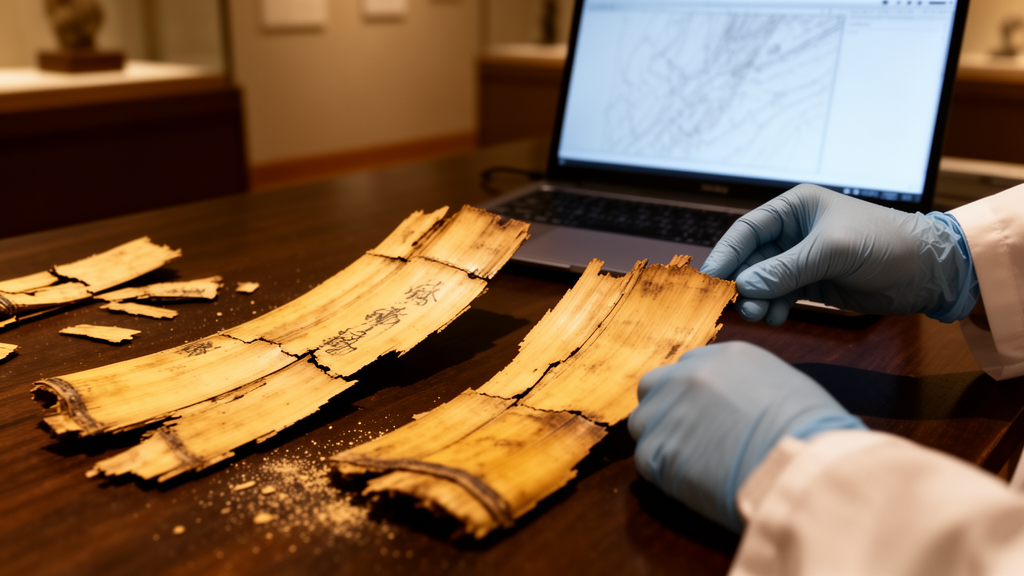
For more than two thousand years, bamboo and wooden slips served as the primary writing medium of early China, carrying laws, letters, ledgers, and literature across generations. When archaeologists excavate these fragile documents today, they rarely emerge intact. Centuries of burial pressure, moisture fluctuation, and biological decay have shattered many slips into narrow, splintered fragments, and reassembling them by hand is a painstaking task that can consume months of expert labor for a single manuscript. A team of researchers in China now reports a computational framework designed to shoulder part of that burden, using three-dimensional scanning and machine learning to align broken slip fragments digitally with a precision that mirrors how a conservator would fit the pieces together.
The new system, called JianduReg, is described in a study published in npj Heritage Science by Teng Wan, Yanna Yang, Fengchen Qi, Qiang Zhang, Ying Qi of Northwest Normal University in Lanzhou, together with Shaoyi Du of Xi’an Jiaotong University. The work addresses a problem that has long frustrated both digital heritage specialists and computer vision researchers: bamboo slips are extraordinarily difficult objects for standard point cloud registration algorithms. Unlike a ceramic pot sherd or a stone block, a bamboo slip is an ultra-thin strip of material whose fracture surfaces are narrow, often abraded, and frequently incomplete because portions of the original material have been lost entirely. The geometric cues that registration methods normally rely on are therefore weak, sparse, and unreliable.
Point cloud registration, at its core, is the task of finding the rigid transformation that brings two sets of three-dimensional points into the best possible alignment. When two fragments of a broken slip are scanned, each produces a cloud of points describing its surface, including the jagged interface where the bamboo split apart. In principle, matching those fracture surfaces should reveal exactly how the pieces fit. In practice, the narrowness of the interface means that only a small fraction of each point cloud carries useful matching information, while the rest describes the flat faces of the slip, the ink-bearing writing surface, and the weathered exterior. A naive algorithm can easily slide one fragment tangentially along the other, producing an alignment that looks plausible in aggregate but leaves a visible gap or overlap at the actual break.
JianduReg attacks this problem with a coarse-to-fine strategy that deliberately restricts the algorithm’s attention to the physically meaningful parts of the fragments. The first stage is semi-automatic: fracture regions are delineated through cropping operations and then refined with expert-guided correction, so that human knowledge about where a slip actually broke is injected into the pipeline before any computation begins. This step matters because it prevents the registration algorithm from being distracted by surfaces that have no matching counterpart on the other fragment. By isolating the broken interfaces, the framework converts an ill-posed global matching problem into a constrained one in which every candidate correspondence lies on a surface that genuinely was continuous before the slip fractured.
With the fracture regions isolated, the framework moves to its coarse alignment stage, which employs an enhanced version of Deep Closest Point, a neural network architecture originally developed for general point cloud registration. The key modification is the incorporation of surface normals alongside raw coordinates. A point’s position tells the network where it sits in space, but the normal vector describes the local orientation of the surface passing through it, and that orientation information is precisely what distinguishes a true fracture match from a spurious one. Two points on opposing fracture faces may be close together in space, but only when their normals point in complementary directions does the pairing represent a genuine physical fit. By jointly encoding coordinates and normals, the network learns a representation that captures the three-dimensional character of the broken interface rather than treating the fragments as undifferentiated point sets.
The coarse pose estimated by the neural module then feeds into a refinement stage built on the iterative closest point algorithm, one of the oldest and most widely used tools in the registration literature. Standard ICP minimizes the squared distance between paired points, which makes it notoriously sensitive to outliers: a single bad correspondence can drag the entire solution away from the correct alignment. The researchers replace this loss with a bidirectional maximum correntropy criterion, a robust statistical measure that down-weights correspondences whose errors fall in the tails of the distribution. In the context of bamboo slips, this robustness is not a luxury but a necessity, because abrasion, material loss, and scanning noise guarantee that many candidate correspondences are simply wrong. The maximum correntropy criterion effectively lets the algorithm ignore the unreliable pairs and concentrate on the trustworthy evidence provided by intact portions of the fracture surface.
The bidirectional formulation adds a further safeguard. Rather than measuring error in only one direction, from the first fragment’s points to the second, the criterion evaluates correspondence quality in both directions simultaneously. This symmetry discourages degenerate solutions in which one fragment’s fracture region collapses onto only a small patch of the other, a failure mode that arises when material has been lost and the two interfaces no longer cover identical areas. By enforcing consistency from both sides, the refinement stage produces alignments that close the fracture gap tightly while avoiding the tangential slipping that plagues conventional methods on thin, elongated objects.
The team evaluated the framework on three tiers of data, a design that strengthens the credibility of the results. On ModelNet40, a widely used benchmark of synthetic three-dimensional shapes, JianduReg demonstrated that its components perform competitively on generic registration tasks. The researchers then constructed synthetic bamboo-slip fragments, which allowed them to control the degree of abrasion and material loss while retaining ground-truth alignments for quantitative comparison. Finally, and most importantly, they tested the system on real scanned Jiandu artifacts, actual excavated bamboo slips whose fracture surfaces carry all the irregularities of two millennia of degradation. Across all three settings, the framework showed improved registration stability, tighter closure of the fracture surfaces, and reduced tangential sliding compared with traditional geometric methods, learning-based baselines, and robust-kernel variants of ICP.
The practical implications extend beyond a single class of artifacts. Bamboo and wooden slips constitute one of the largest bodies of unwritten-in-the-modern-sense textual heritage from early China, and every fragment that can be confidently rejoined potentially restores readable text, a date, an administrative record, or a literary passage. Digital reassembly offers a way to explore these possibilities without ever touching the originals, which is critical because excavated slips are often too fragile to withstand repeated physical manipulation. A reliable registration framework turns the conservator’s trial-and-error fitting process into a computational search that can be run on high-resolution scans, presenting experts with ranked candidate joins that they can verify rather than assemble from scratch. The semi-automatic fracture delineation step also keeps humans in the loop, ensuring that domain expertise about the material and its failure modes continues to guide the machine.
The research, published as an open-access article with support from the National Natural Science Foundation of China and provincial research programs in Shaanxi and Gansu, arrives amid a growing wave of computational heritage science, with related efforts exploring physics-driven deep learning for slip rejoining and corpus-scale reassembly using excavation context. What distinguishes JianduReg is its explicit embrace of the fracture surface as the organizing principle of the entire pipeline, from expert-guided region selection through normal-enhanced neural matching to robust bidirectional refinement. As scanning technology makes high-fidelity three-digitization of fragile artifacts routine, frameworks of this kind suggest a future in which the reassembly of humanity’s shattered written record becomes faster, safer, and more reproducible, one precisely matched fracture at a time.
Subject of Research: Point cloud registration framework for the virtual reassembly of fragmented ancient bamboo slips
Article Title: A fracture surface guided multistage registration framework for bamboo slip point clouds
Article References: Wan, T., Yang, Y., Qi, F., Zhang, Q., Qi, Y., & Du, S. (2026). A fracture surface guided multistage registration framework for bamboo slip point clouds. npj Heritage Science. https://doi.org/10.1038/s40494-026-03039-9
Image Credits: AI Generated
DOI: 10.1038/s40494-026-03039-9
Keywords: bamboo slips, point cloud registration, digital heritage, fracture surfaces, Deep Closest Point, iterative closest point, maximum correntropy criterion, virtual restoration, Jiandu, 3D scanning, cultural heritage, deep learning
Cite Scienmag News
Courtney Benton. (October 9, 2026). AI Learns to Piece Together Ancient Bamboo Scrolls from Their Fracture Surfaces. Scienmag. https://scienmag.com/ai-learns-to-piece-together-ancient-bamboo-scrolls-from-their-fracture-surfaces/
Courtney Benton. "AI Learns to Piece Together Ancient Bamboo Scrolls from Their Fracture Surfaces." Scienmag, 9 October 2026, https://scienmag.com/ai-learns-to-piece-together-ancient-bamboo-scrolls-from-their-fracture-surfaces/. Accessed 9 October 2026.
Courtney Benton. "AI Learns to Piece Together Ancient Bamboo Scrolls from Their Fracture Surfaces." Scienmag. October 9, 2026. https://scienmag.com/ai-learns-to-piece-together-ancient-bamboo-scrolls-from-their-fracture-surfaces/


