

Tuesday, October 27, 2026
Science
No Result
View All Result
  • Login
  • HOME
  • SCIENCE NEWS
  • CONTACT US
  • HOME
  • SCIENCE NEWS
  • CONTACT US
No Result
View All Result
Scienmag
No Result
View All Result
Home Science News Anthropology

Mobile AR keeps restricted heritage sites observable when visitors cannot be there

October 27, 2026
in Anthropology
Courtney Benton
By Courtney Benton Scienmag Editorial Profile - Science and Technology Policy
Reading Time: 2 mins read
0
Mobile AR keeps restricted heritage sites observable when visitors cannot be there

Mobile AR keeps restricted heritage sites observable when visitors cannot be there

65
SHARES
587
VIEWS
Share on FacebookShare on Twitter
ADVERTISEMENT

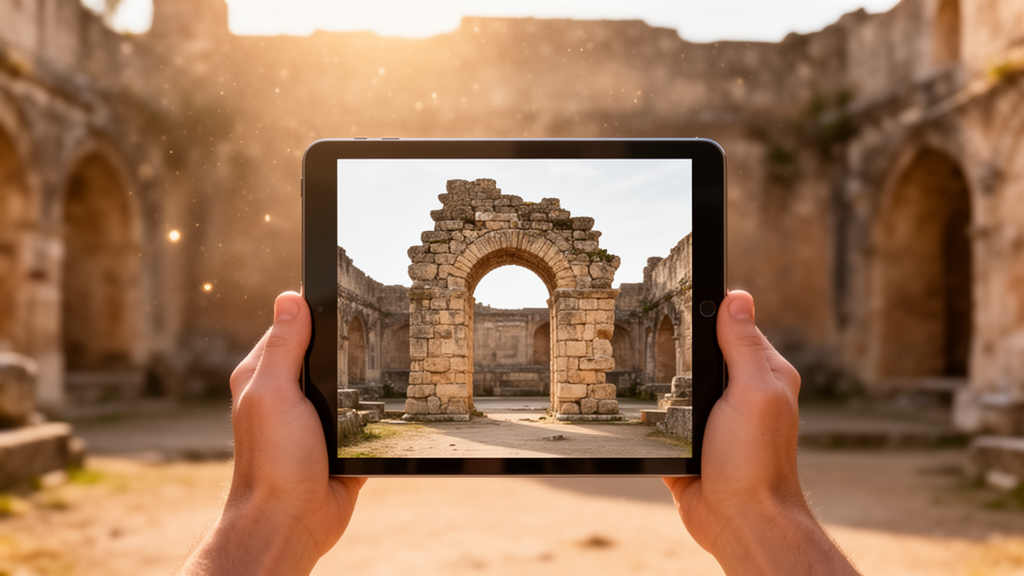
Restricted access to architectural heritage often prevents experts from observing, documenting, and planning preservation work on site. A new study in npj Heritage Science explores how mobile augmented reality (AR) can support stable, structured observation when the deployment space differs from the heritage site itself, a situation the researchers call spatial mismatch.

The team, led by Sunghyun Kim with JiHyung Lee and KiHong Kim, argues that one-to-one physical–virtual correspondence and global registration rarely hold in such settings. Instead of chasing geometric accuracy, they prioritized cognitive coherence, designing the system so that what users perceive remains meaningful and stable even when the virtual reconstruction is not perfectly aligned with the physical room.

Technically, the approach uses a decoupled multi-anchor mapping strategy. Yaw is locked using device sensors, while translation-only corrections from QR anchors reduce rotational leverage, a common source of drift in AR tracking. The system was deployed in an ETRI building as a stand-in for the Seokguram Grotto, a heritage site that visitors and experts cannot freely access.

In that deployment, the overlay stayed perceptually stable across viewing distances. Position jitter measured 0.19 mm, compared with 0.32 mm for a 6-DoF baseline, indicating that the decoupled anchoring strategy reduced instability in the virtual overlay.

The researchers also ran a user study with 32 experts. They found a strong association between perceived AR-specific experience and perceived educational effectiveness, with Spearman’s ρ = 0.86. The authors are careful to note that this correlational association does not establish a causal educational effect; it shows that experts who felt more fluent with the AR system tended to rate its educational value more highly.

Overall, the study positions perceptual stability and cognitive coherence as key design considerations for remote observation of restricted-access heritage.

Subject of Research: Mobile augmented reality for remote observation and preservation planning of restricted-access architectural heritage

Article Title: Mobile AR tele-preservation of architectural heritage under spatial mismatch

Article References: Kim, S., Lee, J., & Kim, K. (2026). Mobile AR tele-preservation of architectural heritage under spatial mismatch. npj Heritage Science. https://doi.org/10.1038/s40494-026-03084-4

Image Credits: AI Generated

DOI: 10.1038/s40494-026-03084-4

Keywords: augmented reality, architectural heritage, Seokguram Grotto, spatial mismatch, QR anchors, cognitive coherence, perceptual stability, remote observation, user study, heritage preservation, tracking jitter, npj Heritage Science

Cite Scienmag News

Courtney Benton. (October 27, 2026). Mobile AR keeps restricted heritage sites observable when visitors cannot be there. Scienmag. https://scienmag.com/mobile-ar-keeps-restricted-heritage-sites-observable-when-visitors-cannot-be-there/


Courtney Benton. "Mobile AR keeps restricted heritage sites observable when visitors cannot be there." Scienmag, 27 October 2026, https://scienmag.com/mobile-ar-keeps-restricted-heritage-sites-observable-when-visitors-cannot-be-there/. Accessed 27 October 2026.

Courtney Benton. "Mobile AR keeps restricted heritage sites observable when visitors cannot be there." Scienmag. October 27, 2026. https://scienmag.com/mobile-ar-keeps-restricted-heritage-sites-observable-when-visitors-cannot-be-there/

Tags: AR deployment in inaccessible sitesAR in restricted access locationsAR tracking accuracyarchitectural heritageaugmented realitycognitive coherencedecoupled multi-anchor mappingheritage preservationheritage site documentationheritage site preservationMobile augmented realitynon-intrusive heritage observationnpj Heritage Scienceperceptual stabilityQR anchorsremote observationSeokguram Grottospatial mismatchspatial mismatch in ARstability of virtual overlaysstructured observation with ARtracking jitteruser studyvirtual reconstructions of architectural heritage
Share26Tweet16
Previous Post

India’s threatened plants: 700 Red List species assessed for cultural and medicinal uses

Next Post

Large dogs die young and dog mortality mirrors human death patterns across states

Related Posts

Ancient Yemeni Qadhad Mortar Decoded: Science Reveals Sustainable Building Secrets
Anthropology

Ancient Yemeni Qadhad Mortar Decoded: Science Reveals Sustainable Building Secrets

October 27, 2026
Cultural identity emerges as strongest predictor of digital heritage engagement
Anthropology

Cultural identity emerges as strongest predictor of digital heritage engagement

October 27, 2026
Ancient Segesta Temple Reveals Its Secrets Through Ambient Vibration Analysis
Anthropology

Ancient Segesta Temple Reveals Its Secrets Through Ambient Vibration Analysis

October 27, 2026
Sinan stone composite heals its own cracks within seconds
Anthropology

Sinan stone composite heals its own cracks within seconds

October 26, 2026
Heritage–tourism coordination in Chinese cities is highly scale-sensitive
Anthropology

Heritage–tourism coordination in Chinese cities is highly scale-sensitive

October 24, 2026
X-rays reveal how Paulus Potter stretched and enlarged his monumental canvases
Anthropology

X-rays reveal how Paulus Potter stretched and enlarged his monumental canvases

October 24, 2026
Next Post
Large dogs die young and dog mortality mirrors human death patterns across states

Large dogs die young and dog mortality mirrors human death patterns across states

  • Mothers who receive childcare support from maternal grandparents show more optimized

    Mothers who receive childcare support from maternal grandparents show more parental warmth, finds NTU Singapore study

    27656 shares
    Share 11059 Tweet 6912
  • University of Seville Breaks 120-Year-Old Mystery, Revises a Key Einstein Concept

    1061 shares
    Share 424 Tweet 265
  • Bee body mass, pathogens and local climate influence heat tolerance

    682 shares
    Share 273 Tweet 171
  • Researchers record first-ever images and data of a shark experiencing a boat strike

    546 shares
    Share 218 Tweet 137
  • Groundbreaking Clinical Trial Reveals Lubiprostone Enhances Kidney Function

    531 shares
    Share 212 Tweet 133
Science

Embark on a thrilling journey of discovery with Scienmag.com—your ultimate source for cutting-edge breakthroughs. Immerse yourself in a world where curiosity knows no limits and tomorrow’s possibilities become today’s reality!

RECENT NEWS

  • Diatoms Strip Silicon from Geothermal Brine While Keeping Lithium and Making Omega-3s
  • Lactate tag on RPA1 drives DNA repair and breast cancer chemoresistance
  • Large dogs die young and dog mortality mirrors human death patterns across states
  • Mobile AR keeps restricted heritage sites observable when visitors cannot be there

Categories

  • Agriculture
  • Anthropology
  • Archaeology
  • Athmospheric
  • Biology
  • Biotechnology
  • Blog
  • Bussines
  • Cancer
  • Chemistry
  • Climate
  • Earth Science
  • Editorial Policy
  • Marine
  • Mathematics
  • Medicine
  • Pediatry
  • Policy
  • Psychology & Psychiatry
  • Science Education
  • Science News
  • Social Science
  • Space
  • Technology and Engineering

Subscribe to Blog via Email

Enter your email address to subscribe to this blog and receive notifications of new posts by email.

Join 5,151 other subscribers

© 2025 Scienmag - Science Magazine

Welcome Back!

Login to your account below

Forgotten Password?

Retrieve your password

Please enter your username or email address to reset your password.

Log In
No Result
View All Result
  • HOME
  • SCIENCE NEWS
  • CONTACT US

© 2025 Scienmag - Science Magazine

Discover more from Science

Subscribe now to keep reading and get access to the full archive.

Continue reading