


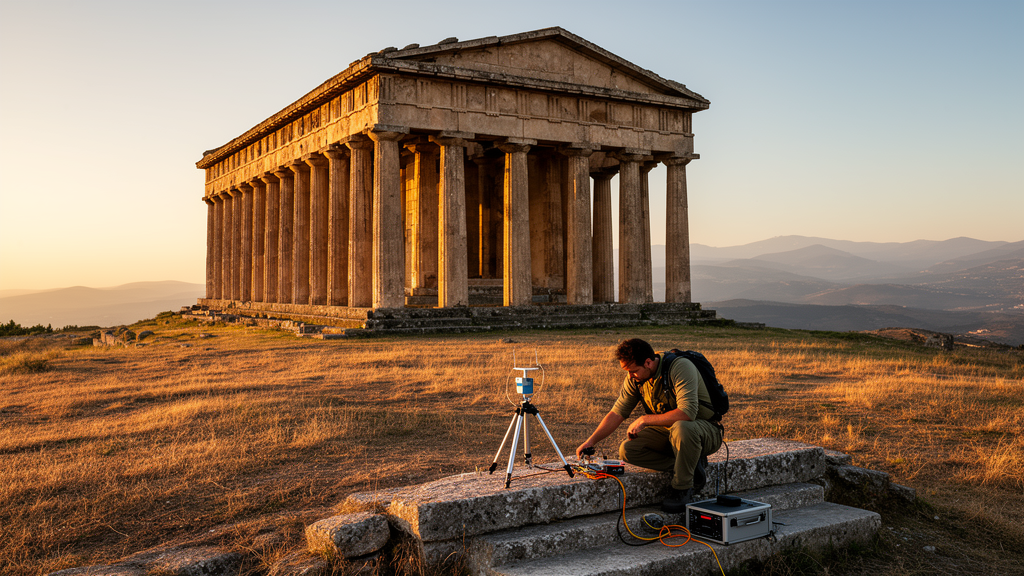
The Temple of Segesta, one of the oldest and best-preserved Doric temples in the Mediterranean, has become the subject of a detailed dynamic characterization study published in npj Heritage Science. The research team, led by Arnaud Montabert with colleagues including Carla Bottari, Luigi Ferranti, Peter Mora, and Klaus-G. Hinzen, combined experimental measurements with numerical modeling. Their work began with a laser-scan-based geometric survey, which, together with earlier investigations, supported the construction of a preliminary numerical model of the structure.
That model in turn guided the placement of sensors for an extensive ambient vibration measurement campaign. The campaign used twelve three-component seismic nodes deployed across 63 positions on the temple. The analysis identified twelve global vibration modes as well as several local modes, in which individual architectural elements move somewhat independently of the whole.
These measured frequencies and mode shapes became the benchmark for calibrating finite-element models of the temple, the numerical counterparts against which the real structure could be compared. The calibration proved revealing. It indicated changes in the elastic properties of the temple's materials, which the authors attribute to degradation over time and to past reinforcement interventions.
The agreement between the recorded response and the model's predictions provided an independent check that the updated numerical representation captures the temple's actual dynamic behavior. The study demonstrates the value of vibration-based model updating as a non-invasive assessment method for heritage structures. Beyond structural health assessment, the authors point to future archaeoseismic applications.
As a case study, the Segesta work illustrates how modern seismic instrumentation, laser scanning, and computational modeling can be integrated to characterize an ancient monument's structural dynamics, establishing a workflow that could be applied to other heritage structures facing seismic risk.
Subject of Research: Dynamic structural characterization of the ancient Doric Temple of Segesta using ambient vibration analysis and finite-element model calibration
Article Title: An integrated experimental and numeric approach to investigate the structural dynamics of the Segesta Temple, Sicily
Article References: Montabert, A., Bottari, C., Burrato, P., Ferranti, L., Nzoumbe-Ekeng, A., Mora, P., & Hinzen, K.-G. (2026). An integrated experimental and numeric approach to investigate the structural dynamics of the Segesta Temple, Sicily. npj Heritage Science. https://doi.org/10.1038/s40494-026-03028-y
Image Credits: AI Generated
DOI: 10.1038/s40494-026-03028-y
Keywords: Segesta Temple, Sicily, ambient vibration, Operational Modal Analysis, finite-element modeling, heritage science, archaeoseismology, structural dynamics, Doric temple, seismic nodes, non-invasive assessment, masonry structures
Cite Scienmag News
Courtney Benton. (October 27, 2026). Ancient Segesta Temple Reveals Its Secrets Through Ambient Vibration Analysis. Scienmag. https://scienmag.com/ancient-segesta-temple-reveals-its-secrets-through-ambient-vibration-analysis/
Courtney Benton. "Ancient Segesta Temple Reveals Its Secrets Through Ambient Vibration Analysis." Scienmag, 27 October 2026, https://scienmag.com/ancient-segesta-temple-reveals-its-secrets-through-ambient-vibration-analysis/. Accessed 27 October 2026.
Courtney Benton. "Ancient Segesta Temple Reveals Its Secrets Through Ambient Vibration Analysis." Scienmag. October 27, 2026. https://scienmag.com/ancient-segesta-temple-reveals-its-secrets-through-ambient-vibration-analysis/


