


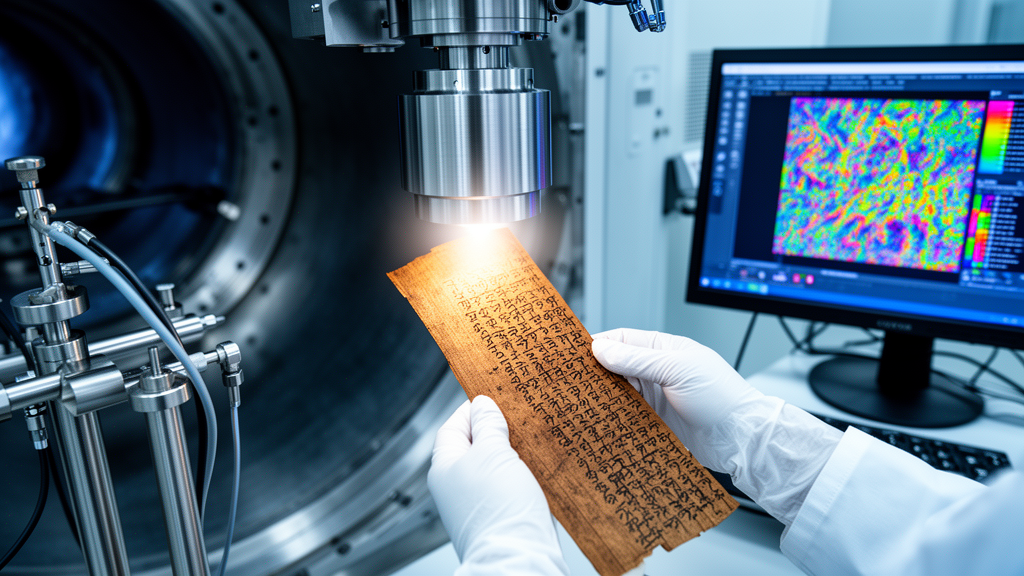
For centuries, palm leaves carried the religious, legal, literary and scientific knowledge of South and Southeast Asia. Inscribed with a stylus and rubbed with carbon-based ink, these fragile folios survived in monasteries, libraries and private collections from India and Sri Lanka to Myanmar, Thailand and Indonesia. Yet the story of how each leaf was cut, boiled, dried, polished and preserved has largely been lost, because historical records of manuscript production are scarce and modern descriptions rarely record the details that matter, such as boiling times, temperatures or the composition of treatment mixtures. Now a team of researchers has shown that the leaves themselves still remember, and that a beam of synchrotron X-rays can coax that memory out.
In a study published in npj Heritage Science, Laura Gallardo of Hamburg University of Technology and colleagues combined three X-ray techniques simultaneously on intact, non-destructively measured manuscripts, modern writing supports and unprocessed palm leaves. Small-angle X-ray scattering, or SAXS, probed the larger-scale organization of the leaf’s fibrillar structure, while wide-angle X-ray scattering, or WAXS, revealed the crystallinity and dimensions of cellulose crystallites. At the same time, X-ray fluorescence, or XRF, mapped the elemental composition of the same scanned region. The measurements were performed at the P62 beamline of PETRA III at DESY in Hamburg and at the BM02 beamline of the European Synchrotron Radiation Facility in Grenoble, with raster scans covering areas of a few millimeters on each object.
The physical challenge is considerable. Palm leaves are lignocellulosic composites in which cellulose microfibrils are embedded in hemicellulose and lignin, with surface waxes and properties that vary with botanical identity and leaf maturity. The two genera most commonly used for manuscripts, Corypha and Borassus, differ in venation, leaf anatomy and stomatal structure, but processing steps such as boiling and polishing alter cellulose crystallinity, porosity and mechanical behavior. Inscription and ink add further modifications, and centuries of ageing, handling and conservation treatments, including oils, botanical extracts and even arsenic-containing compounds, blur the picture further. Any single measurement therefore reflects overlapping influences rather than one identifiable production recipe.
To disentangle these influences, the team extracted physically interpretable descriptors from each scan. From the WAXS patterns they fitted the cellulose Bragg reflections (110), (200) and (004) with Voigt functions, computing crystallinity indices and approximate crystallite sizes, together with a relative amorphous contribution. From the SAXS patterns they quantified fibril orientation by fitting azimuthal intensity distributions with core and halo components in the longitudinal and orthogonal directions. From the XRF spectra, fitted with the pyMCA software, they derived centered log-ratio elemental descriptors, carefully masking inscription regions, which typically showed increased iron and reduced calcium relative to the surrounding support.
These descriptors then fed into a supervised machine-learning framework. Six algorithms were compared, including random forests, support vector machines, logistic regression, gradient boosting and Gaussian process classifiers, using stratified five-fold cross-validation and balanced accuracy to cope with imbalanced class sizes. Crucially, the researchers tested each best model against dummy classifiers and a permutation null distribution, ensuring that the reported classifications reflected genuine structure in the data rather than trivial class imbalance. The team is explicit that the labels, drawn from catalog records, donor documentation, fieldwork and expert assessment, represent the best available classifications rather than independently verified ground truth.
The most reliable result concerned the processing stage. A random forest classifier distinguished unprocessed leaves, modern writing supports and historical manuscripts with high accuracy, correctly assigning 97 percent of manuscripts, and the classification passed all informativeness tests. The cellulose crystallinity index associated with the (200) reflection emerged as the clearest structural marker, showing a broad distribution in unprocessed leaves, lower and narrower values in writing supports, and a further shift toward lower values in manuscripts. This progression indicates that crystallinity is shaped not only by preparation but also by later ageing and degradation. The amorphous contribution followed a non-monotonic trend, rising from raw leaves to writing supports and falling again in manuscripts, suggesting opposing effects of treatment and long-term alteration. Elemental descriptors, particularly copper and nickel, also contributed, and the authors note that elevated copper in processed material could plausibly stem from the use of copper vessels during boiling, although cookware, ink residues, contamination and conservation treatments cannot be distinguished in the present data.
Genus classification proved more subtle. A gradient boosting model separated Borassus from Corypha with the crystallinity index C(200) and the potassium log-ratio as the top features, but a stratified analysis revealed that the separation was far clearer in processed materials than in unprocessed leaves. When the classifier was trained only on unprocessed leaves, its balanced accuracy dropped to 0.65 and relied almost entirely on C(200), whereas the processed subset reached 0.78 with a richer feature basis. The authors conclude that the genus classification is not driven primarily by intrinsic taxonomic markers; instead, processing and degradation introduce changes from which the algorithms learn, so the full-dataset model should not be read as botanical identification independent of material history.
Geographical origin was the hardest task, and the researchers frame it as a comparison of material profiles rather than a provenance tool. Trained on processed samples from India, Indonesia, Myanmar, Sri Lanka and Thailand, the random forest classifier achieved recall above 0.80 for India, Indonesia and Thailand, while Sri Lanka and Myanmar were correctly identified in only 43 and 42 percent of cases. The confusions are historically telling. A recent review of preparation recipes reports similar plant use between Indonesia and India, and Sri Lankan plants are nearly identical to those of Tamil Nadu, which may explain the overlap between Sri Lankan and South Indian material profiles. Thai manuscripts stood out with a distinct and consistent signature, including unusually high crystallinity values. Some Thai preparation recipes are unique in using a kiln to bake the leaves instead of boiling them, and the authors hypothesize that such heat treatment could promote structural rearrangement during drying, although this mechanism remains to be tested directly.
What makes the study broadly significant is its framework rather than any single classification score. Because SAXS, WAXS and XRF are collected simultaneously from the same raster-scanned region, a single synchrotron visit yields structural and compositional information across multiple length scales without taking a single sample from the object. When applied to manuscripts of unknown origin, the trained classifier outputs a probability-based similarity profile across the learned classes, highlighting which collections or traditions a folio most resembles. The authors stress that these outputs must be combined with codicological and historical evidence, and that larger, more balanced datasets will be needed to determine whether observed confusion patterns reflect genuinely shared manuscript traditions or simply underrepresented classes.
For curators, conservators and historians, the message is that the material itself is a document. The cellulose crystallinity of a folio, the orientation of its fibrils and the trace elements distributed across its surface collectively encode the choices of a scribe’s workshop, the chemistry of a boiling pot and the slow chemistry of centuries of storage. By reading those signatures non-destructively, synchrotron analysis offers a scalable way to compare collections worldwide, trace the dissemination of writing traditions across Asia, and guide the preservation of one of the region’s most endangered forms of written heritage.
Subject of Research: Non-destructive multimodal synchrotron X-ray analysis and machine learning classification of palm-leaf manuscripts
Article Title: Multimodal synchrotron X-ray analysis of palm-leaf manuscripts: structural and compositional signatures of botanical genus, manufacture, and provenance
Article References: Gallardo, L., Busch, M., Poliakova, A., Ciotti, G., & Huber, P. (2026). Multimodal synchrotron X-ray analysis of palm-leaf manuscripts: structural and compositional signatures of botanical genus, manufacture, and provenance. npj Heritage Science, 14(1), Article 527. https://doi.org/10.1038/s40494-026-03023-3
Image Credits: AI Generated
DOI: 10.1038/s40494-026-03023-3
Keywords: palm-leaf manuscripts, synchrotron X-ray, SAXS, WAXS, X-ray fluorescence, machine learning, cellulose crystallinity, cultural heritage, provenance, conservation science, South and Southeast Asia, npj Heritage Science
Cite Scienmag News
Teresa Odom. (October 9, 2026). Synchrotron X-rays and machine learning read the hidden fingerprints of palm-leaf manuscripts. Scienmag. https://scienmag.com/synchrotron-x-rays-and-machine-learning-read-the-hidden-fingerprints-of-palm-leaf-manuscripts/
Teresa Odom. "Synchrotron X-rays and machine learning read the hidden fingerprints of palm-leaf manuscripts." Scienmag, 9 October 2026, https://scienmag.com/synchrotron-x-rays-and-machine-learning-read-the-hidden-fingerprints-of-palm-leaf-manuscripts/. Accessed 9 October 2026.
Teresa Odom. "Synchrotron X-rays and machine learning read the hidden fingerprints of palm-leaf manuscripts." Scienmag. October 9, 2026. https://scienmag.com/synchrotron-x-rays-and-machine-learning-read-the-hidden-fingerprints-of-palm-leaf-manuscripts/


