


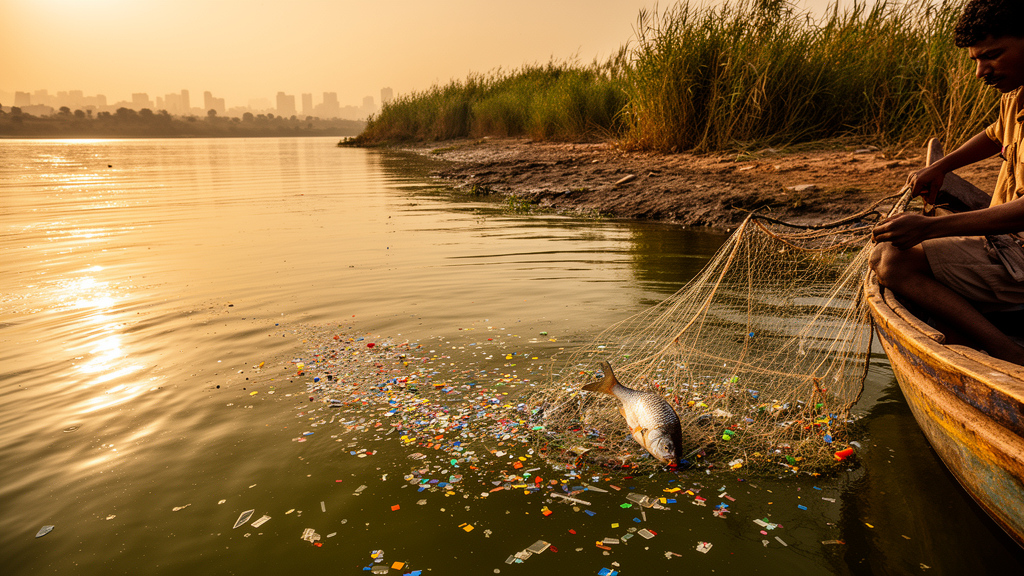
The Nile River, the lifeline of Egypt and much of northeastern Africa, is carrying more than water. According to a new scoping review published in the journal Ecotoxicology, the river’s waters, sediments, and fish are contaminated with microplastics that act as microscopic ferries for a toxic cargo of heavy metals, persistent organic pollutants, antibiotics, and plastic additives. The review, led by Asmaa Mohammad Moawad and colleagues at Cairo University’s Faculty of Medicine, is the first to focus specifically on microplastic-associated toxicants in the Nile, consolidating fifty studies published between 2010 and 2026 into a single, sobering picture of contamination along the world’s longest river.
The numbers are striking. Microplastic particles, dominated by polyethylene, polypropylene, and polystyrene fibers, have been detected in Nile water at concentrations ranging from 2.24 to 3.76 particles per liter, and in river sediments at levels reaching up to 520 particles per kilogram. More alarming still, more than 75 percent of fish sampled from the Nile in Cairo were found to contain microplastics in their tissues. These figures place the Nile alongside other heavily polluted river systems worldwide and confirm what earlier studies, including the landmark 2020 ‘Plastic Nile’ investigation in Cairo, had begun to suggest: plastic pollution has penetrated every compartment of this vast freshwater ecosystem.
What makes microplastics more than a physical nuisance is their chemistry. Plastic particles have large surface areas relative to their volume and hydrophobic surfaces that readily attract organic molecules. Through processes known as physisorption and chemisorption, they bind persistent organic pollutants such as polychlorinated biphenyls and pesticides, along with heavy metals released from industrial and agricultural activity. Experiments cited in the review demonstrate that when aquatic organisms ingest contaminated particles, the pollutants can desorb in the gut and cross biological membranes, effectively delivering concentrated doses of toxins that would otherwise remain dilute in the water column. Plastic additives themselves, including phthalates and other compounds incorporated during manufacturing, can leach from particles over time, adding another layer of chemical exposure.
The review documents clear seasonal dynamics in this contamination. Concentrations of microplastics in the Nile rise during the summer months, a pattern the authors attribute to a combination of factors including increased water use, altered flow regimes, greater runoff, and heightened human activity along the riverbanks during the hot season. Seasonal variation has also been observed in the biological effects of exposure: studies of Nile tilapia have shown that the expression of genes related to muscle performance and immune function varies with both season and habitat, suggesting that warmer conditions may amplify the physiological stress imposed by plastic particles and their chemical passengers.
In aquatic organisms, the consequences of exposure are well documented. Fish, invertebrates, and insect larvae from the Nile exhibit oxidative stress, a biochemical imbalance in which reactive oxygen species damage cellular structures faster than antioxidant defenses can repair them. The review also records immune suppression, slowed growth, and reproductive problems in exposed animals. In chironomid larvae, aquatic insects that live in river sediments and serve as a food source for fish, microplastics have been found both in the larvae themselves and in the protective tubes they build, indicating that contamination is embedded in the benthic food web from its base. These sublethal effects may not kill individual animals outright, but they erode fitness across populations and can ripple through the entire ecosystem.
Bioaccumulation and trophic transfer are central concerns. When small organisms ingest microplastics and are then eaten by larger predators, the particles and their adsorbed chemicals can move up the food chain. Whether microplastics truly biomagnify, meaning concentrations increase at each successive trophic level, remains one of the most debated questions in the field, and the review identifies this as a critical knowledge gap for the Nile specifically. The evidence for chemical biomagnification through plastic-mediated transfer is stronger in experimental settings than in field data, but the sheer prevalence of particles in Nile fish suggests that human consumers who rely on the river’s fisheries are regularly ingesting both plastics and the toxins they carry.
Direct evidence on human health effects from Nile exposure remains limited, and the review is careful on this point. However, the authors draw on a growing global literature linking microplastics and their associated chemicals to tissue buildup, inflammation, and genetic damage in laboratory and biomonitoring studies. Microplastics have now been detected in human blood, lungs, placenta, and other tissues in research from around the world, and chronic inflammation and genotoxicity are recurring themes in experimental toxicology. For the tens of millions of people who depend on the Nile for drinking water, irrigation, and fish protein, these findings raise urgent questions about long-term, low-dose exposure through multiple pathways simultaneously.
The sources of the pollution are as varied as the river’s 6,650-kilometer course. Wastewater inputs, untreated urban discharge, agricultural runoff, and the breakdown of larger plastic debris all contribute. One recent study highlighted an unexpected vector: disposable paper cups, whose plastic linings shed microplastics and leach hazardous substances directly into the river, prompting researchers to describe a ‘paper cups Nile’ phenomenon. Synthetic textiles are another major contributor, releasing microfibers that dominate the particle types found in Nile water. The diversity of sources means that no single intervention will solve the problem; the review calls for better waste management, improved wastewater treatment, and targeted cleanup efforts across the entire basin.
Methodologically, the review also exposes a problem of measurement. Studies of the Nile have used different sampling techniques, size definitions, and identification methods, ranging from visual sorting to micro-FTIR spectroscopy, making it difficult to compare results across sites and years. The authors emphasize the need for standardized monitoring protocols so that trends can be tracked reliably and policy decisions can rest on comparable data. Such standardization is a prerequisite for the kind of basin-wide coordination that the Nile Basin Initiative has begun to promote through its own scoping reports and policy recommendations on plastic pollution.
Ultimately, the review serves as both a synthesis and a warning. It confirms that microplastic pollution in the Nile is not a marginal or localized problem but a systemic one, woven into the river’s water, sediments, and food webs, and inseparable from the toxic chemicals that ride on plastic surfaces. It also charts a research agenda: quantifying trophic transfer and biomagnification in Nile food chains, assessing health outcomes in exposed populations, and establishing long-term monitoring stations along the river. For a river that sustains one of humanity’s oldest civilizations, the message is clear. The plastic age has reached the Nile, and understanding its full consequences will require sustained scientific attention across ecology, toxicology, and public health.
Subject of Research: Microplastic-associated toxicant contamination, bioaccumulation, and health risks in the Nile River
Article Title: Microplastic-associated toxicants in the Nile River: a scoping review of bioaccumulation and health risks
Article References: Moawad, A. M., Haytham, O., & Mahmoud Mahmoud, A. S. (2026). Microplastic-associated toxicants in the Nile River: a scoping review of bioaccumulation and health risks. Ecotoxicology, 35(9), Article 183. https://doi.org/10.1007/s10646-026-03146-0
Image Credits: AI Generated
DOI: 10.1007/s10646-026-03146-0
Keywords: microplastics, Nile River, bioaccumulation, trophic transfer, heavy metals, persistent organic pollutants, ecotoxicology, oxidative stress, Nile tilapia, water pollution, human health, freshwater ecosystems
Cite Scienmag News
Sloane Callahan. (October 9, 2026). The Plastic Nile: Toxic Cargo of Microplastics Threatens River Life and Human Health. Scienmag. https://scienmag.com/the-plastic-nile-toxic-cargo-of-microplastics-threatens-river-life-and-human-health/
Sloane Callahan. "The Plastic Nile: Toxic Cargo of Microplastics Threatens River Life and Human Health." Scienmag, 9 October 2026, https://scienmag.com/the-plastic-nile-toxic-cargo-of-microplastics-threatens-river-life-and-human-health/. Accessed 9 October 2026.
Sloane Callahan. "The Plastic Nile: Toxic Cargo of Microplastics Threatens River Life and Human Health." Scienmag. October 9, 2026. https://scienmag.com/the-plastic-nile-toxic-cargo-of-microplastics-threatens-river-life-and-human-health/


