


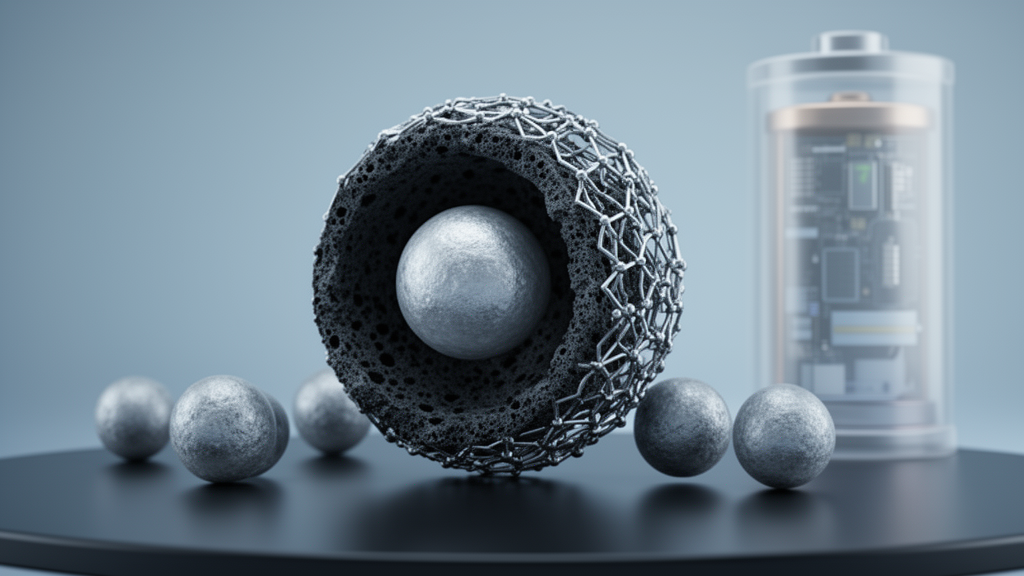
Silicon has long been regarded as the most promising successor to graphite in the anodes of lithium-ion batteries, offering a theoretical lithium storage capacity roughly ten times that of the carbon material that has dominated commercial cells for decades. Yet silicon’s Achilles heel has proved stubbornly difficult to overcome: as lithium ions flood into the material during charging, it swells by up to several hundred percent, cracking particles, fracturing electrodes, and consuming electrolyte until the battery fades away after relatively few cycles. A research team at Dalian University of Technology in China now reports a composite anode design that confronts this problem on multiple fronts at once, combining a yolk-double-shell architecture with a porous carbon scaffold derived from bimetallic metal-organic frameworks and doped with nickel-cobalt alloy nanoparticles.
The study, published in the journal Ionics by Tuo Zhang, Wei Xiao Dong, Ying Yang, Rui Yi Chen, and Ping Chen of the State Key Laboratory of Fine Chemicals, describes a material synthesized through a sol-gel process paired with a MOF self-templating strategy. The resulting composite places silicon at the core of a nested structure in which internal voids and dual carbon shells give the expanding particle room to breathe. After calcination, the bimetallic nickel-cobalt framework transforms into what the authors describe as a concrete-like porous carbon structure embedded with NiCo alloy, a rigid yet permeable matrix that both cushions mechanical stress and conducts electricity.
The electrochemical results reported for the composite are striking. The material retained a specific capacity of 786.1 milliampere-hours per gram after 500 cycles at a current density of 1 ampere per gram, a level of endurance that represents meaningful progress for silicon-based anodes, which frequently lose most of their capacity within far fewer cycles. Equally important for fast-charging applications, the anode delivered an average specific capacity of 335.1 milliampere-hours per gram even at a punishing current density of 5 amperes per gram, indicating that lithium ions and electrons can move through the electrode quickly enough to sustain high-rate operation.
To understand why the design works, it helps to consider the mechanics of silicon lithiation. When silicon absorbs lithium, its crystal lattice distorts dramatically, and the resulting expansion generates stresses that pulverize bare silicon particles and detach them from the conductive network. Conventional approaches have wrapped silicon in carbon shells, but a rigid shell that is too thin ruptures, while one that is too thick adds dead weight and impedes lithium transport. The yolk-shell concept takes a different route: by deliberately leaving void space between the silicon core and its surrounding shells, the structure accommodates expansion internally, allowing the outer architecture to remain intact and electrically connected cycle after cycle.
The bimetallic MOF component adds a second layer of engineering sophistication. Metal-organic frameworks are crystalline lattices of metal nodes linked by organic struts, prized for their enormous internal surface areas and tunable chemistry. When a nickel-cobalt MOF is heated under the conditions used in this synthesis, the organic linkers carbonize while the metal nodes aggregate into alloy nanoparticles dispersed throughout the resulting porous carbon. In the composite anode, this transformation yields a carbon scaffold reinforced with conductive NiCo alloy, which the researchers compare to concrete for its combination of structural robustness and porosity. The alloy phases raise the electrical conductivity of the carbon matrix, shortening the pathways that electrons and lithium ions must travel, while the open pore network facilitates electrolyte diffusion deep into the electrode.
The choice of two metals rather than one is also deliberate. Nickel and cobalt alloys have established track records in electrochemical applications, and bimetallic frameworks allow researchers to tune properties such as catalytic activity, conductivity, and structural stability in ways that single-metal systems cannot easily match. In the context of a silicon anode, the alloy-doped carbon serves as more than passive reinforcement; it helps maintain an unbroken electronic network around particles that are constantly swelling and contracting, a dynamic environment that would quickly isolate more brittle conductive phases.
The synthesis route itself may prove as consequential as the performance numbers. By using the MOF as a self-template, the team avoids elaborate multi-step nanofabrication, letting the framework’s inherent geometry dictate the final architecture as it converts to porous carbon during calcination. Combined with the sol-gel preparation of the silicon-carbon precursor, the process offers a scalable path toward composite anodes whose internal structure is engineered at the nanometer scale without requiring exotic equipment. The authors suggest that this design philosophy provides new ideas for the development of anode materials for lithium-ion batteries, a field where manufacturing practicality often determines whether laboratory breakthroughs reach production lines.
The broader context underscores the stakes. Silicon anodes are already beginning to appear in commercial lithium-ion cells, typically blended with graphite at low percentages to extend driving range in electric vehicles without sacrificing cycle life. Every improvement in silicon’s stability translates directly into batteries that hold more energy per kilogram and charge faster, qualities that automakers and consumer electronics manufacturers are racing to exploit. Strategies reported in recent years, from graphene-wrapped silicon nanosheets to silicon nanowires and pre-lithiated hierarchical carbon composites, have each chipped away at the degradation problem, but a design that simultaneously addresses volume expansion, conductivity, and electrolyte access remains rare.
Rate capability, the composite’s second headline result, deserves particular attention because it speaks to real-world charging behavior. An anode that collapses at high current densities forces batteries to charge slowly, so maintaining a usable capacity of 335.1 milliampere-hours per gram at 5 amperes per gram suggests the porous, alloy-doped architecture keeps ion and electron transport efficient even under aggressive conditions. The combination of high-rate performance with 500-cycle durability at moderate rates indicates that the structural protections are not merely cosmetic but functional across the operating envelope that practical batteries must span.
Challenges remain before such materials leave the laboratory, including demonstrating the synthesis at industrial scale, validating performance in full cells rather than half cells, and confirming long-term behavior under the thermal and mechanical stresses of vehicle operation. The Dalian team’s work was supported by the National Key Basic Research Program, the Liaoning Revitalization Talents Program, and the Dalian Science and Technology Innovation Fund, reflecting sustained institutional investment in next-generation energy storage. Still, by marrying the architectural elegance of yolk-shell voids with the chemical versatility of bimetallic metal-organic frameworks, the study offers a compelling template for taming silicon’s temperamental genius, and a reminder that the future of the battery may be decided as much by clever structural design as by the discovery of new chemistry.
Subject of Research: Yolk-shell bimetallic MOF-reinforced silicon-carbon composite anodes for lithium-ion batteries
Article Title: The electrochemical performance of a yolk-shell bimetallic MOFs reinforced silicon-carbon composite material
Article References: Zhang, T., Dong, W. X., Yang, Y., Chen, R. Y., & Chen, P. (2026). The electrochemical performance of a yolk-shell bimetallic MOFs reinforced silicon-carbon composite material. Ionics. https://doi.org/10.1007/s11581-026-07570-4
Image Credits: AI Generated
DOI: 10.1007/s11581-026-07570-4
Keywords: silicon anode, lithium-ion batteries, metal-organic frameworks, yolk-shell structure, nickel-cobalt alloy, porous carbon, volume expansion, electrochemical performance, sol-gel synthesis, energy storage, anode materials, rate capability
Cite Scienmag News
Faith Mcneil. (October 9, 2026). Yolk-Shell Silicon Anode Reinforced with Bimetallic MOF-Derived Carbon Boosts Battery Durability. Scienmag. https://scienmag.com/yolk-shell-silicon-anode-reinforced-with-bimetallic-mof-derived-carbon-boosts-battery-durability/
Faith Mcneil. "Yolk-Shell Silicon Anode Reinforced with Bimetallic MOF-Derived Carbon Boosts Battery Durability." Scienmag, 9 October 2026, https://scienmag.com/yolk-shell-silicon-anode-reinforced-with-bimetallic-mof-derived-carbon-boosts-battery-durability/. Accessed 9 October 2026.
Faith Mcneil. "Yolk-Shell Silicon Anode Reinforced with Bimetallic MOF-Derived Carbon Boosts Battery Durability." Scienmag. October 9, 2026. https://scienmag.com/yolk-shell-silicon-anode-reinforced-with-bimetallic-mof-derived-carbon-boosts-battery-durability/


