

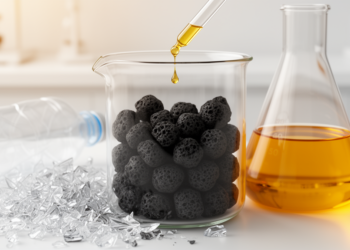
Turning PET Bottle Waste Into Acid Catalysts for Biodiesel
Researchers in Brazil converted discarded PET bottles into sulfonated porous carbon catalysts that achieve 88% oleic acid esterification under mild ...
Researchers in Brazil converted discarded PET bottles into sulfonated porous carbon catalysts that achieve 88% oleic acid esterification under mild ...

Researchers in India have converted Vigna mungo seed skin, a waste byproduct of black gram milling, into KOH-activated porous carbon ...
Researchers at Dalian University of Technology have created a yolk-shell silicon-carbon anode reinforced with nickel-cobalt MOF-derived porous carbon that retains ...
Researchers report a one-step pyrolysis of iron-modified ZIF-8 that yields Fe-N4-doped porous carbon anodes delivering 1180 mAh per gram after ...
A comprehensive review shows how metal–organic framework composites and derivatives are overcoming conductivity and stability limits to power the next ...
An interpretable machine-learning study quantifies how iron loading in biochar improves heavy-metal removal while steadily eroding CO₂ capture capacity, mapping ...
Egyptian researchers have created a magnetically recoverable nanocatalyst, built from MOF-derived porous carbon and onion-peel-synthesized silver nanoparticles, that removes about ...
Chinese researchers have engineered a ZIF-8/cellulose acetate composite porous carbon with a tailored hierarchical pore structure that captures 235.0 mg/g ...

Embark on a thrilling journey of discovery with Scienmag.com—your ultimate source for cutting-edge breakthroughs. Immerse yourself in a world where curiosity knows no limits and tomorrow’s possibilities become today’s reality!