


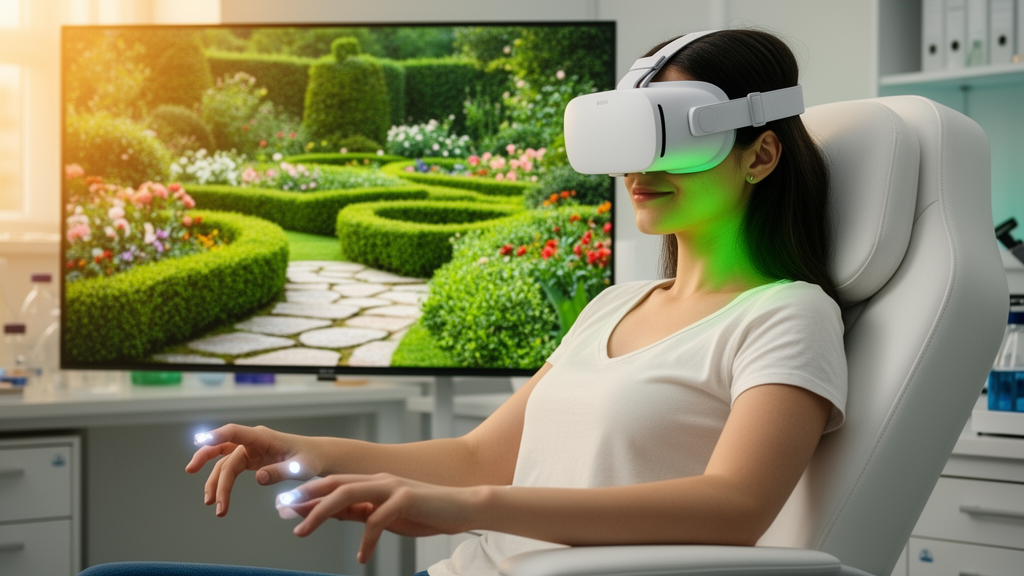
For decades, scientists have documented the remarkable health benefits of spending time in nature, from reduced stress to improved attention and emotional wellbeing. Yet modern humans spend the overwhelming majority of their lives indoors, with surveys indicating that people in the United States spend less than ten percent of their time outside. A new study from Drexel University, published in the October 2026 issue of Building and Environment, now offers a striking twist on this well-known story: carefully designed ornamental gardens may quiet the brain almost as effectively as wild landscapes, while simultaneously awakening the body in a way that untouched nature does not. The findings, generated through immersive virtual reality experiments conducted in partnership with Longwood Gardens in Pennsylvania, suggest that the restorative power of nature can be captured, measured, and perhaps even engineered into the built environments where people spend their days.
The research team, led by doctoral researcher Kevin L. Ramirez-Chavez and senior author Hasan Ayaz, a professor in Drexel’s School of Biomedical Engineering and Science, recruited 32 adults to experience five immersive, 360-degree virtual environments. These digital landscapes were developed with the Antoinette Westphal College of Media Arts & Design’s Digital Media program under the direction of associate professor Nick Jushchyshyn, and were modeled on real settings at Longwood Gardens, the famed 1,100-acre horticultural destination in Kennett Square. The virtual conditions spanned a deliberate spectrum of human curation: an indoor office-like room with no natural elements served as the control, ornamental gardens recreated Longwood’s highly designed Italian Water Garden and Main Conservatory, and natural landscapes drew on the Forest Walk and Meadow Garden, areas characterized by relatively minimal human management.
Each participant spent six minutes exploring the sights and sounds of every virtual site while an array of sensors recorded their brain and body responses. The central instrument was a functional near-infrared spectroscopy, or fNIRS, sensor worn on the forehead. This technology shines near-infrared light into the tissue of the prefrontal cortex, the brain region behind the forehead responsible for executive function, attention, and self-referential thought, and tracks changes in blood oxygenation that reveal how hard that region is working. In parallel, a wristband sensor captured heart rate, heart rate variability, and electrodermal activity, the tiny fluctuations in skin conductance that reflect arousal of the nervous system. Together, these physiological streams offered a window into both cognitive workload and bodily alertness. After each experience, participants also completed surveys assessing their perception of beauty and whether they felt restored.
The results defied the researchers’ expectations in a compelling way. The team had anticipated that responses to the ornamental gardens would fall somewhere between the sterile office and the wild landscapes, forming a simple gradient from built to natural. That is not what the data showed. The fNIRS readings revealed that the curated gardens reduced activity in the prefrontal cortex to nearly the same degree as the natural landscapes, a pattern long associated with mental restoration and cognitive recovery. At the same time, however, the wristband sensors recorded higher electrodermal activity among participants viewing the gardens compared with the office setting, indicating heightened physiological arousal. Participants, notably, still rated the gardens as restorative.
This combination of a quieter brain and a more activated body led the researchers to describe the ornamental condition as producing what they call an aroused fascination. The concept builds on attention restoration theory, which holds that natural environments engage the mind in an effortless, involuntary way that allows directed attention to replenish. The Drexel findings suggest that curated green spaces achieve this mental quieting while also providing a layer of elevated bodily activation, a distinct physiological signature rather than a midpoint on a scale. The ornamental condition was not simply a mid-point between the other two experiences, but a style worth understanding in its own right, particularly for developers, planners and researchers, said Ayaz. We found that these ornamental, curated spaces can quiet the mind almost on par with relatively untouched nature, while also providing the benefit of elevated bodily activation, a condition we refer to as an aroused fascination.
Lead author Ramirez-Chavez emphasized how surprising the bodily signals were. We expected the gardens to fall somewhere between the plain indoor room and the wild landscapes, but that isn’t what the body showed, he said. The ornamental gardens calmed the brain much like the natural scenes did, yet at the same time they put the body on higher alert. That combination showed us that we were looking at a distinct kind of environment, not just a midpoint on a scale from built to natural. By mapping these distinct responses, this work lays the groundwork for eventually designing targeted VR breaks that could help relieve cognitive fatigue among people stuck in windowless spaces.
The control condition produced its own revealing pattern. As the researchers expected, the plain office environment was associated with higher activation in the medial prefrontal cortex, a region linked to internally focused, self-referential thinking. The authors suggest this may reflect the brain turning inward when there is little in the surroundings to engage with, a neural state that can accompany rumination and cognitive fatigue. The natural setting, by contrast, was rated the most restorative of all, and the sensor data confirmed it was less taxing on both the brain and the nervous system than the office environment. Our study shows that these curated green spaces evoke distinct physiological responses and not a simple positive or negative one, Ayaz noted. Researchers and developers need to consider many aspects of brain responses to really understand how humans process exposures to natural elements.
The broader context of the study speaks to a growing public health concern. The health benefits of nature exposure are well-documented, yet the National Human Activity Pattern Survey and the United States Environmental Protection Agency indicate that humans spend less than ten percent of their time outdoors. This widening disconnect, sometimes described as a nature deficit, has been linked to affective disorders, chronic stress, and attentional fatigue. While studies cite many contributing factors, including limited resources and climate change, one of the most frequently cited is the increasing pull of technology itself. The Drexel work proposes a provocative resolution to this paradox: rather than framing technology as the enemy of nature-based restoration, virtual environments could serve as scalable, evidence-based tools for delivering some of nature’s benefits to people who lack convenient access to plants outdoors, including office workers, hospital patients, and residents of dense urban areas.
The team hopes the findings can be used to develop both real-world and virtual ornamental spaces that incorporate elements of nature and built environments to be restorative for the brain and body while also being engaging. For architects, landscape designers, and workplace planners, the concept of aroused fascination offers a new design target: spaces that calm cognitive load while keeping occupants alert and engaged, rather than merely sedated by greenery. Such spaces could prove especially valuable in settings where windowless rooms and screen-dominated work are the norm.
The study, an observational investigation, also acknowledged important limitations. The virtual experiences could not capture every element of real nature, such as smell, airflow, and temperature, which may constrain how broadly the findings apply to physical environments. The authors say future studies that incorporate tasks measuring brain performance and attention, along with different environmental properties such as layout and complexity, would help pinpoint exactly what drives brain and nervous system responses. The research brought together experts from across Drexel, including the School of Biomedical Engineering and Science, LeBow College of Business, and the Antoinette Westphal College of Media Arts & Design. In addition to Ayaz, Jushchyshyn, and Ramirez-Chavez, Adrian Curtin, Felix Maldonado Osorio, and Rajneesh Suri, all of Drexel University, contributed to the work. Ayaz reports a relationship with fNIR Devices, LLC that includes equity. As virtual reality hardware becomes more affordable and physiological sensing more precise, the Drexel findings point toward a future in which the restorative architecture of a garden can be studied neuron by neuron, and perhaps delivered to anyone, anywhere, through a headset and six minutes of carefully curated nature.
Subject of Research: What can virtual reality teach us about nature’s restorative health benefits?
Article Title: What can virtual reality teach us about nature’s restorative health benefits?
Article References: What can virtual reality teach us about nature’s restorative health benefits?. Original publication (Bibliographic details unavailable.)
Image Credits: AI Generated
DOI: Not provided
Keywords: virtual, reality, teach, nature, restorative, health, benefits, scientific research
Cite Scienmag News
Cassandra Pierce. (October 17, 2026). Virtual Reality Reveals How Curated Gardens Calm the Brain While Awakening the Body. Scienmag. https://scienmag.com/virtual-reality-reveals-how-curated-gardens-calm-the-brain-while-awakening-the-body/
Cassandra Pierce. "Virtual Reality Reveals How Curated Gardens Calm the Brain While Awakening the Body." Scienmag, 17 October 2026, https://scienmag.com/virtual-reality-reveals-how-curated-gardens-calm-the-brain-while-awakening-the-body/. Accessed 17 October 2026.
Cassandra Pierce. "Virtual Reality Reveals How Curated Gardens Calm the Brain While Awakening the Body." Scienmag. October 17, 2026. https://scienmag.com/virtual-reality-reveals-how-curated-gardens-calm-the-brain-while-awakening-the-body/


