


Aluminum-air batteries have long been the quiet overachievers of the energy storage world. On paper, they promise a theoretical energy density of roughly 8,100 Wh per kilogram, a specific capacity near 3,000 mAh per gram, and a raw material so cheap and abundant that it is literally the third most common element in the Earth’s crust. Yet despite these extraordinary numbers, aluminum-air technology has never reached the mainstream. A new mini-review published in Frontiers in Batteries and Electrochemistry by researchers from the Instituto Politécnico Nacional in Mexico and the German Aerospace Center in Cologne examines exactly why this gap exists between promise and practice, and what strategies are now being deployed to close it.
The review, led by Luis Fernando Muñiz-Torres and Felipe Caballero-Briones, situates aluminum-air batteries within the broader search for alternatives to lithium-ion technology. Lithium-ion batteries currently dominate the market with energy densities of 150 to 250 Wh per kilogram, but their cycle life of roughly 1,000 to 1,500 cycles remains a limitation, and concerns about lithium availability and environmental impact have intensified the hunt for next-generation systems. Among the candidates based on sodium, potassium, magnesium, and aluminum, aluminum-based batteries stand out for their low cost and long cycle life, with some configurations lasting from hundreds to over 10,000 cycles. Aluminum-battery technology itself splits into three families: aluminum-air, aluminum-ion, and aluminum-sulfur batteries. Of these, the aluminum-air variant is particularly notable for its theoretical energy density, which dwarfs that of conventional lithium-ion cells.
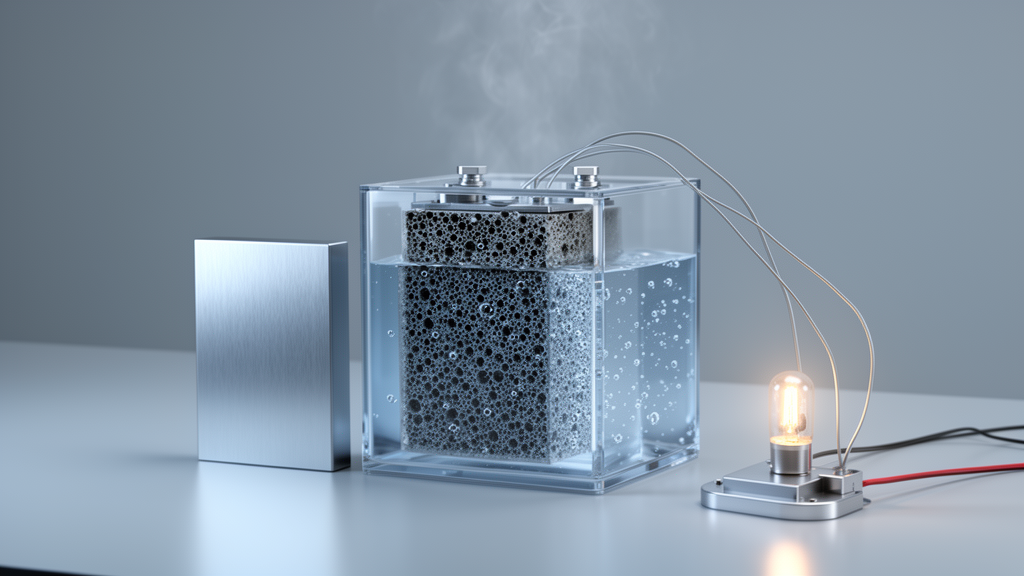
The architecture of an aluminum-air battery is deceptively simple. It comprises an aluminum anode, a porous air cathode, an alkaline electrolyte, and a separator that physically isolates the electrodes while permitting the passage of ions. The air cathode is typically a composite structure including a gas diffusion layer to manage gas transport while preventing electrolyte leakage, alongside a current collector to ensure electron transfer to the external circuit. During discharge, atmospheric oxygen diffuses into the porous cathode and reaches the triple-phase boundary, where gas, liquid electrolyte, and solid catalyst meet. The efficiency of the entire battery is dictated by the pathway of the oxygen reduction reaction, or ORR. The ideal route is the direct four-electron pathway, which reduces oxygen cleanly to hydroxide ions. Alternatively, a kinetically sluggish two-electron pathway may take place, leading to the formation of peroxide intermediates that degrade performance.
Meanwhile, at the anode, hydroxide ions migrate through the electrolyte toward the aluminum, which is oxidized to form aluminum hydroxide while releasing electrons to the external circuit. Here lies one of the central paradoxes of the technology: the very product of the battery’s operation, solid aluminum hydroxide, accumulates on the anode surface and becomes a detrimental physical barrier. This passivation layer hinders the continuous diffusion of hydroxide ions to the active aluminum surface and blocks further electron transfer, ultimately impeding the electrochemical reaction and degrading battery performance. The aluminum anode is also prone to parasitic corrosion in the alkaline electrolyte, which wastes the metal even when the battery is not delivering current. Together, corrosion and self-passivation reduce the effective utilization of aluminum, undermining the theoretical advantages that make the chemistry so attractive.
On the cathode side, the review highlights metal-organic frameworks, or MOFs, as a class of materials that has emerged as a promising solution to the sluggish ORR. MOFs are porous crystalline structures synthesized through hydrothermal methods, where metal ions such as iron are coordinated with organic ligands. Their high surface area and hierarchical porosity optimize the triple-phase boundary, facilitating oxygen diffusion and electrolyte ion transport. MOFs also modulate the Gibbs free energy of oxygenated intermediates, optimizing adsorption and desorption steps and favoring the four-electron pathway. Typically, these materials exhibit half-wave potentials of about 0.80 to 0.90 volts versus the reversible hydrogen electrode and electron transfer numbers approaching 4.0, indicating efficient ORR kinetics comparable to platinum supported on conductive carbon, the commercial benchmark catalyst.
Because pristine MOFs suffer from intrinsically low electrical conductivity, recent research has focused on MOF-derived materials obtained through pyrolysis, which transforms the organic ligands into conductive graphitic carbon while preserving the topological features and dispersing metal nanoparticles. The review describes several categories. MOF-derived carbon materials include a honeycomb-like composite of FeS and Fe3C nanoparticles embedded in nitrogen and sulfur dual-doped carbon, produced by pyrolysis of a single-crystal Fe-MOF, which exhibited a four-electron dominant ORR pathway and at least six hours of stability in alkaline media. Single-metal doped carbon catalysts, such as Fe-Nx active sites embedded in nitrogen-doped carbon matrices derived from Fe-ZIF-8 through melamine-assisted co-calcination, combine a high density of isolated active centers with hierarchical porosity, showing half-wave potentials close to 0.85 volts and performance comparable or superior to commercial Pt/C. Bimetallic-doped carbon catalysts exploit the synergistic effect between two metal centers, as demonstrated by a ZnCo-ZIF hybrid grown in situ on graphene oxide nanosheets, which showed enhanced ORR activity and improved electrical conductivity compared to the pristine framework.
However, the review is candid about the limitations of MOF-derived cathodes. The high-temperature pyrolysis process required for their synthesis is energy-intensive and challenging to scale for industrial production. The instability of active sites during extended alkaline operation can result in performance decline, and single-metal catalysts are frequently constrained by suboptimal adsorption energies of oxygen intermediates, while bimetallic systems may suffer from structural complexity and reduced long-term stability. Perhaps most critically, in an alkaline electrolyte the corrosive environment produced by the aluminum anode and the precipitation of solid aluminum hydroxide byproducts can obstruct the hierarchical porosity of the MOF-derived cathode, blocking oxygen diffusion and mass transport at the triple-phase boundary. The authors point to strategies such as flow-cell designs with circulating electrolytes to remove precipitates, along with hierarchical porous architectures that preserve efficient mass transport, as ways to mitigate this fouling.
On the anode side, protective coatings serve as physical barriers between the aluminum and the aggressive electrolyte, increasing polarization resistance and suppressing parasitic reactions while maintaining ionic transport. Polymer coatings, such as poly(tetrafluoroethylene), have been shown to reduce corrosion current density in alkaline electrolyte, extending the anode’s discharge duration to over 30 hours at 1 mA per square centimeter compared to approximately 5 hours for bare aluminum. Yet hydrophilic variants like poly(vinyl alcohol) tend to absorb water, swell, and eventually detach due to the accumulation of discharge products underneath, while hydrophobic polymers like PTFE and PVDF, despite providing superior corrosion protection, are electrically insulating and can impede ionic transport at high current densities, increasing ohmic losses. PVDF also remains susceptible to long-term chemical degradation through defluorination in strong alkaline environments.
Metal-oxide coatings offer an alternative anti-corrosion strategy, forming stable interfacial barriers that regulate aluminum dissolution while still allowing ionic transport across the interface. Transition metal oxides based on vanadium, manganese, and iron have been shown to significantly reduce corrosion rates, with iron-based coatings demonstrating exceptional 5-volt high-voltage stability by forming robust interfacial compounds involving Fe-F and Al-N bonds that lower the corrosion rate by nearly three orders of magnitude. Carbon-based coatings, meanwhile, create a conductive porous interfacial layer that inhibits oxide formation and minimizes the adherence of aluminum hydroxide, allowing sedimentation while ensuring continuous diffusion of hydroxide ions to the aluminum surface. Carbon black coatings on commercial aluminum alloys have extended the anode’s discharge duration threefold and achieved specific capacities up to 1,210 mAh per gram by keeping the surface electrochemically active, improving electron transfer and reducing charge transfer resistance. Still, highly porous carbon types such as pyrolytic graphite can entrap discharge products within their pores, ultimately obstructing electrolyte access, and carbon coatings exhibit weak adhesion to aluminum.
The review’s conclusion is that no single-component coating can simultaneously provide protection, transport, and stability, and that future research should focus on multifunctional composite coatings, such as polymer-oxide or carbon-oxide hybrids, to synergistically balance corrosion resistance, conductivity, and durability. More broadly, the authors argue that the development of aluminum-air batteries is hampered by research gaps that span the full cell. Degradation byproducts from anode coatings, such as dissolved metal oxides or defluorinated polymers, may migrate and deactivate sensitive ORR catalytic sites at the cathode, meaning that a well-protected anode cannot mitigate cathode deactivation. Conversely, a highly active cathode cannot compensate for rapid electrolyte depletion. Scaling the energy-intensive pyrolysis of MOFs without causing structural variations between batches remains a major industrial obstacle. The authors call for full-cell integration studies that treat the anode, cathode, and electrolyte as an interconnected system rather than isolated components. If these challenges can be overcome, aluminum-air batteries could finally translate their remarkable theoretical energy density into practical, low-cost energy storage for renewable energy systems.
Subject of Research: Challenges and strategies for aluminum-air batteries
Article Title: Challenges and strategies for aluminum-air batteries
Article References: Muñiz-Torres, L. F., Morelos-Santos, O., Ray, A., & Caballero-Briones, F. (2026). Challenges and strategies for aluminum-air batteries. Frontiers in Batteries and Electrochemistry, 5, Article 1842273. https://doi.org/10.3389/fbael.2026.1842273
Image Credits: AI Generated
DOI: 10.3389/fbael.2026.1842273
Keywords: Challenges, strategies, aluminum-air, batteries, scientific research, peer-reviewed research
Cite Scienmag News
Faith Mcneil. (October 17, 2026). Challenges and strategies for aluminum-air batteries. Scienmag. https://scienmag.com/challenges-and-strategies-for-aluminum-air-batteries/
Faith Mcneil. "Challenges and strategies for aluminum-air batteries." Scienmag, 17 October 2026, https://scienmag.com/challenges-and-strategies-for-aluminum-air-batteries/. Accessed 17 October 2026.
Faith Mcneil. "Challenges and strategies for aluminum-air batteries." Scienmag. October 17, 2026. https://scienmag.com/challenges-and-strategies-for-aluminum-air-batteries/


