


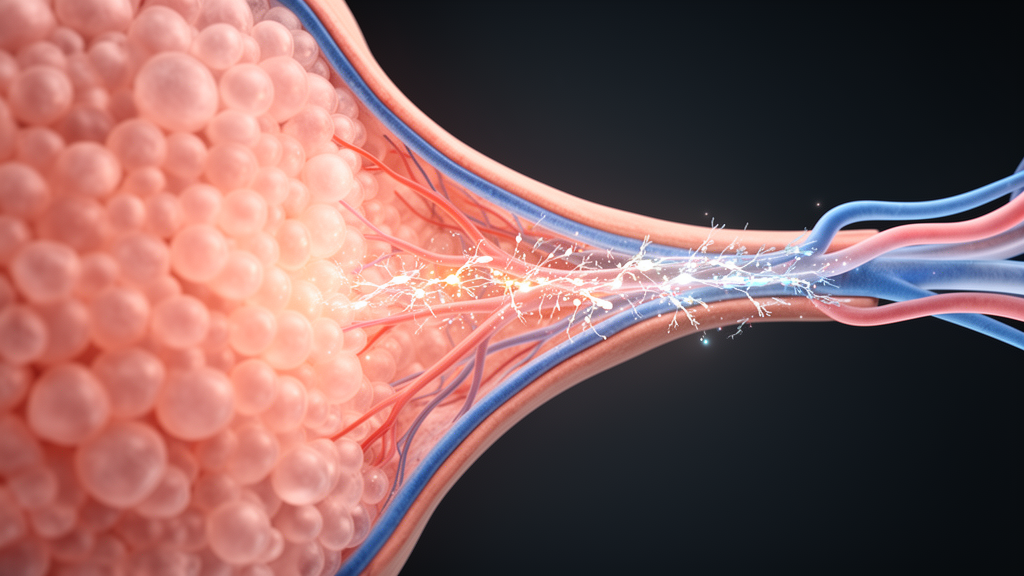
The lung has long been portrayed as a strictly partitioned organ: the branching airways that conduct air form one compartment, and the delicate alveoli where oxygen exchange takes place form another. Each compartment was thought to rely on its own dedicated stem cells for repair, with the boundary between them treated as a fixed line that regenerating cells rarely crossed. A new study published in Nature challenges that view in striking fashion. A team led by Kuo Liu and Bin Zhou, working across institutions in China, has shown that alveolar type 2 (AT2) cells, the canonical stem cells of the alveolar gas-exchange surface, can physically migrate out of their home territory, traverse anatomical boundaries, and transdifferentiate into functional airway cells that repair damaged bronchioles. The finding fundamentally expands the known plasticity of lung epithelial cells and suggests new therapeutic avenues for airway diseases.
The motivation for the work stems from a persistent gap in regenerative biology. Chronic and acute pulmonary diseases, including chronic obstructive pulmonary disease, asthma, pneumonia and bronchiectasis, all involve damage to the bronchial epithelium, and impaired airway regeneration worsens disease progression. Scientists already knew that airway progenitors can mobilize to repair the alveoli, a one-way street of cross-compartmental help. In vitro studies had even suggested that human AT2 cells can become airway basal cells and bronchiolar secretory cells, and similar behavior had been observed in non-human primate injury models. But definitive in vivo evidence was missing, largely because the genetic tools available could not cleanly separate the cell populations involved.
The central technical obstacle was a marker problem. The standard lineage-tracing system for AT2 cells relies on the Sftpc-creER driver, which labels any cell expressing the Sftpc gene. Unfortunately, both genuine AT2 cells and bronchioalveolar stem cells (BASCs), a rare multipotent population sitting at the bronchioalveolar-duct junction that co-expresses Scgb1a1 and Sftpc, light up with this marker. Because BASCs are naphthalene-resistant and known to convert into club cells after injury, any experiment using Sftpc-creER alone could not tell whether newly formed airway cells came from AT2 cells or from BASCs. To break this ambiguity, the team built a series of five complementary dual-recombinase tracing systems that distinguish AT2 cells, BASCs and club cells from one another with unprecedented precision.
The first system, called AT2-tracer1, combined Sftpc-creER labelling with a newly generated Scgb1a1-DTR-GFP knock-in line. In triple transgenic mice, AT2 cells carried only the tdTomato reporter, while club cells and BASCs additionally carried GFP and a diphtheria toxin receptor. Administering diphtheria toxin selectively eliminated all Scgb1a1-expressing cells, wiping out the club cell lining of the bronchioles while leaving pure tdTomato-positive AT2 cells in the alveoli. Four weeks later, lineage tracing revealed that tdTomato-labelled AT2 cells had migrated into the bronchioles and generated tdTomato-positive, GFP-positive club cells. Quantification showed that 77.42 percent, give or take 4.71 percent, of the new club cells originated from AT2 cells, an astonishingly large contribution from a cell type previously thought to stay home.
The AT2-derived cells proved remarkably versatile. Within the bronchioles they differentiated into club cells, AT1 cells, ciliated cells and undifferentiated AT2 cells, all while remaining within the epithelial layer. Clonal analysis using a Confetti multicolor reporter confirmed that individually labelled AT2 cells possess multipotent transdifferentiation capacity at the single-cell level. The researchers also mapped two migratory routes: one through the bronchioalveolar-duct junction, which dominated, and a second through transient channels in the bronchiolar wall lined by AT2-derived AT1-like cells, which served as a supplementary pathway. To rule out artifacts of the toxin-ablation model, the team repeated the experiments with naphthalene injury using a nested dual-recombinase reporter system, AT2-tracer2, and again found that roughly 43 percent of regenerated club cells were of AT2 origin. A third system, AT2-tracer3, allowed simultaneous comparison of club cells, BASCs and AT2 cells in the same mouse, revealing that AT2 cells contributed the majority, about 52 percent, of regenerated club cells, outpacing both BASCs and resident club cells themselves.
Single-cell RNA sequencing then exposed the molecular choreography underlying the fate switch. Pseudotime analysis identified a transient intermediate state marked by expression of Cldn4, the gene encoding the tight-junction protein claudin-4. As AT2 cells progressed through this CLDN4-positive stage, the alveolar program was gradually silenced and the airway secretory program was switched on, with Sftpc expression falling and Scgb1a1 rising. The team built a dedicated genetic system to trace these transient cells directly and found that 62 percent of new club cells passed through the CLDN4-positive intermediate. Critically, deleting Cldn4 in AT2 cells slashed their contribution to club cells from about 66 percent to about 25 percent, demonstrating that this intermediate state is not merely a passive waypoint but a functional requirement for efficient transdifferentiation.
The next question was what instructs the migrating alveolar cells to adopt an airway identity. The answer, it turns out, is Notch signalling delivered by the cells that survive injury. Single-cell analysis showed that Notch pathway genes were upregulated in AT2-derived club cells, and ligand-receptor interaction mapping pointed to JAG1 and JAG2 on residual ciliated cells engaging NOTCH1 and NOTCH2 on the incoming alveolar cells. Functional tests were decisive: deleting the Notch signal transducer Rbpj in AT2 cells nearly abolished club cell conversion, dropping AT2-derived club output from about 38 percent to under 2 percent, while forcing Notch activation through NICD overexpression boosted conversion to about 45 percent. Ablating ciliated cells or deleting Jag1 specifically in ciliated cells, or deleting Notch2 in AT2-derived cells, each independently impaired the transition. Notch therefore acts as a bidirectional rheostat, and when it is disrupted, alveolar cells pile up in the bronchioles without differentiating, thickening airway walls and impairing ventilation.
Equally compelling is the mechanism that summons AT2 cells to the injury site in the first place. Spatial transcriptomics revealed that bronchiolar injury triggers a localized, roughly threefold increase in peribronchiolar immune infiltration, with neutrophils and monocytes secreting the chemotactic factor SPP1, also known as osteopontin. This secreted molecule forms a concentration gradient radiating outward from the damaged bronchioles, and AT2 cells sense it through the integrin subunit ITGB1 on their surface. The evidence chain is thorough: recombinant SPP1 accelerated wound closure and Transwell migration of AT2-like cells in vitro; an SPP1 inhibitor blocked the migratory effect of immune cells in co-culture; pharmacological SPP1 inhibition in living mice reduced bronchiolar coverage by AT2-derived cells; and genetic deletion of Itgb1 in AT2 cells significantly impaired their migration, thickened bronchiolar walls and worsened small-airway function. Matrix metalloproteinases such as MMP9 and MMP14, induced in immune and stromal cells, likely help clear a physical path through the extracellular matrix.
One of the most reassuring aspects of the study is what happens over the long term. At four weeks after injury, AT2-derived club cells still carried residual alveolar and PATS-like transcriptional signatures, raising the question of whether they were truly equivalent to native airway cells. By six months, however, single-cell multi-omics showed that these cells had converged with BASC-derived and club-cell-derived populations at both the transcriptomic and epigenetic levels. The AT2-specific chromatin accessibility signature declined rapidly and stayed low, while club-cell-specific secretory and immune gene programs rose progressively. AT2-derived club cells even retained progenitor capacity, proliferating and generating ciliated cells after a secondary naphthalene challenge. In other words, prolonged repair resolves lineage-specific differences through maturation to a common functional endpoint.
The implications reach well beyond basic biology. Current clinical strategies for airway repair focus on airway-resident stem cells such as basal and secretory cells, but this work suggests AT2 cells could serve as an alternative, and arguably more accessible, cellular reservoir for airway regeneration, particularly given their ability to mature fully into functional club cells. The identification of SPP1-ITGB1 signalling as the migration cue and Notch activation as the fate switch offers two concrete molecular targets for enhancing cross-compartmental repair. The authors are careful to note the caveats: mouse and human lungs differ structurally, and whether a conserved AT2-to-club program exists in humans remains unresolved, though in vitro evidence from human and primate systems is suggestive. Questions also remain about whether AT2 cells pass through a BASC-like state and whether other niche cells contribute. Still, the demonstration that the lung’s two great compartments are connected by a two-way regenerative dialogue rewrites a core assumption of pulmonary biology and opens a genuinely new chapter in the search for therapies that rebuild damaged airways.
Subject of Research: Cross-compartmental transdifferentiation of alveolar type 2 stem cells driving bronchiolar epithelial regeneration in the mouse lung
Article Title: Alveolar stem cells transdifferentiate to drive bronchiolar regeneration
Article References: Liu, K., Liu, Z., Meng, X., Tang, M., Di, F., Wang, Z., Li, C., Yang, S., Zhang, Y., Yang, X., Lv, Z., Li, X., Jin, H., Pu, W., Zhao, H., Li, F., Sui, P., & Zhou, B. (2026). Alveolar stem cells transdifferentiate to drive bronchiolar regeneration. Nature. https://doi.org/10.1038/s41586-026-11127-w
Image Credits: AI Generated
DOI: 10.1038/s41586-026-11127-w
Keywords: alveolar type 2 cells, bronchiolar regeneration, lineage tracing, Notch signalling, SPP1, ITGB1, club cells, CLDN4, lung stem cells, transdifferentiation, ciliated cells, lung injury repair
Cite Scienmag News
Denise Maddox. (October 9, 2026). Alveolar Stem Cells Cross the Lung’s Divide to Rebuild Damaged Airways. Scienmag. https://scienmag.com/alveolar-stem-cells-cross-the-lungs-divide-to-rebuild-damaged-airways/
Denise Maddox. "Alveolar Stem Cells Cross the Lung’s Divide to Rebuild Damaged Airways." Scienmag, 9 October 2026, https://scienmag.com/alveolar-stem-cells-cross-the-lungs-divide-to-rebuild-damaged-airways/. Accessed 9 October 2026.
Denise Maddox. "Alveolar Stem Cells Cross the Lung’s Divide to Rebuild Damaged Airways." Scienmag. October 9, 2026. https://scienmag.com/alveolar-stem-cells-cross-the-lungs-divide-to-rebuild-damaged-airways/


