


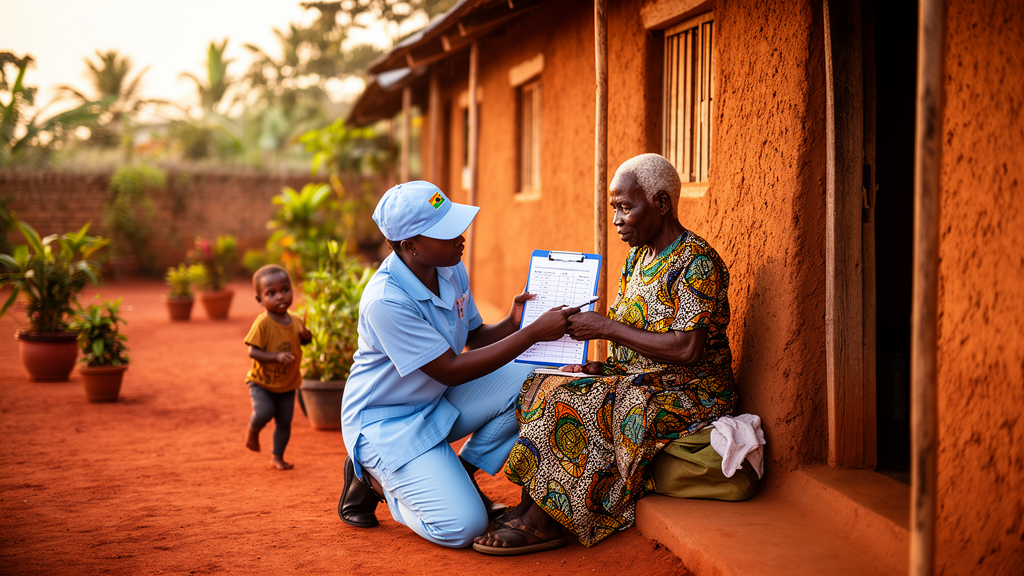
In a quiet but potentially transformative experiment, community health workers in Ghana have shown that a simple paper-and-digital checklist tucked into their routine household visits can uncover hundreds of suspected cases of neglected tropical diseases that would otherwise remain invisible to the health system. A pilot study published in PLOS Neglected Tropical Diseases describes how 64 Community Health Officers across three districts screened households for seven easily observable signs of disease over three months, generating more than 1,100 suspected case observations from 1,932 home visits. The findings offer a practical blueprint for how one of the world’s most persistent public health blind spots might be folded into everyday primary care, and they expose a sobering bottleneck: finding cases is only half the battle, because getting patients through the clinic door proved far harder in some districts than others.
Neglected tropical diseases, a group of 21 conditions clustered in tropical regions with poor access to clean water and sanitation, affect more than 1.7 billion people worldwide. In Ghana the burden is strikingly broad: 14 endemic NTDs have been identified, and at least two of them are present in every district. Schistosomiasis and soil-transmitted helminths occur nationwide, onchocerciasis is found in 53 percent of districts, and lymphatic filariasis in 44 percent. These diseases cause disability, disfigurement, stigma and lost productivity, yet they are largely preventable or treatable. The World Health Organization’s 2021 to 2030 roadmap for NTDs explicitly calls for integrating their control into primary health care as a route toward universal health coverage, the Sustainable Development Goal target that promises essential services without financial hardship. The problem, until now, has been operational: how do you actually detect these conditions in scattered rural households when the health system’s data streams barely register them?
The Ghanaian team, led by researchers from World Vision Ghana, the Kumasi Centre for Collaborative Research in Tropical Medicine and the Ghana Health Service, chose a pragmatic entry point. Community Health Officers already criss-cross their catchment areas conducting home visits, recording maternal health, immunization, nutrition and blood pressure data in a standard register. The researchers convened a five-day technical workshop with the NTD Programme, the Centre for Health Information Management and other stakeholders to select seven syndromic indicators that frontline workers could recognize without laboratory equipment: blood in urine, skin lesions, visible deformities such as clawed or shortened digits, eye complications, lymphoedema or limb swelling, suspected hydrocele, and deep skin wounds with undermined edges. Each indicator maps onto multiple priority diseases. Blood in urine suggests urogenital schistosomiasis; lymphoedema, hydrocele and visible deformities point to chronic lymphatic filariasis; skin lesions and eye signs reflect onchocerciasis, trachoma, yaws, scabies or leprosy-related morbidity.
The pilot unfolded in three districts chosen to represent Ghana’s different ecological zones: Kassena Nankana West in the rural north, Nkwanta South in the middle belt, and the more peri-urban Ga South municipality near the coast. After two-day training sessions covering case definitions, visual aids and basic software skills, the officers deployed the revised register, in both electronic and paper versions, during routine outreach from September to December 2023. The design was deliberately a feasibility test rather than an epidemiological survey: there was no population sampling frame or prevalence estimate, only a question of whether ordinary health workers could absorb the new task and whether the resulting data would be useful. Twenty-three disease control officers, public health nurses and health information officers were trained alongside them to provide supervision and monitoring.
The detection results were encouraging. Skin lesions were the most common finding across all three districts, accounting for the bulk of the 1,117 recorded observations, and the geographic patterns made epidemiological sense. The coastal Ga South district produced 75 percent of all blood-in-urine reports, a hallmark of urogenital schistosomiasis in communities with freshwater exposure. Kassena Nankana West, in the north, contributed 80.8 percent of lymphoedema observations and 67.5 percent of eye-related complications, consistent with chronic filarial disease and eye conditions in that zone. Ga South also dominated the visible deformity count, while deep skin wounds clustered in Nkwanta South and Ga South. For a health ministry long hampered by sparse and fragmented NTD data, the message was clear: community health officers can act as effective surveillance sentinels, generating locally relevant intelligence that could shift resources from uniform interventions toward targeted, equitable allocation.
Uptake of the training was equally strong. Post-implementation monitoring found that more than 85 percent of trained health workers were actively applying the new identification and reporting protocols. In Kassena Nankana West every single trained officer, 21 of 21, was observed implementing the training, compared with 84 percent in Ga South and 83.3 percent in Nkwanta South. Monitoring teams also compared the electronic and paper registers running in parallel and found no major discrepancies that would compromise interpretation, an important signal for a country weighing digital health investments. The authors argue that this high engagement transforms community health officers into more comprehensive primary care practitioners, capable of sustaining an integrated model rather than depending on short-lived vertical campaigns.
Then came the catch. Of the 1,117 suspected cases identified, 615 referrals were made to health facilities, but only 67 percent of referred individuals actually attended, and district-level compliance ranged from a remarkable 92.1 percent in Kassena Nankana West down to 52.4 percent in Nkwanta South and a dismal 6.5 percent in Ga South, where just four of 62 referred patients reached a facility. Referral generation also varied enormously, from 60.6 percent of home visits in Nkwanta South to 9.2 percent in Ga South. The study did not investigate why patients failed to complete referrals, but the authors point to plausible culprits documented elsewhere in the literature: distance and transport costs, out-of-pocket expenses, stigma attached to visible conditions, competing priorities, and in peri-urban areas the easy availability of alternative providers such as pharmacies and informal healers. Whatever the mix of causes, the pattern demonstrates that passive referral slips handed to patients are insufficient to bridge the gap between community detection and clinical care.
The district contrasts carry their own lessons. Kassena Nankana West’s success, with full training implementation and near-universal referral completion, suggests the model is particularly well suited to remote areas with established, trusted community health structures and strong community-facility linkages. Ga South’s struggles hint that integration strategies cannot simply be copied across contexts; a large municipality with different patient expectations and health-seeking options may need adapted approaches, perhaps patient navigation, transport subsidies or community sensitization dialogues to build trust. The authors recommend that high-performing districts share their practices through audit-and-feedback visits, and that future iterations add digital decision-support tools to help officers distinguish between look-alike conditions and apply standardized management algorithms.
The study’s limitations are candidly acknowledged. The three-month window could not capture seasonal transmission peaks, such as those driving schistosomiasis. The indicators were deliberately syndromic, prioritizing sensitivity over specificity, so suspected cases were never confirmed diagnostically and misclassification is possible; without facility data, the positive predictive value of community identification could not be calculated. There was no population denominator, so screening coverage cannot be estimated, some indicators rest on small numbers, and the short duration says nothing about long-term data quality or worker motivation. Still, as proof of concept the pilot is persuasive: a low-cost modification of an existing tool, co-designed with national and district stakeholders, turned routine household visits into a functioning surveillance network within weeks.
The implications reach well beyond Ghana. Many countries in sub-Saharan Africa are betting on community health worker networks to deliver universal health coverage, and this study offers a template for loading those networks with additional, high-value tasks without building parallel structures. The same platform could be adapted to screen for Buruli ulcer, monitor adverse events after preventive chemotherapy, or support post-elimination surveillance, as Ghana is already doing for trachoma by retaining eye indicators after eliminating the disease as a public health problem. What the pilot makes unmistakably clear, however, is that integration is a two-way street. Embedding seven questions in a home visit register can fill data gaps and surface hidden suffering, but unless health systems invest equally in the referral pathway, in facility capacity, diagnostics, transport and trust, the patients found at the end of a dusty path will still never reach the care that early detection was supposed to unlock.
Subject of Research: Integration of neglected tropical disease surveillance into community-based primary healthcare in Ghana
Article Title: Integrating neglected tropical diseases into primary healthcare services in Ghana: Results from an initial pilot
Article References: Dadzie, A. Q., Ananya, S. A., Tougoue, J. J. N., Tuwor, R. D., Nkrumah-Appau, M., Opare, J. K. L., Mensah, E., Bimpeh, K. A., Gberbie, L. T., Agbanyo, A., Dzathor, I., Agbavor, B., Phillips, R. O., & Amoako, Y. A. (2026). Integrating neglected tropical diseases into primary healthcare services in Ghana: Results from an initial pilot. PLOS Neglected Tropical Diseases, 20(10), e0014792. https://doi.org/10.1371/journal.pntd.0014792
Image Credits: AI Generated
DOI: 10.1371/journal.pntd.0014792
Keywords: neglected tropical diseases, Ghana, primary health care, CHPS, community health workers, surveillance, schistosomiasis, lymphatic filariasis, universal health coverage, referral compliance, PLOS Neglected Tropical Diseases, implementation research
Cite Scienmag News
Phoebe Ingram. (October 9, 2026). Ghana Pilots Simple Home-Visit Checklist to Find Hidden Tropical Diseases. Scienmag. https://scienmag.com/ghana-pilots-simple-home-visit-checklist-to-find-hidden-tropical-diseases/
Phoebe Ingram. "Ghana Pilots Simple Home-Visit Checklist to Find Hidden Tropical Diseases." Scienmag, 9 October 2026, https://scienmag.com/ghana-pilots-simple-home-visit-checklist-to-find-hidden-tropical-diseases/. Accessed 9 October 2026.
Phoebe Ingram. "Ghana Pilots Simple Home-Visit Checklist to Find Hidden Tropical Diseases." Scienmag. October 9, 2026. https://scienmag.com/ghana-pilots-simple-home-visit-checklist-to-find-hidden-tropical-diseases/


