


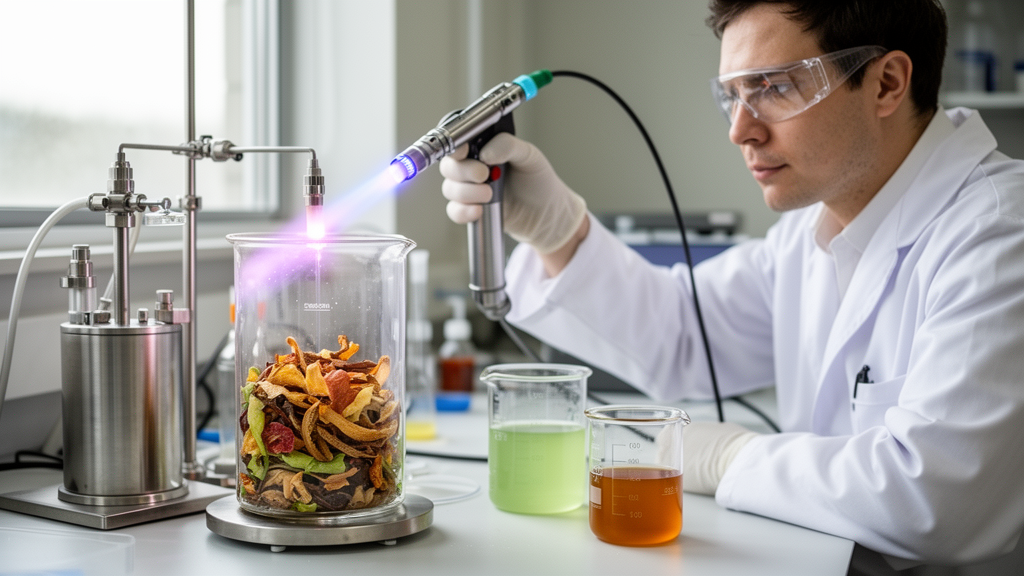
Every year, the global food industry discards mountains of peels, pomace, husks, bran, and bones—materials that still contain valuable antioxidants, proteins, fibers, and oils locked inside stubborn cellular structures. A new review published in npj Science of Food argues that an unlikely technology, cold plasma, could unlock much of that hidden value. The work, led by Javaneh Karimi and colleagues at Shahid Sadoughi University of Medical Sciences in Iran, synthesizes the mechanisms, applications, and unresolved questions surrounding cold plasma-assisted valorization of food industry byproducts, offering one of the most systematic assessments yet of where the technology genuinely performs and where it still falls short of industrial reality.
Cold plasma is often described as the fourth state of matter tamed for the food industry. When a gas such as air, oxygen, or argon is subjected to a strong electric field at near-ambient temperature and pressure, electrons are stripped from atoms, producing a reactive soup of ions, free radicals, ultraviolet photons, and excited molecules. Unlike thermal plasma, which reaches thousands of degrees, cold plasma stays close to room temperature, which means it can treat heat-sensitive food materials without cooking them. Those reactive species collide with biological surfaces, breaking chemical bonds, etching cell walls, and generating pores that dramatically increase permeability. In the context of waste valorization, that etching action is precisely the point: it opens the door for solvents and enzymes to reach compounds that would otherwise remain trapped.
The review identifies three principal mechanisms by which cold plasma transforms byproducts. First, cell wall disruption physically fractures rigid plant matrices, releasing intracellular contents such as polyphenols and carotenoids. Second, surface oxidation introduces hydrophilic oxygen-containing groups onto otherwise waxy or lignified surfaces, improving wettability and solvent access. Third, enhanced permeability accelerates mass transfer, shortening extraction times and reducing the need for harsh chemicals. Together, these effects allow the technology to act as a pretreatment, a direct modifier, or a standalone extraction aid, depending on the material and the target compound. The authors emphasize that the same reactivity that makes plasma powerful also makes it unforgiving: overtreatment can degrade the very molecules a processor hopes to recover.
The most striking finding concerns fruit and vegetable wastes, which emerge as the most plasma-responsive category. Under remarkably mild conditions—treatments lasting only 5 to 15 minutes at applied voltages between 1 and 60 kilovolts—these materials showed increases of 20 to 40 percent in phenolic content and antioxidant capacity. The explanation lies in their relatively soft, cellulose-rich cell walls, which yield quickly to plasma etching. Apple pomace, grape skins, onion peels, and similar residues can therefore be upgraded into antioxidant-rich ingredients for functional foods, nutraceuticals, or natural preservatives with minimal energy input. For an industry under pressure to replace synthetic antioxidants with clean-label alternatives, that combination of mildness and effectiveness is a compelling selling point.
Lignocellulosic wastes, by contrast, demand far more patience and power. Materials such as cereal straws, husks, and woody residues are built around lignin, a cross-linked aromatic polymer that shields cellulose and hemicellulose from enzymatic attack. The review reports that these substrates require intensive treatment—anywhere from 1 to 7 hours, often using ozone-rich plasma—to achieve up to 95 percent lignin degradation. Once that recalcitrant shield is dismantled, enzymatic hydrolysis of the exposed polysaccharides improves substantially, opening a route to fermentable sugars and, downstream, biofuels, bioplastics, and platform chemicals. The trade-off is sobering: the energy and time requirements for lignocellulosic pretreatment remain a significant hurdle, and the authors flag this as a key area where process economics must improve before plasma can compete with conventional delignification methods.
Protein-rich byproducts occupy the most delicate middle ground. Whey, blood plasma, fish processing residues, and oilseed meals contain proteins whose structure determines their functionality—solubility, emulsification, foaming, and digestibility. Plasma treatment can beneficially modify these proteins, improving solubility and creating new functional surfaces, but it can also cause denaturation, aggregation, or cross-linking that destroys the properties processors want. More concerning are changes to allergenicity: oxidative modification of epitopes can either reduce or, in some cases, alter immune reactivity in unpredictable ways. The review stresses that protein-rich streams demand careful, case-by-case optimization of voltage, gas composition, exposure time, and moisture content, and that safety testing must accompany any functional claim.
One of the more forward-looking sections of the review explores synergies between cold plasma and other green technologies. Combining plasma pretreatment with ultrasound, for example, amplifies extraction efficiency because the acoustic cavitation of ultrasound and the surface etching of plasma act on complementary structural barriers. Similarly, pairing plasma with enzymatic hydrolysis exploits the fact that plasma-roughened surfaces give enzymes far better access to their substrates, reducing enzyme loads and reaction times. These hybrid approaches point toward integrated biorefinery concepts in which a single waste stream is fractionated stepwise into antioxidants, proteins, fibers, and fermentable sugars, with plasma serving as the low-temperature key that unlocks each fraction in turn.
Despite the enthusiasm, the authors are candid about the barriers standing between laboratory promise and factory floor. Parameter standardization is perhaps the largest: plasma devices vary enormously in geometry, gas feed, frequency, and power delivery, making it nearly impossible to compare results across studies or to scale a recipe from a bench-top reactor to an industrial line. Techno-economic assessments remain scarce, so the true cost per kilogram of recovered compound is largely unknown. Safety questions also linger. Reactive nitrogen and oxygen species can, under some conditions, generate nitrosamines or acrylamide—compounds with recognized toxicological concern—and the review argues that comprehensive toxicity evaluation must precede any regulatory approval of plasma-treated food ingredients. Without standardized protocols and validated safety data, industrial translation will remain slow.
The review also exposes a striking geographic and material bias in the literature. Fruit and vegetable wastes dominate the research landscape, while marine byproducts—fish frames, shells, seaweed residues—and animal-derived wastes remain largely underexplored, despite representing enormous and growing streams with high protein, chitin, and lipid content. Given that aquaculture and seafood processing are expanding rapidly worldwide, the absence of systematic plasma studies on these materials represents a significant research gap. The authors call for targeted investigations into how plasma interacts with chitinous shells, collagenous residues, and marine polysaccharides, which could yield chitosan, gelatin, and bioactive peptides for high-value markets.
The bottom line of the review is measured optimism. Cold plasma is a genuinely promising, solvent-light, low-temperature technology that aligns well with circular economy objectives, capable of converting what is now a disposal liability into antioxidant extracts, functional proteins, and fermentation feedstocks. But the authors conclude that successful adoption hinges on three conditions: standardized, reproducible treatment protocols; comprehensive toxicological evaluation of treated products; and integrated biorefinery designs that capture value from every fraction of a waste stream rather than a single compound. If those conditions are met, the ionized glow of cold plasma reactors may become a familiar sight in food processing plants—turning the industry’s leftovers into some of its most valuable products.
Subject of Research: Cold plasma treatment for recovering valuable compounds from food industry byproducts
Article Title: Cold plasma-assisted valorization of food industry byproducts: a review of mechanisms, applications and research gaps
Article References: Karimi, J., Kazemi, M., Ahsani, A., Heydari-Majd, M., Kenari, R. E., & Mollakhalili-Meybodi, N. (2026). Cold plasma-assisted valorization of food industry byproducts: a review of mechanisms, applications and research gaps. npj Science of Food. https://doi.org/10.1038/s41538-026-01062-5
Image Credits: AI Generated
DOI: 10.1038/s41538-026-01062-5
Keywords: cold plasma, food waste, valorization, byproducts, phenolics, antioxidants, lignocellulose, lignin degradation, protein modification, biorefinery, circular economy, food safety
Cite Scienmag News
Alan Morgan. (October 9, 2026). Cold Plasma Turns Food Waste Into Valuable Compounds, Review Finds. Scienmag. https://scienmag.com/cold-plasma-turns-food-waste-into-valuable-compounds-review-finds/
Alan Morgan. "Cold Plasma Turns Food Waste Into Valuable Compounds, Review Finds." Scienmag, 9 October 2026, https://scienmag.com/cold-plasma-turns-food-waste-into-valuable-compounds-review-finds/. Accessed 9 October 2026.
Alan Morgan. "Cold Plasma Turns Food Waste Into Valuable Compounds, Review Finds." Scienmag. October 9, 2026. https://scienmag.com/cold-plasma-turns-food-waste-into-valuable-compounds-review-finds/


