


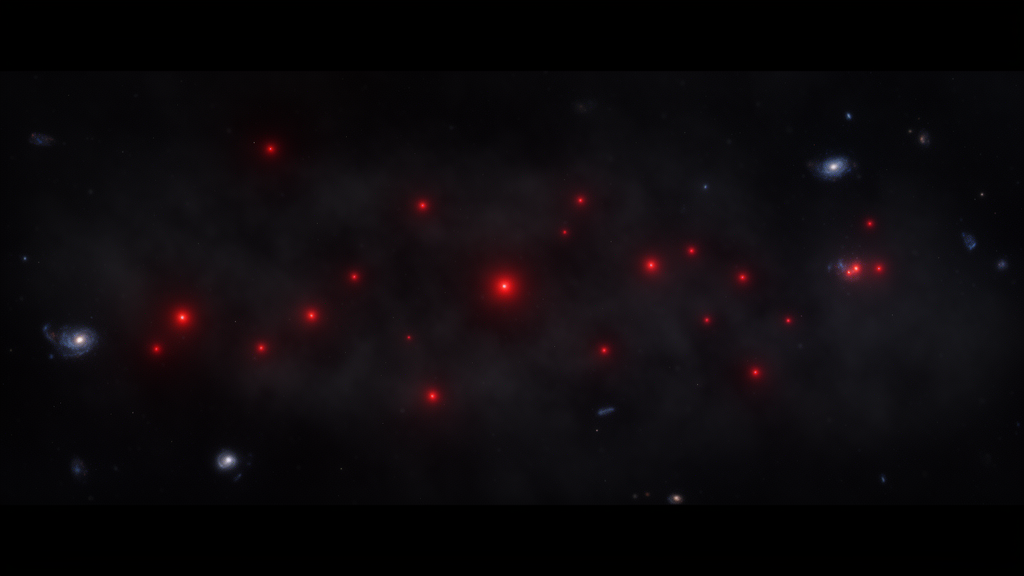
When the James Webb Space Telescope began peering into the deepest reaches of cosmic history, it found something nobody had quite predicted: a profusion of tiny, crimson objects scattered across the early universe. Astronomers nicknamed them little red dots, and within months they had become one of the most hotly debated discoveries of modern extragalactic astronomy. These compact sources, now widely interpreted as galaxies hosting actively feeding supermassive black holes, appear in remarkable numbers at redshifts between roughly 4 and 7, corresponding to epochs when the universe was less than two billion years old. Yet a strange pattern soon emerged. As researchers searched for the same objects closer to home, at redshifts below 3, they found almost nothing. The little red dots seemed to vanish, and explaining their disappearance became a central puzzle in the field.
A new study published in Nature Astronomy by Chenxuan Zhang, Huanian Zhang, Qingwen Wu, Luis C. Ho, Jian-Min Wang and colleagues offers the most comprehensive environmental explanation yet for this vanishing act. The team assembled a sample of 98 spectroscopically confirmed little red dots spanning redshifts from 3 to 7, drawn from some of the most sensitive JWST survey programs ever conducted, including JADES, CEERS, PRIMER and UNCOVER. Rather than examining the objects in isolation, the researchers asked a deceptively simple question: where do little red dots live? Are they embedded in crowded cosmic neighborhoods, or do they prefer the empty outskirts of the universe’s large-scale structure?
The answer turned out to depend dramatically on cosmic time. By measuring the overdensity of galaxies surrounding each little red dot, the team found that at redshifts greater than 4, these objects predominantly occupy under-dense regions, cosmic voids and quiet backwaters where galaxy formation has been relatively sluggish. This came as a surprise, because many other classes of high-redshift quasars, particularly the luminous beacons studied in wide-field surveys, tend to reside in the densest peaks of the cosmic web, where the largest reservoirs of gas and dark matter accumulate. Little red dots, it seems, were born in the suburbs rather than the city centers of the early universe.
But as the researchers traced the population forward in time toward redshift 3.5, a clear transition emerged. The environments of little red dots shifted from these under-dense pockets toward more typical galaxy environments, the kinds of neighborhoods that host ordinary star-forming galaxies. This migration was not a physical movement of the objects themselves, of course, but a reflection of how the cosmic web evolves: over hundreds of millions of years, gravity pulls matter together, voids empty out, and structures that once sat in isolation gradually become incorporated into denser regions as surrounding filaments and clusters assemble around them.
The second pillar of the study concerns dark matter halos, the invisible gravitational scaffolding within which all galaxies form. Using cross-correlation analyses, a statistical technique that measures how strongly a population of objects clusters relative to the underlying matter distribution, the team inferred the halo masses of their little red dots across cosmic time. The results reveal remarkably rapid growth. At redshift 7.5, when the universe was barely 700 million years old, little red dots inhabited halos of roughly 10 to the power of 10.1 solar masses, modest structures by galactic standards. By redshift 3.5, their halos had swollen to around 10 to the power of 11.3 solar masses, a hundredfold increase in less than two billion years of cosmic time.
That final halo mass is significant for a specific reason: it approaches the halo masses occupied by normal galaxies at lower redshifts. In the hierarchical picture of structure formation, dark matter halos grow by accreting material and merging with neighbors, and the halos that host little red dots appear to have followed this standard trajectory faithfully. The implication is that the halos themselves did nothing exotic. What changed was what happened inside them, and whether the conditions remained suitable for producing the distinctive little red dot phenomenon.
The study also weighed in on one of the most contentious questions surrounding these objects: the relationship between their central black holes and their host galaxies. Applying an empirical stellar-to-halo mass scaling relation, which links the mass of a galaxy’s stars to the mass of its dark matter halo, the researchers found that at redshifts above 4, little red dots still host black holes that are over-massive relative to their stellar content, in some cases dramatically so. This overmassive regime has fueled speculation that the earliest black holes formed through unusual channels, such as the direct collapse of massive primordial gas clouds, and then grew faster than their host galaxies could assemble stars. Yet the new analysis shows that this imbalance does not persist. As redshift decreases, the black hole and stellar masses of little red dots converge toward the local black hole to stellar mass relation observed in the nearby universe, where galaxies and their black holes have settled into a well-regulated co-evolution.
Taken together, these two trends, the migration from under-dense to typical environments and the growth of halo masses toward those of ordinary galaxies, provide a coherent and physically motivated explanation for why little red dots become scarce below redshift 3. In essence, the special conditions that produced little red dots were transient features of the early universe. Young halos in quiet regions, freshly seeded with black holes growing at extraordinary rates, created a population of compact, red, actively accreting objects that JWST could spot in abundance. As those halos matured, merged and drifted into denser environments, the conditions changed. The black holes may have continued to grow, but the distinctive configuration of an overmassive black hole embedded in a small, gas-rich, rapidly evolving host became increasingly rare, and the little red dots faded from the census.
The authors are careful to note that while the large-scale environmental evolution explains the declining abundance, the underlying small-scale physical mechanisms remain elusive. Researchers have proposed a wide range of possibilities for what powers the red, compact appearance of these objects, from dense gas shrouds around accreting black holes to unusual stellar populations, and the debate is far from settled. What this study adds is a crucial environmental dimension to that conversation. Any successful theory of little red dots must now account not only for their spectra and luminosities but also for where they live, how their halos grow, and why their numbers dwindle as the universe ages. The coherence between environmental evolution and the normalization of black hole to galaxy mass relations suggests that little red dots are not a separate species of cosmic object but rather an early phase in the ordinary lives of galaxies, a phase that the universe has largely outgrown.
For astronomers, the study demonstrates the power of combining JWST’s spectroscopic depth with the statistical machinery of large-scale structure analysis, and it hints at what comes next. If little red dots represent a brief evolutionary stage, their descendants should still be lurking among the ordinary galaxies of the local universe, their early flamboyance recorded only in the fossil record of their stars and black holes. Finding those descendants, and confirming that the once-anomalous black holes have settled into quiet compliance with the local relations, would complete the story of one of JWST’s most captivating discoveries. For now, the little red dots stand as a vivid reminder that the early universe was a place of fleeting, extraordinary possibilities, and that even the most puzzling cosmic phenomena may simply be youth catching up with the universe around them.
Subject of Research: Environmental and dark matter halo evolution of little red dots in the early universe
Article Title: Reduced incidence of little red dots at z < 3 based on number density and halo mass evolution
Article References: Zhang, C., Zhang, H., Wu, Q., Ho, L. C., & Wang, J.-M. (2026). Reduced incidence of little red dots at z < 3 based on number density and halo mass evolution. Nature Astronomy. https://doi.org/10.1038/s41550-026-03001-6
Image Credits: AI Generated
DOI: 10.1038/s41550-026-03001-6
Keywords: little red dots, JWST, supermassive black holes, dark matter halos, high-redshift galaxies, cosmic web, active galactic nuclei, galaxy evolution, large-scale structure, black hole to stellar mass relation, Nature Astronomy, early universe
Cite Scienmag News
Grant Pearson. (October 9, 2026). Why the universe stopped making little red dots. Scienmag. https://scienmag.com/why-the-universe-stopped-making-little-red-dots/
Grant Pearson. "Why the universe stopped making little red dots." Scienmag, 9 October 2026, https://scienmag.com/why-the-universe-stopped-making-little-red-dots/. Accessed 9 October 2026.
Grant Pearson. "Why the universe stopped making little red dots." Scienmag. October 9, 2026. https://scienmag.com/why-the-universe-stopped-making-little-red-dots/


