


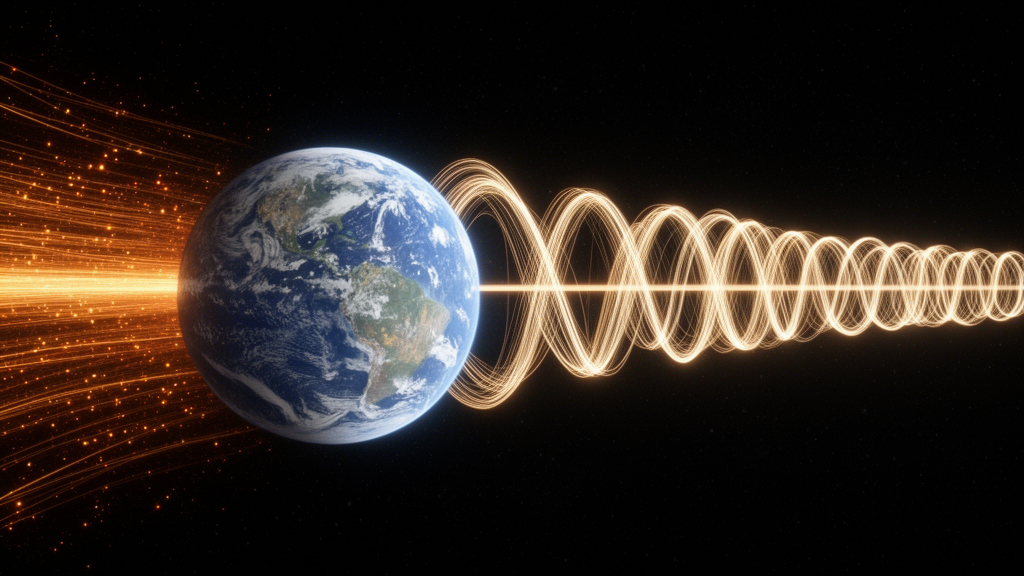
Every few weeks, as the Sun rotates on its axis, streams of fast solar wind catch up with slower plasma ahead of them, compressing the interplanetary magnetic field into turbulent structures known as corotating interaction regions, or CIRs. When these structures sweep past Earth, they trigger geomagnetic storms that are usually moderate in peak intensity but remarkably persistent, pumping energy into the magnetosphere for days at a time. A new statistical study published in Annales Geophysicae has now dissected how Earth’s magnetotail, the elongated magnetic reservoir on the nightside of our planet, responds to forty of these CIR-driven storms observed between 2001 and 2016, and the results reveal a strikingly rhythmic coupling between the Sun and our planet’s magnetic environment.
The research team, led by Adriane Marques de Souza Franco of the Federal University of Jataí and UNIFESSPA in Brazil, together with colleagues from the National Centre for Polar and Ocean Research in India and the Brazilian National Institute for Space Research, combined data from three complementary sources. They used the interplanetary magnetic field’s north-south component, known as IMF Bz, from NASA’s OMNI database; magnetic field measurements in the east-west aligned Bx component recorded by the SC1 spacecraft of the European Space Agency’s Cluster constellation during its passages through the magnetotail; and the auroral electrojet index, AE, a ground-based measure of auroral zone currents compiled by the World Data Center in Kyoto. All data were analyzed at one-minute resolution, allowing the team to resolve fluctuations on timescales of hours.
The central finding is deceptively simple: more than eighty percent of the most energetic oscillations in both the IMF Bz component and the magnetotail Bx field occur at periods shorter than four hours, regardless of whether the storm is in its main phase, when the disturbance indices plunge, or its recovery phase, when the system slowly returns to normal. This dominance of short-period energy was consistent across the entire fifteen-year dataset, which included thirty-five moderate storms and five intense events. The magnetotail, in other words, does not respond sluggishly to CIR-driven forcing; it reacts in rapid, repeated pulses that coincide with the characteristic timescale of cyclic magnetospheric substorms, the episodic loading and unloading cycles that govern how magnetic energy is stored and explosively released in the tail.
To extract these periodicities, the team applied the wavelet transform, a mathematical technique well suited to non-stationary signals whose dominant frequencies change over time. Unlike a simple Fourier analysis, which averages spectral content across an entire interval, the wavelet transform maps how energy is distributed in both time and period, revealing when particular oscillations appear and disappear. The researchers complemented this with the cross-wavelet transform, which identifies the periods at which two different time series share high common power, effectively pinpointing the frequencies at which energy is most efficiently transferred from one region to another. Long-term trends in the magnetotail data were removed using a Haar wavelet filtering technique before analysis.
The cross-wavelet results paint a coherent picture of a coupled chain of energy transfer. When the team compared IMF Bz against magnetotail Bx, IMF Bz against the AE index, and magnetotail Bx against the AE index, periods of four hours or less dominated in both storm phases. Roughly half of the highest-correlation intervals between the solar wind and the magnetotail fell below two hours, with a further thirty percent in the two-to-four-hour band. Similar distributions emerged for the solar wind-auroral and magnetotail-auroral pairings, suggesting that solar wind fluctuations drive magnetotail oscillations, which in turn drive auroral substorms, all at the same characteristic timescales. The authors interpret this as evidence of resonant coupling within the solar wind-magnetosphere-ionosphere system, a linked sequence in which each link vibrates at the frequency of the driver.
Not everything behaves identically across the storm lifecycle, however. The auroral electrojet index showed a clear phase-dependent difference in its energy distribution. During the main phase, energetic AE periodicities were concentrated between two and four hours, with a secondary population between four and six hours. During the recovery phase, the distribution spread outward to periods as long as twelve hours, and no significant energetic periods shorter than two hours were observed at all. The team attributes this broadening to the frequent occurrence of HILDCAA events, high-intensity long-duration continuous auroral activity, during storm recovery phases. These prolonged intervals of elevated auroral activity are driven by trains of Alfvén waves embedded in the high-speed streams that follow CIRs, and their characteristic periodicities of four to twelve hours imprint themselves on the auroral record.
The classification of energy persistence added further texture to the picture. The researchers sorted each identified periodicity into four categories: local, meaning power confined to brief intervals; intermittent, meaning features that appear and disappear; quasi-continuous, meaning signals present for most of the interval; and continuous, meaning power persisting throughout. During main phases, continuous behavior dominated the IMF Bz energy distribution, reflecting sustained solar wind driving, while the magnetotail Bx periodicities were overwhelmingly local, consistent with transient phenomena such as bursty bulk flows and fast plasma jets during intense substorms. In recovery phases, intermittent and quasi-continuous distributions became more common, suggesting a transition from direct external forcing toward the magnetosphere’s internal process of unloading stored energy through repeated, cyclic substorms.
Beyond timing, the study also probed the turbulent character of the magnetotail and auroral regions using Fourier power spectral analysis. Fitting power-law functions to the spectra yields a spectral index that describes how rapidly fluctuation power decreases with frequency, a measure of how efficiently energy cascades from large scales to small ones. The IMF Bz and magnetotail Bx time series both followed the Kolmogorov power law of negative five-thirds, the classic signature of fully developed magnetohydrodynamic turbulence, during the main phase. The AE index, by contrast, showed steeper spectra with mean indices near negative 1.92, a difference the authors link to intermittency effects and to the enhancement of ionospheric conductivity by high-amplitude southward IMF fluctuations, consistent with earlier work by Tsurutani and colleagues.
The recovery phase told an even more turbulent story. Mean spectral indices for the magnetotail Bx steepened to about negative 1.95 and for the AE index to about negative 2.23, both higher in absolute value than during the main phase, while the IMF Bz index remained near the Kolmogorov value. The authors propose that during recovery, the geomagnetic system promotes a rapid transfer of energy from large to small scales, effectively accelerating the turbulent cascade as the magnetosphere works to shed its stored energy and return toward a steady state. This finding extends previous work on supersubstorms and HILDCAA events, and it underscores that the quiet-seeming recovery phase is dynamically anything but quiet.
The broader significance of the study lies in both its statistical reach and its practical implications. By analyzing forty CIR-driven storms over fifteen years of Cluster observations, the team established a far broader evidence base than earlier case studies, confirming that the two-to-four-hour substorm timescale is the fundamental rhythm of solar wind-magnetosphere coupling during these events. Although CIR storms are typically weaker at their peak than those driven by interplanetary coronal mass ejections, their long recovery phases mean they dissipate more integrated energy in the magnetosphere, posing real risks to satellites, communications, power grids, and navigation systems, particularly during the declining phase of the solar cycle when CIRs dominate. The authors suggest that applying the same wavelet and spectral toolkit to the magnetotails of other planets, such as Jupiter, could reveal whether such rhythmic coupling is a universal feature of magnetized plasma environments throughout the solar system.
Subject of Research: Magnetotail response to corotating interaction region driven geomagnetic storms using Cluster wavelet and spectral analysis
Article Title: Magnetotail response to corotating interaction region driven geomagnetic storms: Cluster observations
Article References: Marques de Souza Franco, A., Rawat, R., Alves Bolzan, M. J., & Echer, E. (2026). Magnetotail response to corotating interaction region driven geomagnetic storms: Cluster observations. Annales Geophysicae, 44(2), 881-901. https://doi.org/10.5194/angeo-44-881-2026
Image Credits: AI Generated
DOI: 10.5194/angeo-44-881-2026
Keywords: magnetotail, corotating interaction regions, geomagnetic storms, Cluster mission, wavelet analysis, substorms, HILDCAA, solar wind, interplanetary magnetic field, auroral electrojet, space weather, plasma turbulence
Cite Scienmag News
Violet Maxwell. (October 9, 2026). Earth’s Magnetotail Pulses to a Four-Hour Rhythm During Recurring Solar Wind Storms. Scienmag. https://scienmag.com/earths-magnetotail-pulses-to-a-four-hour-rhythm-during-recurring-solar-wind-storms/
Violet Maxwell. "Earth’s Magnetotail Pulses to a Four-Hour Rhythm During Recurring Solar Wind Storms." Scienmag, 9 October 2026, https://scienmag.com/earths-magnetotail-pulses-to-a-four-hour-rhythm-during-recurring-solar-wind-storms/. Accessed 9 October 2026.
Violet Maxwell. "Earth’s Magnetotail Pulses to a Four-Hour Rhythm During Recurring Solar Wind Storms." Scienmag. October 9, 2026. https://scienmag.com/earths-magnetotail-pulses-to-a-four-hour-rhythm-during-recurring-solar-wind-storms/


