


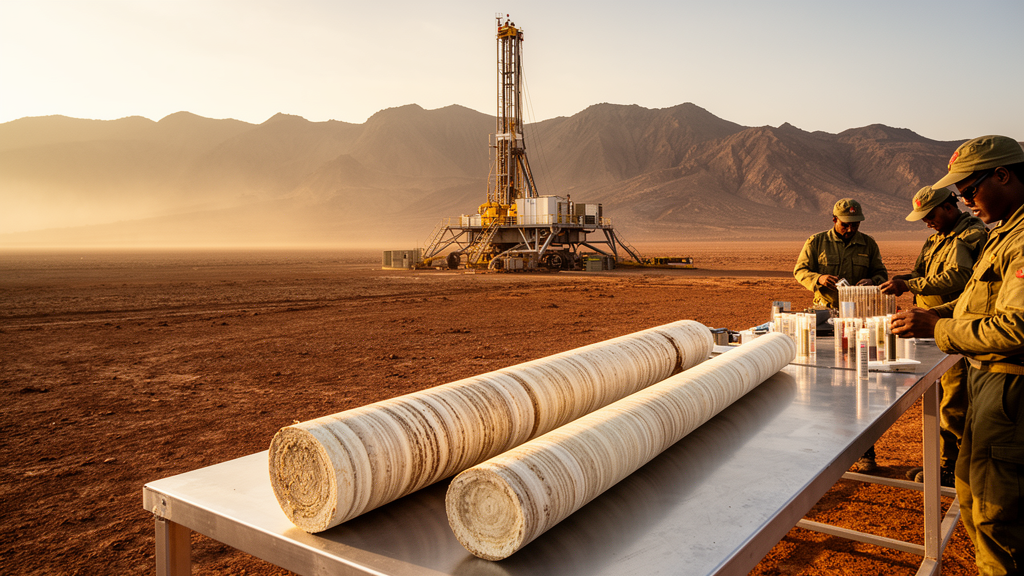
Deep in the southern Ethiopian Rift lies a salt-crusted mudflat that is dry for most of the year, yet beneath its cracked surface rests one of the most valuable climate archives on Earth. The Chew Bahir basin, a tectonic depression fed by the Weyto and Segen rivers, has accumulated up to several kilometres of fluvio-lacustrine sediment since the Late Miocene, quietly recording the environmental conditions under which our species, Homo sapiens, evolved. Between 2009 and 2014, an international team of scientists drilled into this archive in a series of increasingly ambitious campaigns, ultimately recovering twin sediment cores nearly 300 metres long that together span roughly 620,000 years of environmental history. Now, in a detailed retrospective published in Scientific Drilling, the team has laid out the full story of how those cores were planned, drilled, merged and dated, offering an unusually candid account of both the triumphs and the pitfalls of scientific deep drilling in one of the most remote corners of Africa.
The project grew out of the Hominin Sites and Paleolakes Drilling Project, or HSPDP, an initiative launched in November 2008 with the goal of assembling continuous, high-resolution paleoenvironmental records from lake sediments across eastern Africa, close to the fossil and archaeological sites that document human evolutionary history. During the first ICDP-funded workshop, a pivotal moment came when Asfawossen Asrat and the late Mohammed Umer proposed the Chew Bahir basin as a new drilling location, even though it was not on the original list of candidate sites. Their case rested on intimate knowledge of the regional geology, which comprises thick fluvio-lacustrine deposits within a tectonic basin, and on unpublished industry gravity survey data from the Ethiopian Ministry of Mines indicating that the basin contained two to three kilometres of sediment. The site also offered a decisive scientific advantage: proximity to key archaeological localities such as Omo-Kibish, where some of the oldest known Homo sapiens fossils have been found, along with important sites in the Ethiopian Highlands.
Before any deep drilling could begin, the team needed proof that the archive was worth the considerable expense. In late 2009, researchers from the universities of Cologne, Addis Ababa and Aberystwyth recovered a pilot core, CB01, from the western margin of the basin using a rotary single-tube drill. The core extended nearly 19 metres into the lake deposits with a recovery rate of 81 percent, and an organic-rich layer sent for radiocarbon dating returned an age of 13,600 years before present at about 7.35 metres depth. That single date, included in the first full HSPDP proposal submitted in January 2010, demonstrated the site’s potential. A second campaign in November 2010 added five more short cores, CB02 through CB06, collected with a vibro-corer along a roughly 20-kilometre transect running from the western margin toward the geographic centre of the basin. Together, these six cores revealed fine-grained clays, silts and carbonate-rich horizons, along with diatoms, molluscs and fish bones that pointed to shifting lake stages through time.
The short cores also delivered a crucial quantitative insight: sedimentation rates in the basin vary dramatically with climate. During wet episodes, sediment accumulated at roughly 0.5 to 0.7 millimetres per year, while drier intervals such as the Last Glacial Maximum saw rates drop to about 0.1 millimetres per year, a six- to seven-fold difference. Rates also declined from the basin margin toward its centre. This spatial gradient in accumulation would later prove decisive for choosing where to drill. It also shaped an early scientific surprise: the team discovered that potassium in the sediments, which they had expected to indicate humid conditions and enhanced feldspar weathering, actually tracked aridity through a smectite-to-illite transformation driven by increasing pore-water alkalinity. Defending this reinterpretation of the potassium proxy against entrenched prior knowledge became one of the project’s formative intellectual battles.
The deep-drilling campaign itself was originally scheduled for 2013, but it was cancelled on short notice when the contracted drilling rig failed to meet contractual specifications. Forecasts of an impending ENSO and Indian Ocean Dipole extreme event, which threatened severe flooding in eastern Africa, prompted a further one-year postponement. To keep the team’s momentum and satisfy funding requirements, the researchers improvised a shorter campaign in March 2014, recovering a roughly 41-metre core, CHB14-1, from the basin centre. That operation came within days of disaster: intense overnight rainfall flooded the saline mudflat, rendering the fine lacustrine clays slippery and unstable, and the drilling crew had to camp at the basin margin for two days until the water receded. The episode taught the team a lesson they would never forget about the volatility of working on a playa surface, even in the supposedly dry season.
When the deep drilling finally commenced in November and December 2014, the team applied everything the earlier campaigns had taught them. Two parallel boreholes, HSPDP-CHB14-2A and 2B, were drilled about 20 metres apart, roughly halfway along the original transect and close to the western margin of the basin. The location was chosen using seismic lines provided by the oil company Tullow Oil, which helped identify undisturbed deep sediment layers free of tectonic displacement. Drilling proceeded around the clock in day and night shifts, using a wireline diamond coring rig fitted with specialised soft-sediment tools adapted from ocean drilling: a hydraulic piston corer for the softest sediments, an extended nose corer with a non-rotating shoe for firmer material, and an alien corer functioning like a standard rock-coring tool for the most lithified intervals. Each tool could collect three-metre cores of 6.4-centimetre diameter in plastic liners, and all three shared the same bottom hole assembly, allowing rapid switching as lithology changed with depth.
The duplicate coring strategy, which the team had to defend during planning because of its higher cost, paid off handsomely. Incomplete recovery is inevitable in unconsolidated sediments, with gaps especially common between coring runs, and the gaps in hole 2A, mostly associated with sandy layers, could largely be filled from the overlapping sections of hole 2B. Drilling in the second hole was continuously optimised based on what the first hole revealed, with the hydraulic piston corer deployed at depths where sandy deposits had caused core loss, recovering them in short, slow drives rather than rotation-based drilling. The combined recovery rate reached approximately 90 percent, and the two holes yielded cores of about 279 and 266 metres that were merged into a composite profile of roughly 293 metres. Logistics were formidable: drilling fluid demand, initially estimated at under 20,000 litres per day, more than doubled due to lost circulation into the formation, requiring two 20,000-litre water trucks to shuttle continuously from the Weyto River some 35 kilometres away, with the water stored in six hand-dug sumps at the site.
Merging the twin cores into a single continuous record proved to be the project’s most technically demanding challenge. The cores were shipped to the Continental Scientific Drilling Facility at the University of Minnesota, where they were logged, split, photographed and described section by section, with 306 sections in hole 2A and 276 in hole 2B. Correlation between the holes relied on identifying matching stratigraphic features, such as colour changes and magnetic susceptibility peaks, to define tie points where the record could switch from one core to the other. The splice went through three major versions as new datasets became available, from low-resolution whole-core logging through high-resolution scanning to X-ray fluorescence elemental data. Each revision shifted the composite depths, causing roughly ten percent of the approximately 14,000 discrete samples to fall off-splice and requiring manual re-attribution of 1,362 samples to their equivalent depths in the parallel core. In the final version, about five percent of tie points carried depth uncertainties of 10 to 20 centimetres, tracked through a colour-coded quality flag system. An automated alternative using a dynamic time warping algorithm was tested but abandoned because it could not exclude known data artifacts that the human analysts could recognise and disregard.
Dating the composite record demanded an equally multi-pronged approach. Radiocarbon dating of ostracods and bulk organic material constrained the upper sections, optically stimulated luminescence dating of fine-silt quartz grains extended the chronology deeper, and single-crystal argon-40/argon-39 dating of feldspars from volcanic ash layers anchored the oldest intervals. A tephra layer in the core was geochemically matched to the Silver Tuff outcropping at Konso, and an independent check came from identifying ash from the Corbetti Ignimbrite, dated to 177,000 years, at a depth corresponding to 178,000 years in the core, a striking confirmation of the age model’s accuracy. Confidence intervals grow with depth, from under 10,000 years in the uppermost 50 metres to 10,000 to 35,000 years across the oldest 100,000 to 620,000 years of the record. The resulting archive, documented across more than 25 publications, has revealed how Pleistocene climate variability in eastern Africa influenced hominin evolution, including hydroclimate shifts that may have shaped early human dispersal.
The lessons the team draws are both practical and philosophical. Drilling close to the basin margin minimised logistical risks while maximising sedimentation rates and time resolution, and the pre-study transect of short cores proved essential for testing hypotheses about proxies and chronometers before committing to expensive deep drilling. Duplicate coring, now regarded as best practice for scientific drilling in modern sedimentary basins, delivered higher recovery, better tool selection and additional material for dating, but the compositing process introduced its own hidden uncertainties with every tie point chosen and every splice revision. The team recommends keeping tie points to an absolute minimum, clustering splice revisions closely in time, and exploring hybrid approaches that combine automated pattern recognition with manual oversight. They also caution that small drill rigs and lightweight supply chains impose real limits, as the boreholes fell short of the original 400-metre target due to borehole instability, strong groundwater inflow and logistical constraints, factors that future projects in the Chew Bahir and Turkana basins will need to address with larger rigs and more detailed engineering plans. The paper is dedicated to Andrew Cohen and Mohammed Umer, two of the project’s founding visionaries, whose insistence on drilling twin cores rather than one ultimately transformed how paleoclimate archives of human evolution are built.
Subject of Research: Scientific deep drilling of overlapping sediment cores in the Chew Bahir basin, southern Ethiopia, to reconstruct paleoclimate during human evolution
Article Title: Scientific deep drilling in the Chew Bahir basin: advantages and pitfalls of two overlapping sediment cores
Article References: Foerster, V., Asrat, A., Bronk Ramsey, C., Brown, E. T., Deino, A., Erbello, A., Fischer, M. L., Gebregiorgis, D., Junginger, A., Kaboth-Bahr, S., Lane, C. S., Opitz, S., Noren, A., Roberts, H. M., Tiedemann, R., Vidal, C.-M., Viehberg, F., Vogelsang, R., Zachow, C., … Trauth, M. H. (2026). Scientific deep drilling in the Chew Bahir basin: advantages and pitfalls of two overlapping sediment cores. Scientific Drilling, 35(1), 61-81. https://doi.org/10.5194/sd-35-61-2026
Image Credits: AI Generated
Keywords: Chew Bahir, scientific drilling, paleoclimate, Homo sapiens, Ethiopian Rift, sediment cores, HSPDP, ICDP, duplicate coring, geochronology, tephrochronology, human evolution
Cite Scienmag News
Violet Maxwell. (October 9, 2026). Twin Cores in the Cradle of Humankind: How Chew Bahir Drilling Rewrote the Rules of Climate Archiving. Scienmag. https://scienmag.com/twin-cores-in-the-cradle-of-humankind-how-chew-bahir-drilling-rewrote-the-rules-of-climate-archiving/
Violet Maxwell. "Twin Cores in the Cradle of Humankind: How Chew Bahir Drilling Rewrote the Rules of Climate Archiving." Scienmag, 9 October 2026, https://scienmag.com/twin-cores-in-the-cradle-of-humankind-how-chew-bahir-drilling-rewrote-the-rules-of-climate-archiving/. Accessed 9 October 2026.
Violet Maxwell. "Twin Cores in the Cradle of Humankind: How Chew Bahir Drilling Rewrote the Rules of Climate Archiving." Scienmag. October 9, 2026. https://scienmag.com/twin-cores-in-the-cradle-of-humankind-how-chew-bahir-drilling-rewrote-the-rules-of-climate-archiving/


