


When the LIGO, Virgo and KAGRA detectors first caught the ripples in spacetime produced by two colliding black holes, astronomers faced an uncomfortable question: how do such pairs come to exist at all? Most massive stars in the Universe are born in binary systems, yet the vast majority of those binaries appear, at first glance, unsuited to producing two black holes that spiral together and merge within the age of the cosmos. A new study published in Nature Astronomy by Xiao-Tian Xu of the Tsung-Dao Lee Institute and Nanjing University, together with Norbert Langer, Jakub Klencki, Chen Wang, Xiang-Dong Li and colleagues, now shows that one of the most promising pathways, the so-called stable mass transfer channel, can indeed deliver merging binary black holes with precisely the masses and spins that gravitational-wave observatories have been recording.
The problem with previous models lies in their simplifications. Population synthesis codes, which simulate millions of stellar binaries at once, typically treat stars as simplified one-dimensional objects and make sweeping assumptions about what happens when one star dumps its outer layers onto its companion. Whether the transfer of mass is stable or runaway, how much of the material is actually retained by the accreting star, and how the angular momentum of the orbit is redistributed inside the stellar interiors all remain deeply uncertain. These uncertainties have left the fate of the stable mass transfer channel, long considered a leading route to double black hole formation, frustratingly ambiguous. Earlier detailed calculations even suggested that the channel might produce far fewer merging systems than the observed gravitational-wave population requires.
Xu and his collaborators took a different approach. Rather than relying on approximate prescriptions, they constructed detailed binary evolution models using the MESA stellar evolution code, following two massive stars from the zero-age main sequence, the moment they begin burning hydrogen, all the way to the formation of their black holes. Crucially, their models include the internal differential rotation of the stars and the simultaneous transfer of both mass and angular momentum between the components. This level of physical fidelity allows the team to track the chemical structure of the initially less massive star in exquisite detail, first as it accretes material from its more massive partner and later as it, in turn, overflows its own Roche lobe and transfers mass back.
The chemical structure turns out to be the hidden protagonist of the story. When the initially more massive star, the primary, loses material to its companion, the accreting secondary is polluted with fresh hydrogen-rich gas that dilutes the chemically processed layers near its surface. By the time the secondary itself expands and begins its own episode of Roche-lobe overflow, the reverse mass transfer, its internal composition profile determines how the star responds. A star whose interior has been thoroughly mixed behaves very differently from one with a steep chemical gradient. In the models of Xu and colleagues, the accretion history imprinted on the secondary’s chemical structure strongly influences how much mass the star can stably donate, how tight the orbit becomes, and how much angular momentum the system retains.
To explore the consequences systematically, the team computed a grid of such models spanning a range of initial orbital separations and mass ratios, all with a fixed primary mass and at the metallicity of the Small Magellanic Cloud, a nearby dwarf galaxy whose metal-poor environment resembles the conditions in many star-forming regions across cosmic history. Metallicity matters because it controls the strength of stellar winds: at low metallicity, massive stars lose less mass, retain more of their heft, and are more likely to leave behind substantial black holes. The Small Magellanic Cloud thus serves as a natural laboratory for the kind of environments in which many of the observed gravitational-wave sources likely formed.
The outcome of the grid is striking. The models produce black hole binaries whose mass ratios and spin magnitudes fall squarely within the regime observed for gravitational-wave sources with primary black hole masses between roughly 10 and 25 solar masses. In particular, the stable mass transfer channel naturally generates moderately unequal-mass systems, binaries in which one black hole is noticeably heavier than the other, a configuration that has proven difficult to reproduce with some alternative formation scenarios. Because the accreting star is spun up by the material it receives, the resulting black holes can carry significant natal spins, and the predicted effective spin parameters of the merging binaries align well with the values inferred from the gravitational-wave waveforms in the fourth Gravitational-Wave Transient Catalog.
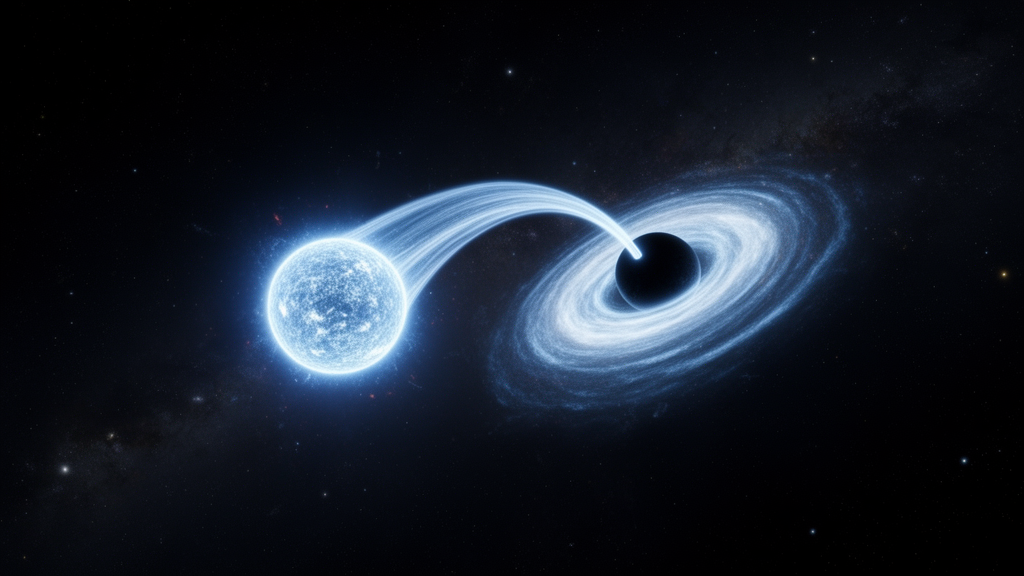
The physical chain of events deserves a closer look. In a close massive binary, the primary exhausts the hydrogen in its core and expands, spilling material through the inner Lagrangian point onto its companion. If the transfer is stable, meaning the donor shrinks in step with its Roche lobe rather than engulfing the companion in a common envelope, the system survives with its two stars intact but transformed. The primary, stripped of its envelope, evolves into a helium star and eventually collapses into a black hole. The secondary, now rejuvenated and rotating rapidly, continues its own evolution before undergoing a second episode of mass transfer, this time onto the newly formed black hole or, in some configurations, shedding mass from the system entirely. The final orbit must be tight enough that gravitational radiation, as described by the classic Peters formulas, drives the two black holes to coalescence within a Hubble time.
One of the most compelling aspects of the new work is that the ingredients for this channel are not exotic. As a large number of potential progenitor binaries are already known to exist among the observed population of massive binaries, the authors conclude that stable mass transfer might contribute considerably to the observed gravitational-wave source population, especially to mergers of moderately unequal-mass black hole binaries. Observational surveys of massive stars, including the Binarity at LOw Metallicity campaign, have revealed that a high fraction of massive stars live in close binaries and interact with their companions, providing an ample reservoir of systems that could follow exactly the evolutionary path traced by the new models.
The study also sharpens the contrast between competing formation scenarios. In the common envelope channel, a star engulfs its companion and the pair spirals together inside a shared gaseous shroud, a process so violent and poorly understood that its efficiency remains one of the great open problems in stellar astrophysics. In the chemically homogeneous evolution channel, very tight binaries rotate so fast that their interiors stay well mixed, allowing both stars to burn their fuel almost entirely before collapsing. The stable mass transfer channel now emerges as a third, quantitatively robust pillar, one that can be tested against the growing statistical power of the gravitational-wave catalogs. As the catalog expands with each observing run, the distributions of mass ratios and effective spins become increasingly precise fingerprints of the underlying astrophysics.
What makes the result resonate beyond the specialist community is the elegance of the mechanism. Two stars exchanging material back and forth over millions of years, with the chemistry of their interiors quietly dictating the outcome, ultimately produce the most violent events since the Big Bang, events that humanity now detects as fleeting chirps in laser interferometers. The work of Xu and colleagues demonstrates that resolving the mystery of merging black holes requires not grander telescopes but deeper fidelity in the physics of stars themselves. By following the rotation, the angular momentum and the chemical stratification of massive binaries from birth to collapse, the study transforms a channel once considered marginal into a credible, perhaps dominant, factory of the gravitational-wave sources that now illuminate the dark side of the Universe.
Subject of Research: Formation of merging binary black holes through stable mass transfer in massive binary star evolution
Article Title: The formation of merging black holes via stable mass transfer in massive binary stars
Article References: Xu, X.-T., Langer, N., Klencki, J., Wang, C., & Li, X.-D. (2026). The formation of merging black holes via stable mass transfer in massive binary stars. Nature Astronomy. https://doi.org/10.1038/s41550-026-03000-7
Image Credits: AI Generated
DOI: 10.1038/s41550-026-03000-7
Keywords: binary black holes, gravitational waves, stable mass transfer, massive binary stars, stellar evolution, black hole spins, MESA, Small Magellanic Cloud, Roche-lobe overflow, common envelope, LIGO, Nature Astronomy
Cite Scienmag News
Grant Pearson. (October 9, 2026). How Stable Mass Transfer Forges the Merging Black Holes Seen by Gravitational-Wave Detectors. Scienmag. https://scienmag.com/how-stable-mass-transfer-forges-the-merging-black-holes-seen-by-gravitational-wave-detectors/
Grant Pearson. "How Stable Mass Transfer Forges the Merging Black Holes Seen by Gravitational-Wave Detectors." Scienmag, 9 October 2026, https://scienmag.com/how-stable-mass-transfer-forges-the-merging-black-holes-seen-by-gravitational-wave-detectors/. Accessed 9 October 2026.
Grant Pearson. "How Stable Mass Transfer Forges the Merging Black Holes Seen by Gravitational-Wave Detectors." Scienmag. October 9, 2026. https://scienmag.com/how-stable-mass-transfer-forges-the-merging-black-holes-seen-by-gravitational-wave-detectors/


