

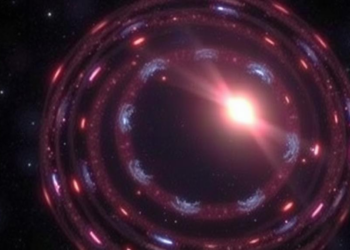
Hubble observations challenge supernova-wind theory of cosmic reionization
Hubble observations of nearby starburst galaxies associate faster supernova-driven winds with less escaping ionizing radiation, strengthening a reionization scenario in ...
Hubble observations of nearby starburst galaxies associate faster supernova-driven winds with less escaping ionizing radiation, strengthening a reionization scenario in ...

Astronomers using South Africa's MeerKAT telescope have directly detected the faint 21-centimetre radio signal of neutral hydrogen from billions of ...
A detailed radio map of molecular gas in Stephan's Quintet shows that turbulent gas motions suppress star formation even where ...
A new Nature Astronomy study shows that little red dots vanish at low redshifts because their dark matter halos and ...
Following the Nancy Grace Roman Space Telescope's Aug. 30 launch, University of Kansas researcher Gregory Rudnick will co-lead GRACE, a ...
Arizona State University astronomers have found that supermassive black hole jets ionize hydrogen gas along their paths deep into the ...
New observations give the strongest test yet of tidal torque theory, showing that present-day galaxies retain a statistical memory of ...
A new Nature Astronomy report argues that JWST and ALMA observations of dynamically mature early galaxies are transforming the century-old ...
A landmark FAST and DESI survey shows that the universe's atomic hydrogen reservoir has barely declined over the past 4.5 ...
A Hubble survey of 29 massive stars in extremely metal-poor dwarf galaxies reveals unexpectedly weak stellar winds that could explain ...

Embark on a thrilling journey of discovery with Scienmag.com—your ultimate source for cutting-edge breakthroughs. Immerse yourself in a world where curiosity knows no limits and tomorrow’s possibilities become today’s reality!