


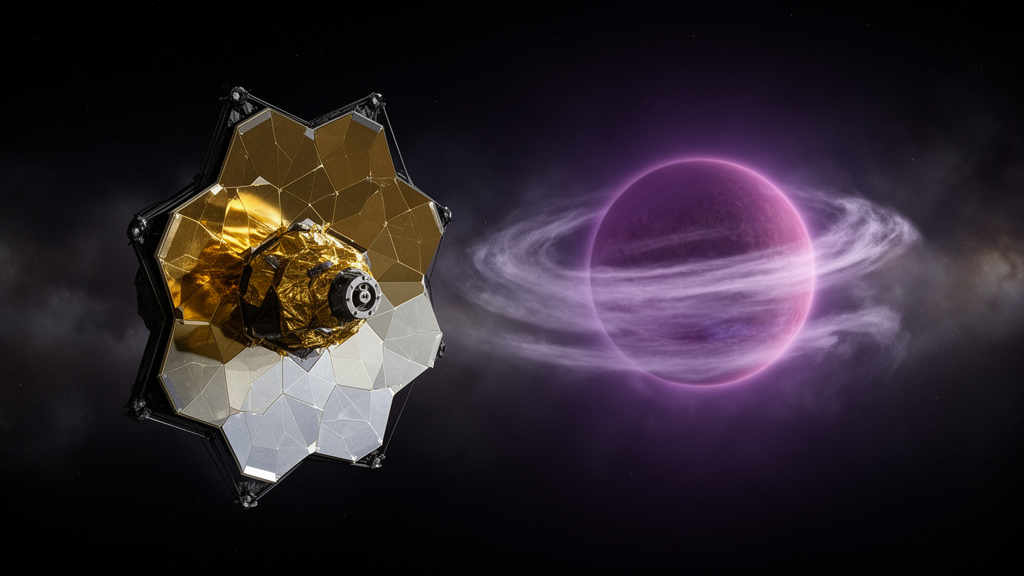
Just 7.5 light-years from Earth, a frigid, Jupiter-sized world is quietly making weather. Using the James Webb Space Telescope, a team led by Brittany Miles, assistant astronomer at the University of Arizona’s Steward Observatory, has captured the first direct evidence that water clouds on a body outside our solar system are changing thickness over time. The target, WISE 0855, is the coldest known brown dwarf, and the new observations reveal an atmosphere shaped by two distinct processes unfolding at once: high-altitude water clouds that thicken and thin as the object rotates, and deep chemical gases being churned upward by convection from far below. The study, published in The Astrophysical Journal, represents the most detailed time-series portrait ever taken of this enigmatic world.
The achievement required patience and precision. Miles and her colleagues spent eleven hours staring at WISE 0855, collecting a full spectrum of its light every fifteen minutes. That cadence mattered. As the brown dwarf rotates, different patches of its surface swing into view, each with slightly different cloud cover and temperature. By sampling the spectrum repeatedly, the team could watch those patches come and go, effectively turning the telescope into a weather-monitoring station for a world colder than Earth’s own surface. No previous observatory could resolve such subtle changes in an object this dim and this cold.
The key advance lies in what astronomers call time-resolved spectroscopy. Before JWST, observations of WISE 0855 were limited to photometry, measurements of brightness through broad filters that lump together every physical effect at once. Clouds, chemistry, and temperature all blurred into a single varying signal that could not be disentangled. Webb’s medium-resolution spectrograph changed that by spreading the object’s light across hundreds of individual molecular features, allowing the team to track how specific gases and cloud signatures changed independently as the world spun. In this case, the variable temperatures followed the rotation of the brown dwarf, while a separate, rhythmic wave-like signal emerged tied to two particular gases: carbon monoxide and phosphine.
That second signal tells a story about what is happening deep inside the object. Carbon monoxide and phosphine fluctuate because heat from WISE 0855’s interior constantly churns them upward toward the upper atmosphere, the same way a pot of hot soup pushes warmer liquid up from the bottom. Planetary scientists call this disequilibrium chemistry, and it is a familiar phenomenon. On Jupiter, convective mixing dredges gases from deep, hot layers up into the visible atmosphere, where they would not otherwise survive. The same process has been observed in brown dwarfs before, but watching it vary in real time, molecule by molecule, is entirely new territory.
Co-author Mark Marley, director and department head of the Lunar and Planetary Laboratory at the University of Arizona, offers a vivid analogy for how astronomers read such an atmosphere. The photons collected by the telescope pass through the atmosphere and escape to space, he explains, like looking at the world through a screen door where the screen filters out some of the light. Scientists are learning about the world on either side of the screen, but they must also understand the screen itself. For WISE 0855, that screen keeps changing: water clouds grow thicker and thinner with rotation, while the chemical fingerprints of rising gases rise and fall beneath them.
Brown dwarfs occupy a strange middle ground in the cosmic census. They begin their lives like stars, collapsing out of clouds of gas, but they never accumulate enough mass to fuse atoms steadily at their cores and ignite with starlight. Instead, they glow dimly with leftover heat from their formation, cooling slowly over billions of years. WISE 0855 sits at the very bottom of that category. With a temperature of roughly 265 Kelvin, colder than Earth’s surface, and a mass of about twice Jupiter’s at nearly the same size, it looks and behaves in many ways like a free-floating giant planet, blurring whatever line astronomers once drew between planets and failed stars.
Miles emphasizes that the real value of the discovery extends well beyond WISE 0855 itself. The basic physics of convection, clouds, and chemistry that governs Jupiter also governs this cold, free-floating world more than seven light-years away. If that physics is universal, it applies equally to the gas giant exoplanets that astronomers are now beginning to study in earnest with JWST. Brown dwarfs, being isolated and bright in the infrared, serve as natural laboratories: easier targets that stand in for the directly imaged exoplanets whose atmospheres are harder to observe. What is learned from WISE 0855’s weather becomes a calibration point for understanding worlds orbiting other stars.
Even though brown dwarfs are not true planets, Miles notes, they exhibit planet-like behavior. There is a spectrum of behaviors rather than a hard line between brown dwarfs and planets. Jupiter and WISE 0855 look distinctly different, yet they share similar weather patterns, and there are basic physics and chemistry that can be applied across all of these worlds. That continuity, from a solar system giant to a dim ember drifting between the stars, is precisely what makes the detection so compelling. Weather, it turns out, is not a quirk of Earth or even of the solar system. It happens everywhere conditions allow, and the same rotating, cloud-streaked, convecting dynamics now observed at 7.5 light-years likely plays out on countless worlds across the galaxy.
For Miles, the paper is as much a generational milestone as it is a discovery. Her models were built on foundational work by theorists like Marley, whose atmospheric models were themselves benchmarked against Jupiter decades earlier. She credits that mentorship with shaping her physical intuition about what the models were missing, and she describes the project as a multi-year effort to which many people contributed to make sure it could be done right. The work also demonstrates a new capability for the JWST era: the ability to separate overlapping atmospheric signals that older instruments could only smear together, opening the door to routine weather monitoring on the coldest and most planet-like objects beyond the solar system.
Miles and her team now look ahead to logging more hours of baseline observations with JWST to pin down further details about WISE 0855’s rotation and the three-dimensional nuances of its atmospheric movement. Longer baselines should clarify how the cloud patterns evolve over successive rotations and how the convective chemical cycle behaves over time, adding depth to the two-dimensional picture painted by the first eleven hours of data. For now, the message from this coldest of brown dwarfs is clear and quietly profound: weather happens everywhere, and some of our closest neighbors have skies worth watching.
Subject of Research: Time-resolved JWST spectroscopy detecting variable water clouds and convective disequilibrium chemistry in the coldest known brown dwarf, WISE 0855
Article Title: Discovery marks the first detection of variable water clouds outside of our solar system
Article References: Discovery marks the first detection of variable water clouds outside of our solar system. (n.d.). Original publication
Image Credits: AI Generated
DOI: Not provided
Keywords: WISE 0855, brown dwarf, water clouds, James Webb Space Telescope, weather, disequilibrium chemistry, convection, spectroscopy, Jupiter, exoplanets, University of Arizona, atmosphere
Cite Scienmag News
Grant Pearson. (October 9, 2026). Webb Telescope Catches Water Clouds Changing Weather on a Nearby Brown Dwarf. Scienmag. https://scienmag.com/webb-telescope-catches-water-clouds-changing-weather-on-a-nearby-brown-dwarf/
Grant Pearson. "Webb Telescope Catches Water Clouds Changing Weather on a Nearby Brown Dwarf." Scienmag, 9 October 2026, https://scienmag.com/webb-telescope-catches-water-clouds-changing-weather-on-a-nearby-brown-dwarf/. Accessed 9 October 2026.
Grant Pearson. "Webb Telescope Catches Water Clouds Changing Weather on a Nearby Brown Dwarf." Scienmag. October 9, 2026. https://scienmag.com/webb-telescope-catches-water-clouds-changing-weather-on-a-nearby-brown-dwarf/


