


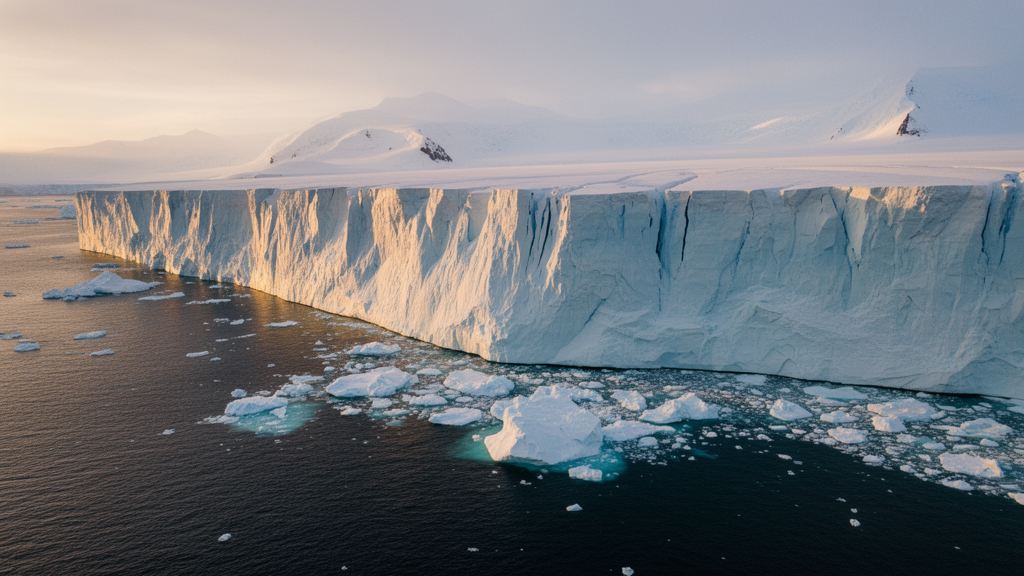
The Antarctic Ice Sheet, Earth’s largest reservoir of freshwater and the equivalent of 57.9 metres of potential global sea-level rise, is now very likely committed to losing mass through the end of this century no matter how aggressively humanity cuts emissions, according to a new study published in Nature Geoscience. Using a machine-learning emulation framework trained on the Ice Sheet Model Intercomparison Project (ISMIP6), researchers led by Yucheng Lin of City University of Hong Kong and CSIRO Environment quantified, for the first time, how each individual physical assumption in ice-sheet models cascades into projection uncertainty. Their observation-calibrated results suggest a probability of at least 0.92 that the ice sheet continues losing mass by 2100 even under the most ambitious emissions-reduction scenario, SSP1-1.9, rising to at least 0.95 under the very high-emissions SSP5-8.5 pathway.
The central problem the team tackled is that Antarctic sea-level projections have long been dominated by a bewildering spread of outcomes. In ISMIP6, the flagship model intercomparison feeding into the IPCC Sixth Assessment Report, projections of the Antarctic contribution to sea-level rise by 2100 under SSP5-8.5 ranged from less than minus 7 centimetres to more than 40 centimetres of sea-level equivalent, with models outside the exercise suggesting an even broader range. Traditional intercomparison exercises follow a ‘one model, one vote’ approach, which can bias ensemble results towards whichever modelling choices happen to be adopted by more research groups, regardless of their physical plausibility or consistency with observations. Until now, the contribution of each individual modelling decision to that spread had never been systematically disentangled.
To break the problem open, the researchers built a statistical emulator that mimics the behaviour of computationally expensive numerical ice-sheet models. They compiled a database of 340 ISMIP6-2300 simulations from 41 model submissions, spanning 29,240 samples across 86 annual time steps, and characterised each simulation with 21 features: 18 ice-dynamical modelling choices, plus the driving atmosphere-ocean general circulation model, the emissions scenario and the projection year. After testing six machine-learning algorithms with tenfold cross validation, they adopted Gradient Boosting, which sequentially builds decision trees that each correct the errors of the last. The emulator achieved a coefficient of determination of 0.98, outperforming previous long-short-term-memory and Gaussian-process emulators, and its 95 per cent credible intervals captured 95.5 per cent of true simulation values. Running at roughly 30,000 samples per second on a laptop, it allowed the team to generate ensembles of half a million projections that would have been computationally impossible with full numerical models.
The variance decomposition delivered a striking verdict: in raw, uncorrected simulations, ice-model features dominate twenty-first-century Antarctic uncertainty, accounting for an average of 64 per cent of projection variance. Sliding laws, the equations relating basal shear stress to sliding velocity at the ice-bed interface, alone contributed 21 per cent of the variance between 2015 and 2100. A Budd-type sliding law yielded 5.0 plus or minus 4.2 centimetres more sea-level rise by 2100 than a linear Weertman law. Ice-shelf melt parameterizations, which translate coarse ocean warming signals into spatially variable basal melt beneath floating ice, contributed another 20 per cent; an observation-calibrated linear thermal forcing function produced 7.8 plus or minus 5.2 centimetres more than the ISMIP6 standard non-local parameterization. Numerical choices mattered too: running models at 1-kilometre resolution instead of 8 kilometres reduced projected sea-level rise by 4.3 plus or minus 2.8 centimetres, because fine grids better resolve the topography controlling ice streams and grounding-line migration.
The picture changes when drift-corrected simulations are used, in which each model’s control-run variability is subtracted to isolate the dynamical response to climate change. Because control-run variability accounts for 45 per cent of raw-simulation variance, removing it cuts ice-model feature uncertainty to 23 per cent and elevates climate forcing to nearly half of the total, with the choice of atmosphere-ocean model contributing 31 per cent and global mean surface temperature 17 per cent. The team also quantified how the spatial geometry of Antarctic mass loss, which generates gravitational, rotational and deformational sea-level fingerprints, adds location-specific uncertainty. For London and Singapore the fingerprint effect contributes less than 1 per cent of variance, rising to 5 per cent in New York and 3 per cent in Shanghai, but near the ice sheet itself it becomes a major factor, reaching 17 per cent in Buenos Aires and 21 per cent in Melbourne.
Probing the relationship between warming and ice loss, the study found it to be delayed, non-stationary and strongly nonlinear. Distinguishable differences between emissions scenarios in Antarctic sea-level contribution emerge only late in the century, long after global temperature trajectories diverge, reflecting the substantial forcing needed to initiate mass loss and the lag between climate perturbation and dynamical response. By 2100, the sensitivity of Antarctic sea-level rise to warming more than an order of magnitude higher in the calibrated high-end analysis: from 0.56 plus or minus 0.01 centimetres per degree Celsius at 0 to 2 degrees of warming to 5.97 plus or minus 0.01 centimetres per degree at 2 to 4.5 degrees. The choice of climate model also exerts dominant control over whether Antarctica gains or loses mass by 2100. Notably, UKESM1-0-LL, the model producing the highest twenty-first-century warming of any tested, yields net mass gain from enhanced snowfall and modest regional ocean warming, a transient gain the authors caution is confined to this century before sustained ocean-driven dynamic losses overtake surface accumulation.
A key innovation was Bayesian calibration against satellite observations. Many raw ISMIP6 simulations fail to reproduce observed mass-loss trends or exhibit unrealistic model drift, partly because they are initialised to fit static rather than transient observations. The team updated their prior assumptions using the observed 2002-2021 Antarctic mass-loss rate of 0.44 plus or minus 0.04 millimetres per year of sea-level equivalent, measured by the GRACE and GRACE Follow-On gravimetry missions. Calibration reduced projection uncertainty by 30 to 42 per cent and raised median projections by 15 to 25 per cent, while the posterior probabilities shifted decisively against sliding-law formulations, such as pseudo-plastic and Budd variants, that produce unrealistically fast ice flow. Crucially, the calibrated projections raise the probability of committed mass loss under SSP1-1.9 from 0.80 to 0.92, indicating that warming-enhanced snowfall is very unlikely to compensate for ocean-driven losses.
For risk-averse planners responsible for long-lived infrastructure, the team also characterised a physically plausible high-end pathway consistent with satellite observations. This posterior high-end scenario, defined as the top 1 per cent of calibrated 2100 projections under SSP5-8.5, unfolds as a cascade: a highly sensitive ocean warming response coincides with a sensitive melt parameterization, converting warming into vigorous basal melt; paired with a strongly plastic sliding law that lowers basal resistance, ice discharge accelerates, particularly under higher-order stress-balance formulations; and subgrid-scale melt and ice-shelf collapse then reduce buttressing, enabling rapid grounding-line retreat and potentially triggering marine ice-sheet instability. Together these mechanisms yield a median of 15.7 centimetres of sea-level rise by 2100, with a 95th-percentile value of 25.4 centimetres, and a probability of at least 0.99 that higher emissions produce higher sea-level rise than the lowest scenario.
The authors emphasise that several processes remain largely unexplored within ISMIP6, including marine ice cliff instability, coupled ice-ocean-atmosphere interactions, high-resolution surface mass balance, ice damage mechanisms and subglacial hydrology, any of which could accelerate mass loss once incorporated into future experiments. Their framework, they argue, offers a template for transparent documentation of ice-model features and a route to integrating new process representations coherently. The bottom line for coastal communities is sobering but actionable: Antarctic mass loss this century is effectively locked in, higher emissions directly amplify near-term risk with a probability of at least 0.89, and managing that risk demands both rapid emissions reductions in line with the Paris Agreement and sharper constraints on the modelling choices, climate model selection, sliding laws and ice-shelf melt parameterizations, that drive the deepest uncertainties in sea-level projections.
Subject of Research: Committed twenty-first-century mass loss of the Antarctic Ice Sheet and its contribution to sea-level rise
Article Title: Committed Antarctic Ice Sheet mass loss by the end of the twenty-first century
Article References: Lin, Y., Zhang, X., Golledge, N. R., Kopp, R. E., Church, J. A., Jin, Y., Zhao, C., & Stokes, C. R. (2026). Committed Antarctic Ice Sheet mass loss by the end of the twenty-first century. Nature Geoscience. https://doi.org/10.1038/s41561-026-02102-1
Image Credits: AI Generated
DOI: 10.1038/s41561-026-02102-1
Keywords: Antarctic Ice Sheet, sea-level rise, ice-sheet modelling, ISMIP6, machine learning, Bayesian calibration, emissions scenarios, ice-shelf melt, sliding laws, marine ice-sheet instability, climate projections, coastal risk
Cite Scienmag News
Thomas Green. (October 8, 2026). Antarctica Is Locked In to Sea-Level Rise by 2100, Machine-Learning Study Finds. Scienmag. https://scienmag.com/antarctica-is-locked-in-to-sea-level-rise-by-2100-machine-learning-study-finds/
Thomas Green. "Antarctica Is Locked In to Sea-Level Rise by 2100, Machine-Learning Study Finds." Scienmag, 8 October 2026, https://scienmag.com/antarctica-is-locked-in-to-sea-level-rise-by-2100-machine-learning-study-finds/. Accessed 8 October 2026.
Thomas Green. "Antarctica Is Locked In to Sea-Level Rise by 2100, Machine-Learning Study Finds." Scienmag. October 8, 2026. https://scienmag.com/antarctica-is-locked-in-to-sea-level-rise-by-2100-machine-learning-study-finds/


