


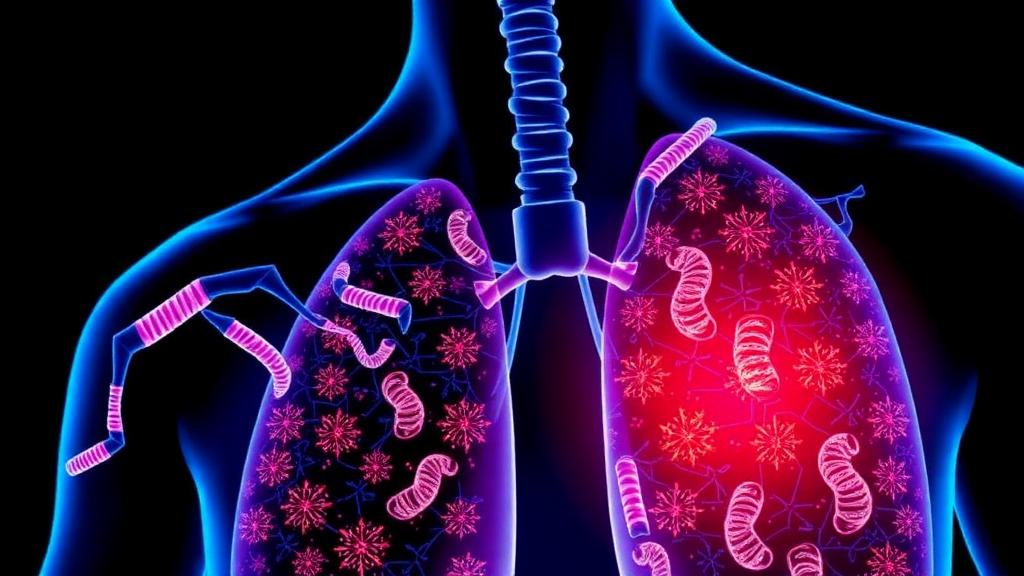
Lung adenocarcinoma is the most common form of lung cancer, and one of the most stubborn problems in treating it is figuring out, early and accurately, which patients will do well and which will not. A new study published in the journal 3 Biotech by Dongmei Liu, Binchan He, Xuan Zhou and colleagues at hospitals affiliated with Nanjing University of Chinese Medicine and Nanjing Medical University takes an unusual angle on that problem. Instead of looking at the usual suspects in cancer biology, the team built a prognostic model around a process most people associate with cell suicide: mitochondrial outer membrane permeabilization, or MOMP, the moment when the outer membrane of a cell’s mitochondria becomes permeable and commits the cell to dying by apoptosis.
MOMP is not simply an on-off switch for death. When it fully opens, mitochondrial integrity collapses, pro-death factors spill out, and the cell dismantles itself in an orderly fashion. But research over the past decade has shown that partial, sublethal permeabilization can occur without killing the cell. That limited permeabilization generates DNA damage and drives genomic instability, which is a hallmark of tumor evolution. In other words, the same gatekeeping event that protects the body from damaged cells can, when it misfires, help cancers diversify and adapt. This dual role makes the genes that regulate MOMP an intriguing, if underexplored, source of prognostic information in cancer.
To test that idea, the researchers used The Cancer Genome Atlas lung adenocarcinoma cohort, known as TCGA-LUAD, as their training dataset, and an independent Gene Expression Omnibus dataset, GSE42127, to validate whatever they found. Their first step was to intersect genes associated with MOMP activity with genes that were differentially expressed between tumor and normal tissue. They then layered on survival analysis to see which of those genes actually tracked with patient outcomes, and added Mendelian randomization analysis, a statistical technique that uses genetic variants as instruments to probe whether associations might reflect causal relationships rather than mere correlation.
The most striking methodological feature of the study is its sheer computational breadth. The team screened 101 different machine-learning algorithm combinations, spanning the families of feature-selection and model-building methods commonly used in bioinformatics, to find the most robust way of turning seven candidate genes into a single risk score. Out of that exhaustive search, a gradient boosting machine, or GBM, emerged as the optimal algorithm. Gradient boosting works by sequentially adding simple predictive models, each one trained to correct the errors of the ensemble so far, which makes it well suited to capturing nonlinear interactions among genes that simpler regression approaches can miss.
The seven genes that survived this gauntlet were BIRC5, PSMD11, TNFRSF13C, YWHAZ, YWHAG, CYCS and LTB. Each has a plausible connection to the biology at play. BIRC5, better known in the literature as survivin, is a well-characterized inhibitor of apoptosis that is frequently overexpressed in tumors and helps cancer cells evade the very death program that MOMP initiates. CYCS encodes cytochrome c, the protein released through the permeabilized mitochondrial outer membrane that triggers the apoptotic cascade downstream. The 14-3-3 family members YWHAZ and YWHAG act as scaffold proteins that shuttle signaling molecules and have been implicated in epithelial-mesenchymal transitions and oxidative cell death pathways, while PSMD11 is a component of the proteasome’s regulatory lid, linking the model to controlled protein degradation. TNFRSF13C and LTB round out the set with roles in immune cell signaling and lymphoid organization.
Using the GBM model, the researchers computed a risk score for each patient and split the cohorts into high-risk and low-risk groups. The separation was consistent: patients in the high-risk group showed significantly poorer overall survival in both the TCGA training cohort and the independent GSE42127 validation cohort. To make the model usable at the bedside, the team also built a nomogram, a graphical scoring tool that integrates the gene-based risk score with clinicopathological factors such as stage. The nomogram showed favorable predictive performance for one-year, three-year and five-year survival, offering clinicians a quantitative way to translate gene expression data into individualized survival estimates.
What are high-risk tumors actually doing differently? Functional enrichment analysis pointed to DNA replication-related pathways, suggesting that these tumors are in a state of heightened proliferative and replicative stress, which fits with the idea that sublethal mitochondrial permeabilization fuels genomic instability. Consistent with that picture, the high-risk group carried a higher tumor mutation burden, a measure of how many somatic mutations a tumor has accumulated. Tumor mutation burden is itself clinically meaningful, because it can influence how tumors respond to immune checkpoint inhibitors, so its association with the MOMP-derived risk score hints at possible immunotherapy implications that would need dedicated trials to confirm.
The immune analysis added another layer. Correlation analysis showed that TNFRSF13C expression was positively correlated with activated B cells, whereas BIRC5 was negatively correlated with eosinophils, suggesting that the MOMP-related genes may participate in remodeling the immune microenvironment of lung adenocarcinoma rather than acting purely within tumor cells. Single-cell RNA sequencing data reinforced this immune dimension: T lymphocytes emerged as a key cell type, with many of the seven prognostic genes showing differential expression in T cells or dynamic changes as the cells differentiated. That pattern implies the signature may be reading out tumor-immune crosstalk, not just intrinsic tumor behavior, which could help explain why it predicts survival so consistently.
The study also explored therapeutic stratification. Drug sensitivity analysis, which predicts the half-maximal inhibitory concentration, or IC50, of various compounds from tumor gene expression profiles, found differences between the high- and low-risk groups. In principle, that means the risk score could eventually help guide which patients are more likely to benefit from particular drugs, although predicted IC50 values from expression data are screening-level signals rather than proof of clinical efficacy. The authors are careful to frame the signature as a reference tool for prognostic stratification and a source of candidate genes for subsequent experimental and clinical validation, not as a ready-made clinical test.
There are real caveats. The work is retrospective and computational, built on public cohorts rather than prospective patient samples, and the authors note that no new experimental data were generated. Mendelian randomization strengthens causal interpretation but relies on assumptions about genetic instruments that are debated in the literature. Still, the study’s core contribution is compelling: it shows that the machinery governing mitochondrial outer membrane permeabilization, long studied as a matter of life and death for individual cells, carries enough prognostic information to stratify an entire cancer. If the seven-gene signature holds up in prospective validation, a process once viewed mainly through the lens of apoptosis may become a practical lens for viewing how lung adenocarcinoma patients will fare, and how best to treat them.
Subject of Research: A machine-learning prognostic model based on mitochondrial outer membrane permeabilization-related genes for stratifying lung adenocarcinoma patients
Article Title: Stratifying lung adenocarcinoma: a novel prognostic model based on mitochondrial outer membrane permeabilization activity
Article References: Liu, D., He, B., Zhou, X., Yang, Y., Song, M., & Xu, X. (2026). Stratifying lung adenocarcinoma: a novel prognostic model based on mitochondrial outer membrane permeabilization activity. 3 Biotech, 16(10), Article 425. https://doi.org/10.1007/s13205-026-05058-6
Image Credits: AI Generated
DOI: 10.1007/s13205-026-05058-6
Keywords: lung adenocarcinoma, mitochondrial outer membrane permeabilization, apoptosis, prognostic model, machine learning, gradient boosting machine, TCGA, tumor mutation burden, tumor microenvironment, single-cell RNA sequencing, nomogram, BIRC5
Cite Scienmag News
Juliet Wilcox. (October 2, 2026). Mitochondrial Gatekeeping Genes Offer New Way to Predict Lung Cancer Survival. Scienmag. https://scienmag.com/mitochondrial-gatekeeping-genes-offer-new-way-to-predict-lung-cancer-survival/
Juliet Wilcox. "Mitochondrial Gatekeeping Genes Offer New Way to Predict Lung Cancer Survival." Scienmag, 2 October 2026, https://scienmag.com/mitochondrial-gatekeeping-genes-offer-new-way-to-predict-lung-cancer-survival/. Accessed 2 October 2026.
Juliet Wilcox. "Mitochondrial Gatekeeping Genes Offer New Way to Predict Lung Cancer Survival." Scienmag. October 2, 2026. https://scienmag.com/mitochondrial-gatekeeping-genes-offer-new-way-to-predict-lung-cancer-survival/


