


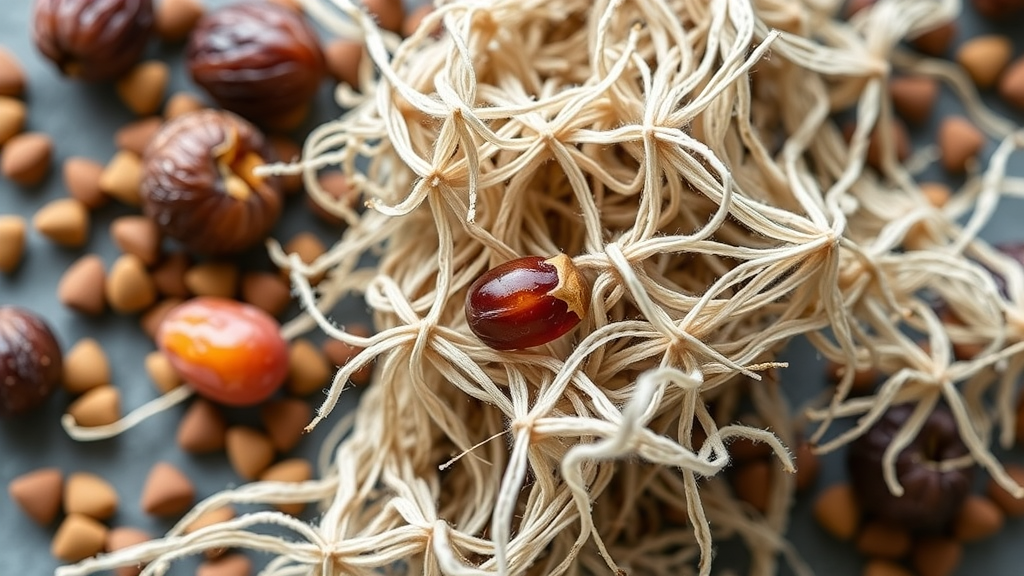
Every year, millions of tonnes of date seeds are discarded as agricultural waste, yet researchers keep finding reasons to believe that these pits are far more valuable than their humble reputation suggests. In a new study published in Results in Chemistry, a team from King Saud University has taken this idea to striking lengths, converting oil extracted from Sukkary date seeds into the core of an antimicrobial, drug-loaded nanofiber system that could one day dress wounds, fight infection, and release antibiotics on demand. The work, led by Enas S. Radwan with Mohamed El-Newehy and Abdullah M. Al-Enizi among the co-authors, combines green chemistry, electrospinning, and a dash of pharmaceutical engineering to turn a biowaste product into a multifunctional biomedical platform.
The starting material could hardly be more accessible. Sukkary dates are among the most prized varieties in Saudi Arabia, prized for their nutritional value, and their seeds are routinely thrown away. The researchers collected seeds from household waste, washed and dried them, ground them into a fine powder, and then extracted the oil using ethyl acetate, a relatively mild and environmentally friendlier solvent than the harsh organic solvents often used in phytochemistry. After macerating 50 grams of seed powder in 400 millilitres of solvent overnight, they centrifuged and dried the mixture, then analysed the resulting oil by gas chromatography coupled with mass spectrometry.
The GC-MS profile revealed a rich phytochemical inventory. Nine major compounds were identified, dominated by gamma-sitosterol, which accounted for nearly 20 percent of the extract, followed by bis(2-ethylhexyl) hexanedioate at about 16.6 percent and a sterol derivative at roughly 14.7 percent. Bioactive fatty acids such as oleic acid and lauric acid were also present in significant proportions, alongside squalene, a terpenoid known for anti-inflammatory and antioxidant properties. This composition matters because sterols and fatty acids are increasingly recognised as pharmacologically interesting molecules, and previous studies have linked date seed extracts to antioxidant, anti-inflammatory, cardiovascular, and even anticancer effects. In other words, the oil is not merely a filler; it is an active ingredient in its own right.
To deliver that oil, and an antibiotic alongside it, the team turned to emulsion electrospinning, a technique that spins a liquid emulsion into ultrathin fibers under a high-voltage electric field. The polymer blend consisted of polyvinyl pyrrolidone, or PVP, a hydrophilic and widely used pharmaceutical carrier, mixed in a nine-to-one ratio with POVAcoat, a polyvinyl alcohol-based copolymer grafted with acrylic acid and methyl methacrylate. Ciprofloxacin, a common antibiotic, was dissolved directly into the date seed oil at a concentration of 10 milligrams per millilitre, and this drug-oil solution was then blended into the aqueous polymer mixture to form a stable emulsion. Under an applied voltage of 16 kilovolts, a feeding rate of 0.4 millilitres per hour, and a tip-to-collector distance of 16 centimetres, the emulsion was drawn into continuous nanofibers over a 20-hour spinning run.
The crucial trick of emulsion electrospinning is that it produces core-shell architecture without the complexity of coaxial spinning. As the solvent evaporates and the fiber solidifies, the oil phase migrates to the center, forming a nanoscale core of drug dissolved in date seed oil, wrapped in a protective polymeric shell. Transmission electron microscopy confirmed this structure directly, revealing core-shell fibers with total diameters ranging from roughly 72 to 169 nanometres. Scanning electron microscopy showed uniform, bead-free fibers with average diameters between 150 and 270 nanometres, depending on the formulation. Adding the oil increased fiber diameter, a sign that the viscous oil phase was genuinely incorporated into the fiber rather than sitting on the surface.
Thermal and spectroscopic analyses painted a consistent picture of molecular intimacy between the components. Thermogravimetric analysis showed that the drug-loaded fibers remained stable up to several hundred degrees Celsius, while differential scanning calorimetry revealed shifts in glass transition and melting temperatures that pointed to hydrogen bonding between PVP, POVA, and ciprofloxacin. Fourier transform infrared spectroscopy corroborated these interactions, detecting characteristic carbonyl and hydroxyl bands, along with a new peak near 750 wavenumbers attributed to the chloride counterion of ciprofloxacin. Viscosity measurements added a further layer of insight: the oil-rich formulation was the most viscous of all the samples tested, which the authors link to the stability of the emulsion and the quality of the resulting fibers.
The drug delivery performance was the most striking result. When ciprofloxacin was simply blended into PVP fibers, more than 60 percent of the drug leached out within the first hour, a classic burst release that wastes medication and risks toxicity. Adding POVA slowed that burst to about 30 percent in the first hour. But when the drug was dissolved in date seed oil and encapsulated in the core of the PVP/POVA fibers, the release became remarkably gentle: only 36 percent of the drug was released over a full 48 hours, with the shell acting as a diffusion barrier. Drug loading efficiency climbed to roughly 93 percent in the oil-containing formulation, compared with about 31 percent for the simple PVP blend, indicating that the oil phase dramatically improved how much drug the fibers could hold.
Kinetic modelling of the release data suggested that Fickian diffusion was the dominant mechanism, with the Korsmeyer-Peppas model providing the best fit. In practical terms, this means the drug molecules migrate gradually through the swollen polymer shell rather than being ejected by matrix erosion, a behaviour well suited to wound dressings where a steady, low-level antibiotic supply is more useful than a sudden dump. The authors note that the loaded antibiotic remained effective beyond 48 hours in a wound-like environment, a timescale that could help prevent infection during the critical early stages of healing while reducing the frequency of dressing changes.
Antimicrobial testing reinforced the case for the date seed oil as more than a passive carrier. In agar well diffusion assays, the oil itself inhibited the growth of Escherichia coli and Pseudomonas aeruginosa in a concentration-dependent manner, producing inhibition zones of up to 14 and 12 millimetres respectively at the highest dose tested. When the oil was incorporated into the nanofiber mats, the fibers gained broad-spectrum activity against both Gram-negative and Gram-positive bacteria, including Staphylococcus aureus and Staphylococcus epidermidis, with the drug-and-oil-loaded formulation showing the largest inhibition zones of all. The polymer blend alone showed no antibacterial effect, confirming that the oil was the active ingredient. Taken together, the results suggest that a material once destined for the compost heap can be re-engineered into a biocompatible, antimicrobial, sustained-release drug delivery system, a small but compelling demonstration of how circular economy thinking and nanomedicine can converge on the same humble seed.
Subject of Research: Biocompatible core-shell nanofibers made from date seed oil and synthetic polymers for antimicrobial controlled drug delivery.
Article Title: Fabrication of new biocompatible polymeric core shell nanofibers incorporated with antimicrobial date seed oil for drug delivery system
Article References: Radwan, E. S., El-Newehy, M., Abdulhameed, M. M., Almoutiri, N. D., & Al-Enizi, A. M. (2026). Fabrication of new biocompatible polymeric core shell nanofibers incorporated with antimicrobial date seed oil for drug delivery system. Results in Chemistry, 30, Article 103839. https://doi.org/10.1016/j.rechem.2026.103839
Image Credits: AI Generated
DOI: 10.1016/j.rechem.2026.103839
Keywords: date seed oil, nanofibers, electrospinning, drug delivery, ciprofloxacin, antimicrobial, core-shell structure, PVP, biowaste, controlled release, wound healing, green chemistry
Cite Scienmag News
Alan Morgan. (September 20, 2026). Date Seed Waste Transformed Into Antimicrobial Nanofibers for Controlled Drug Delivery. Scienmag. https://scienmag.com/date-seed-waste-transformed-into-antimicrobial-nanofibers-for-controlled-drug-delivery/
Alan Morgan. "Date Seed Waste Transformed Into Antimicrobial Nanofibers for Controlled Drug Delivery." Scienmag, 20 September 2026, https://scienmag.com/date-seed-waste-transformed-into-antimicrobial-nanofibers-for-controlled-drug-delivery/. Accessed 20 September 2026.
Alan Morgan. "Date Seed Waste Transformed Into Antimicrobial Nanofibers for Controlled Drug Delivery." Scienmag. September 20, 2026. https://scienmag.com/date-seed-waste-transformed-into-antimicrobial-nanofibers-for-controlled-drug-delivery/


